



Use Wozber and land your dream job
Create Resume
No registration required
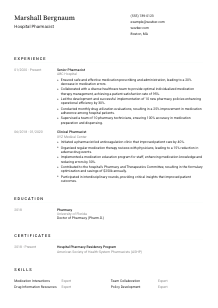
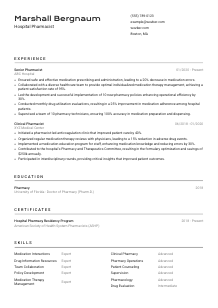
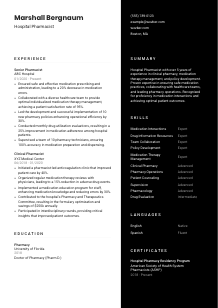
Doling out the right doses, but your resume is causing a reaction? Check out this Hospital Pharmacist resume example, created with Wozber free resume builder. It shows how to blend your medical marvels with job requisites, scripting a career pathway that's as effective as your prescriptions!
Hospital pharmacy work sits close to patient risk. Your resume needs to show that you can protect medication safety, contribute to therapy decisions, and operate confidently inside the pace of a hospital where orders, protocols, and interdisciplinary communication all matter.
In hospital pharmacist hiring, a tailored resume quickly clarifies whether your background matches the clinical setting being staffed, whether that means inpatient verification, therapy management, policy work, or technician oversight. Wozber's free resume builder helps you shape that experience into an ATS-compliant resume so the hiring team can immediately see where your practice adds value on the floor and across pharmacy operations.
The personal details section should read cleanly and professionally, with no friction for the reviewer. For a Hospital Pharmacist, that means making your identity, licensure-ready title, contact information, and any location match easy to spot without crowding the top of the page.
Use your full name in a clear, readable style so it anchors the resume immediately. In healthcare hiring, flashy formatting adds nothing. A simple, prominent name line works better and keeps the document easy to parse in an ATS-friendly resume format.
Place "Hospital Pharmacist" directly under your name if that is the role you are pursuing. Matching the job title helps position your background correctly from the first line, especially when employers are sorting candidates across retail, ambulatory, and inpatient pharmacy experience.
Add a reliable phone number and a professional email address, then check both carefully. Missed calls and bounced emails can stall an application quickly, particularly when pharmacy hiring moves fast to fill licensed clinical roles.
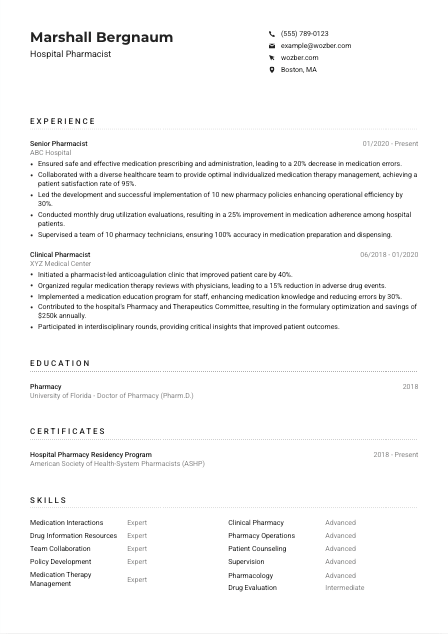
If the employer asks for local availability or willingness to relocate, include your city and state. In the example, "Boston, MA" immediately addresses the posting's location requirement. That kind of detail belongs here, not repeated throughout the resume.
Include LinkedIn or a professional website only if it supports your candidacy with matching employment history, publications, presentations, or committee work. For hospital pharmacists, a clean profile that reinforces inpatient practice, residency training, or clinical interests can strengthen credibility.
This section does not need personality flourishes. It needs accuracy, professionalism, and any detail that removes doubt about how to contact you or whether you meet a practical requirement. That gives the rest of the resume room to prove your clinical value.




This is the section most likely to separate one pharmacist from another. Hospital employers want to see where you practiced, what level of clinical responsibility you carried, how you improved medication use, and how you worked with physicians, nurses, and technicians in real care settings.
Read the posting closely and mark the phrases tied to actual practice, such as hospital-based clinical experience, medication interaction knowledge, therapy management, policy support, drug utilization review, and technician supervision. Those are the themes your bullets should answer directly, using the same terminology when it reflects your real work.
List positions in reverse chronological order and make the hospital setting obvious through employer names, titles, and dates. If you have worked in both hospital and non-hospital pharmacy, give more space to inpatient, clinical, or acute-care responsibilities because that is the experience most aligned with this kind of role.
Focus each accomplishment on work that matters in hospital practice: verifying orders, reducing medication errors, participating in rounds, managing therapy plans, supporting formulary decisions, educating staff, or improving dispensing accuracy. The example resume does this well by tying duties to concrete work such as policy implementation, drug utilization evaluations, and technician supervision rather than listing general pharmacist tasks.
Use numbers where they reflect real outcomes, such as reduced adverse drug events, improved adherence, lower medication error rates, cost savings, technician accuracy, or patient satisfaction. A line like "20% decrease in medication errors" or "$250k annual formulary savings" carries weight because those are outcomes hospital pharmacy leaders actually track.
Every bullet should strengthen your case for safe medication management in a clinical setting. Remove older or weaker details that do not connect to inpatient workflows, interdisciplinary care, policy development, or pharmacy operations. Space is better used on interventions and results that show how you practice inside a hospital system.
A hospital pharmacist resume reads best when experience is tied to outcomes that matter on the unit and in the department. If your bullets make it easy to see your clinical judgment, collaboration, and medication safety impact, this section is doing its job.
Education carries real screening weight in pharmacy hiring because the degree is non-negotiable. Present it clearly so the reviewer can confirm your Pharm.D. quickly, then use the rest of the section to support any additional hospital-focused training that strengthens your profile.
List your Doctor of Pharmacy degree exactly and make sure the school name is easy to read. For this role, the Pharm.D. is a baseline qualification, so it should never be buried behind less important academic details.
Use a straightforward structure with degree, field, institution, and graduation year. That format helps both recruiters and ATS systems process your credentials quickly, especially when they are screening for accredited pharmacy education as an early requirement.
If you completed a hospital pharmacy residency or similar postgraduate training, make sure it is visible. In this posting, residency is preferred rather than mandatory, which is a good reminder to feature it prominently when it strengthens your candidacy without treating it as universal for every hospital pharmacist opening.
Recent graduates can include relevant coursework or clinical rotations if it helps show preparation for inpatient practice, such as pharmacokinetics, infectious disease, critical care, or institutional pharmacy operations. Once you have solid hospital experience, those details usually matter less than your clinical results on the job.
If you are closer to graduation, honors, leadership roles, research, or residency-related projects can support your profile, especially when they connect to formulary management, medication safety, or hospital practice. With more experience, trim those details back and let your professional achievements lead.
This section should answer the degree question immediately and support the rest of your clinical story without overexplaining. Clear education details help the reader move quickly from eligibility to the work you have done in practice.
For a Hospital Pharmacist, certifications are not decorative. Licensure is essential to practice, and additional credentials or residency training can reinforce your clinical preparation, regulatory standing, and commitment to current standards in hospital pharmacy.
An active state pharmacy license should appear first or near the top of this section because it is a gating requirement. If the employer asks for an unrestricted license, make sure your entry is current and specific enough to show that you meet the standard.
After licensure, feature residency training, board certifications, or other credentials that connect to inpatient care, medication management, or institutional practice. The example includes a hospital pharmacy residency, which is a strong fit here because the posting lists it as preferred preparation.
Use issue or renewal dates when relevant so reviewers can confirm that your license or certification is active. In regulated clinical roles, date accuracy matters because expired or unclear credentials create immediate doubt.
Review this section regularly and add credentials that reflect where your work is heading, whether that is specialty practice, advanced clinical training, or updated licensure in a new state. For pharmacists targeting hospital roles, stale certification details can make an otherwise strong resume feel neglected.
Hospital pharmacy hiring often starts with licensure and then moves to role-specific training. When this section is current and well ordered, it supports both compliance screening and your broader clinical profile.
A hospital pharmacist skills section should reflect how you practice, not just what sounds impressive. The most useful skills here connect directly to medication safety, clinical decision-making, information resources, operational accuracy, and collaboration with care teams.
Start with the terms the employer already uses, especially around medication interactions, dosages, drug information resources, medication therapy management, and supervision. Mirroring that language helps with ATS optimization and makes your resume feel immediately relevant to the department's needs.
Lead with hospital pharmacy competencies rather than broad traits. Clinical pharmacy, medication safety, formulary support, patient counseling, pharmacy operations, and technician supervision all carry more value here than generic items like "communication" listed on their own.
This role combines therapeutic expertise with process reliability, so your list should reflect both. The example does that by pairing skills such as medication interactions and drug information resources with policy development, team collaboration, and pharmacy operations. That mix fits how hospital pharmacists actually work across patient care and department workflows.
If a skill appears here, you should be able to support it with a clinical example, a workflow you handled, or an outcome you improved. That keeps the section credible and aligned with the rest of your resume.
Language skills matter in healthcare when they improve patient counseling, coordination, and documentation accuracy. For a Hospital Pharmacist, the first priority is meeting the communication requirement in the posting, then showing any added language ability that could help in a diverse patient population.
If the role explicitly requires English reading and writing, list English clearly with an honest proficiency level. That directly addresses a stated requirement and removes uncertainty about your ability to document, counsel, and communicate with the care team.
Place the required or primary working language first, then add others based on actual proficiency. In hospital settings, this keeps the section focused on communication that supports patient care rather than turning it into a casual profile detail.
Extra languages can strengthen your application when they help with counseling, medication education, or communication in a multilingual community. Spanish, for example, can be useful in many hospital environments, but it should be presented as an added asset rather than a substitute for core clinical qualifications.
Choose levels you can stand behind in real interactions. In pharmacy, overstating language ability can create risk during patient education or care-team communication, so precision matters as much here as it does in dosing or documentation.
Think about whether a language skill is likely to be useful in the hospital's patient population or internal workflows. That helps you decide what to feature and how much weight to give it without overstating its importance in the overall application.
When language skills are presented honestly and in the right order, they support your ability to communicate safely and effectively. That is the point hiring teams care about most.
Your summary should give a quick, credible picture of the pharmacist behind the bullet points. For hospital roles, that usually means combining years of experience with the kind of clinical work you handle well and the outcomes or responsibilities that define your practice.
Read the posting again before you write the top paragraph. Pull out the two or three themes that matter most, such as hospital clinical experience, safe prescribing support, medication therapy management, policy contribution, or technician oversight, and let those shape the wording.
Start with your professional identity and experience in terms that place you clearly in hospital pharmacy. A line like "Hospital Pharmacist with 5+ years of clinical pharmacy experience in inpatient settings" is stronger than a vague opener because it establishes scope immediately.
Use one or two specifics to show what kind of pharmacist you are. The sample summary points to medication therapy management, policy development, and safe medication practices, which works well because those themes match the responsibilities in the posting. Add metrics only if they sharpen the picture rather than crowd it.
Aim for a short paragraph that can be scanned quickly. Three to five lines is usually enough to cover your experience level, core hospital strengths, and one distinguishing contribution without repeating the experience section word for word.
A well-written summary should make the reader expect strong inpatient pharmacy experience, sound clinical judgment, and useful collaboration with the care team. If those qualities are clear in a few lines, the rest of the resume lands more effectively.
A Hospital Pharmacist resume works best when it makes three things clear fast: you meet the licensing and education requirements, you have relevant clinical experience in a hospital setting, and your work improves medication safety, therapy decisions, or pharmacy operations in measurable ways.
Use Wozber's free resume builder to organize those strengths into an ATS-compliant resume, refine the language with role-specific terms, and check alignment with the posting through ATS optimization tools. The finished document should make it easy to judge how you will contribute to patient care and medication safety from day one.




