



Use Wozber and land your dream job
Create Resume
No registration required
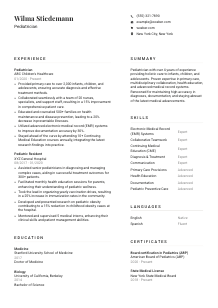
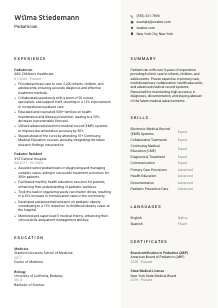
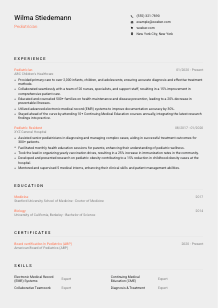
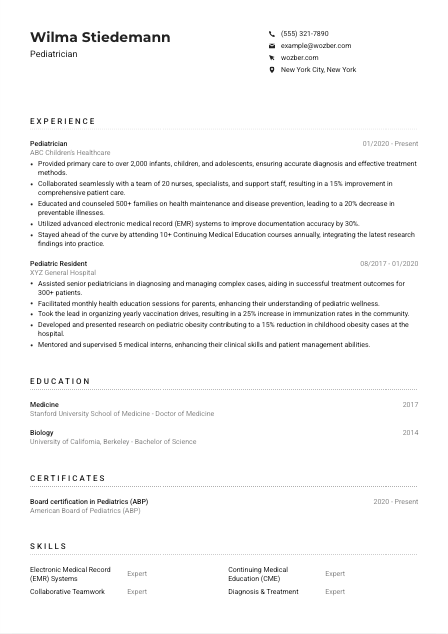
Caring for tiny humans, but your resume doesn't measure up? Check out this Pediatrician resume example, created with Wozber free resume builder. It shows how to highlight your pediatric expertise to match job demands, paving a professional path as bright as a child's smile!
Pediatric resumes are read through a clinical lens. Hiring teams want to see how you handle well-child visits, acute presentations, chronic condition management, family counseling, and documentation without losing accuracy or continuity of care. Your resume should make that day-to-day pediatric work visible, not hide it behind generic physician language.
The first pass often comes down to whether your resume quickly surfaces pediatric credentials, patient-care scope, and terms used in the posting, from preventive care to EMR documentation. Wozber's free resume builder helps organize that content into an ATS-friendly resume format so your board certification, residency training, and frontline care experience are easy to identify before the deeper review begins.
In pediatric hiring, the personal details section does not need flair. It needs to confirm who you are, what role you practice, and whether the practical basics line up for follow-up. Keep it clean, accurate, and immediately relevant to a clinical employer.
Use your full professional name in a clear font and slightly larger size than the body text. In healthcare settings, your name is tied to licensure, credentialing, and publication or training records, so consistency matters. Match the name format you use across your license, certifications, and professional profiles.
Place "Pediatrician" directly under your name if that is the role you are targeting. This helps the employer distinguish you from family medicine physicians, pediatric subspecialists, or residents still in training. If you are currently in residency, use the accurate training title unless you are applying after completion and updating the resume for attending-level roles.
Include one reliable phone number and a professional email address. Healthcare employers often move candidates into credentialing and interview scheduling quickly, so avoid extra contact channels that create confusion. A straightforward format such as firstname.lastname@email.com works well.
If the employer specifies a location requirement, include your city and state in this section. In the example posting, New York City, New York is explicitly requested, so listing that detail immediately removes a practical question from the review. Use this only when it is relevant to the target role, not as a filler line.
A LinkedIn profile or professional webpage can help if it reinforces your clinical background, hospital appointments, research, or speaking work. Make sure the dates, titles, and credentials match your resume exactly. For pediatric roles, an outdated profile with mismatched training dates or incomplete certifications can create unnecessary friction.
This section should make it easy to contact you and confirm the basics of your candidacy. When your title, location, and professional identity are clear from the top of the page, the reader can move straight to your clinical experience.




This is where a pediatric resume earns attention. Employers are looking for evidence that you can manage routine care, recognize illness early, work with families, document thoroughly, and collaborate with nurses and specialists without dropping continuity of care.
Pull the core responsibilities from the job description and reflect them in your bullets using your own real experience. For pediatric roles, that often means preventive care, diagnosis and treatment of acute and chronic conditions, family education, multidisciplinary collaboration, and EMR documentation. In the example, those themes appear clearly in the accomplishments, which helps the experience line up with the employer's priorities.
List positions in reverse chronological order with your job title, employer, and dates. For physicians, that sequence should clearly show the transition from residency to independent practice, hospital-based work, or outpatient primary care. A hiring team should be able to trace your clinical progression in seconds.
Focus each bullet on what you handled and what changed because of your work. Good pediatric bullets often mention patient volume, age group, care setting, immunization efforts, parent counseling, care coordination, or documentation improvements. The sample resume does this well by pairing responsibilities with measurable outcomes, such as serving more than 2,000 pediatric patients and reducing preventable illnesses through family education.
Numbers add credibility when they reflect how pediatric care is actually measured. Patient panels, visit volume, vaccination rates, documentation accuracy, care quality improvement, family education reach, and team size all work better than vague claims about excellence. A line such as improving EMR documentation accuracy by 30% or increasing immunization rates by 25% gives your work real clinical context.
Keep the emphasis on work that supports the target position. Bullets about unrelated administrative tasks or broad physician duties can crowd out stronger proof of pediatric judgment, patient communication, and continuity of care. Prioritize the experience that best shows you can step into a pediatric clinic or hospital service and contribute quickly.
Your experience section should show how you treat, educate, document, and coordinate care in real settings. If the reader can picture your patient load, your clinical responsibilities, and your outcomes, the section is doing its job.
For a pediatrician, education is not a background detail. It establishes the medical foundation behind your clinical decisions and confirms that you meet baseline physician requirements before the employer reviews the rest of the resume.
Make your MD or DO easy to find because it is a stated requirement in many pediatric postings, including the one here. Include the full degree name, school, and graduation year. If the institution is widely recognized, let the entry stand on its own without extra explanation.
List degree, field, institution, and year in a consistent structure. This helps the reviewer move quickly from medical school to earlier academic preparation. In most pediatric applications, simplicity works better than adding excess academic detail unless the role is strongly research-focused.
Your medical degree should be paired with education entries that make your progression into pediatrics clear. In the example, a Doctor of Medicine followed by an undergraduate biology degree creates a clean academic story. If you have additional relevant training, include it where it strengthens that story rather than overloading the section.
Coursework, honors, research, or leadership can be useful if they relate directly to child health, pediatrics, community medicine, or academic medicine. Otherwise, keep the section lean and let your residency, certifications, and experience carry more of the application. Most attending-level pediatric roles care more about clinical readiness than old classroom detail.
Continuing education usually belongs in certifications or experience rather than under formal education, unless the format of your resume requires otherwise. The key is to separate your core physician training from later professional development so the employer can scan both quickly.
This section should confirm that you meet the educational standard for pediatric practice without forcing the reader to search for it. Once your degree path is obvious, the employer can move on to the training and work that show how you practice.
In pediatric hiring, certifications are operational, not decorative. Board status and medical licensure often determine whether a candidate can move forward at all, so this section should be easy to scan and current.
If the posting requires board certification in Pediatrics, list it prominently with the certifying body. The example job description names the American Board of Pediatrics, so that credential should appear in the section exactly and clearly. For many employers, this is one of the first items they verify.
List the certifications and licenses most relevant to practicing pediatrics in the target role. An unrestricted state medical license and ABP certification matter more here than older or less relevant coursework certificates. Keep the list focused on credentials that affect employability, scope of practice, or trust.
Show when each credential was issued or note that it is current. In medicine, recency matters because employers need confidence that your certification and licensure are active and usable. A simple format such as "2020 - Present" works well when appropriate.
Pediatric practice changes with new guidance, vaccine updates, and evolving treatment standards. While CME itself may sit in experience or summary, this section can still reflect a pattern of staying current when you include active credentials and relevant renewals. That matters in both outpatient and hospital settings.
A hiring team should be able to glance at this section and know you meet the formal practice requirements. Clear board certification and licensure entries reduce friction and strengthen the rest of your application.
The right skills section for a pediatrician should read like a clinical toolkit, not a generic list of strengths. Choose skills that connect directly to patient care, documentation, coordination, and family communication in pediatric settings.
Start with the skills the employer names directly, then add the ones embedded in the responsibilities. Here, EMR proficiency is explicit, while preventive care, diagnosis, chronic illness management, family education, and multidisciplinary teamwork are built into the role. That gives you a practical list rooted in the actual work.
Put the most role-specific skills first. For this type of position, that may include pediatric preventive care, diagnosis and treatment, EMR systems, patient and family education, documentation, and collaborative care. The sample resume also includes teamwork and CME, which support the picture of an active practicing pediatrician when they are backed by experience.
Do not try to capture every clinical, administrative, and interpersonal skill you have developed over time. A shorter list with direct relevance to pediatric practice is more useful than a crowded inventory. If a skill would not help someone picture your day-to-day work with infants, children, adolescents, or their families, it may not belong here.
When this section is tailored well, it reinforces the language of the job description and supports your experience bullets. The result is a clearer picture of how you practice, document, and work with families and care teams.
In pediatrics, communication often involves more than the patient. You may need to explain symptoms, treatment plans, preventive care, and follow-up instructions to parents or guardians in clear, reassuring language. Your language section should reflect that practical reality.
If the posting requires English proficiency, list English first and mark your level clearly. In this case, English is mandatory, so placing it at the top helps the employer confirm the requirement immediately. Use plain labels such as Native or Fluent.
Other languages can strengthen your application when they are genuinely usable in clinical conversations with families. In many pediatric settings, being able to discuss routine care, vaccine questions, or follow-up instructions in another language can support rapport and continuity of care. The sample resume's Spanish entry is a good example of an added language that could matter in a diverse patient population.
Use honest proficiency levels so employers understand how you can communicate in practice. Distinguish between conversational ability and professional fluency, especially if you may be discussing diagnosis, medication instructions, or developmental concerns. Accuracy matters in clinical communication.
Some pediatric roles place greater value on multilingual ability because of the community they serve. That is not universal, so tailor this section to the employer and setting rather than assuming every posting values the same language mix. Keep the emphasis on patient care usefulness, not on listing languages for their own sake.
A second language is worth listing when it helps you educate families, build trust, and reduce communication barriers during visits. In pediatrics, that can support everything from preventive counseling to chronic disease management. Include it when it reflects real capability you would use on the job.
A well-chosen language section adds practical context to your patient care style. It tells the employer how you may connect with children and caregivers across a wider range of clinical encounters.
Your summary should sound like a physician introducing a well-defined clinical profile. In a few lines, show your level of experience, the kind of pediatric care you provide, and the parts of your practice that match the role most closely.
Before writing, identify the two or three themes the employer emphasizes most. Here, those include primary care for infants through adolescents, collaboration with multidisciplinary teams, accurate medical records, and family education. Your summary should reflect that kind of emphasis rather than repeating broad physician language.
Start with a direct statement of who you are professionally and how long you have practiced. The example summary begins with "Pediatrician with over 4 years of experience," which works because it gives the reader immediate context. Keep the first sentence factual and role-specific.
Use the next sentence or two to highlight the clinical strengths most relevant to the job. For a pediatrician, that might include preventive care, diagnosis and treatment, chronic disease management, family counseling, EMR proficiency, or team-based care. Choose the areas you can support with clear experience elsewhere in the resume.
Aim for three to five lines that read cleanly and avoid repeated claims. A concise summary is especially effective when it combines scope, strengths, and one distinguishing point such as strong documentation habits or consistent CME engagement. Finish with language that sounds grounded in practice, not promotional.
When written well, this section tells the employer what kind of pediatrician they are about to read about. It should prepare them to see consistent proof of patient care, family education, documentation quality, and team collaboration throughout the page.
A pediatric resume works best when it shows real clinical scope, current credentials, and clear alignment with the employer's patient care needs. Before you send it, check that your board certification, licensure, residency training, EMR experience, and family-centered care examples are easy to find.
Wozber's free resume builder can help you refine that structure, strengthen ATS optimization, and keep the language aligned with the posting without losing the specifics of your practice. The finished resume should make one thing clear quickly: you are prepared to deliver thoughtful, well-documented pediatric care from the first day.