



Use Wozber and land your dream job
Create Resume
No registration required
Exploring the brain's mysteries, but your resume feels like a headscratcher? Tune into this Neurologist resume example, created with Wozber free resume builder. Learn how to match your neurological expertise to job expectations, making your career as clear and focused as a healthy mind!
Neurology hiring turns quickly on whether your resume makes clinical judgment visible. Hospitals and practices need to see how you work through complex presentations, use diagnostic studies such as EEG or EMG appropriately, and turn findings into treatment plans patients can actually follow. If your resume only lists duties, it can miss the parts of the job that matter most in practice: diagnostic reasoning, continuity of care, and collaboration across specialties.
That is where tailoring changes how your application is read. Wozber's free resume builder helps you align your wording with the posting and build an ATS-compliant resume that surfaces the right clinical terms, credentials, and scope early, so reviewers can quickly understand whether your background matches the patient population, diagnostic work, and interdisciplinary expectations of the role.
For a neurologist, the top of the resume should communicate professional legitimacy without clutter. Hiring teams first need clear identity, current role alignment, and reliable contact information before they move into licensure, training, and case volume. Keep this section clean and exact, the same way you would document a patient chart.
Use your full name in a larger, clean font so it is immediately identifiable. In physician hiring workflows, resumes are often reviewed alongside credentialing materials, interview notes, and licensure records, so consistency in how your name appears matters.
Place "Neurologist" directly under your name if that is the role you are applying for. This sounds simple, but it helps distinguish you from adjacent profiles such as neurohospitalists, fellows, or physicians whose recent work leans more heavily toward research or administration.
List one reliable phone number and a professional email address tied to your name. Accuracy matters here. A typo in contact information creates the same concern as an error in clinical documentation: unnecessary friction in a process that depends on precision.
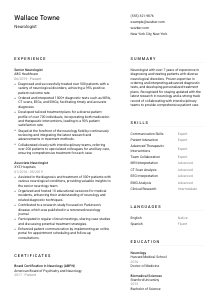
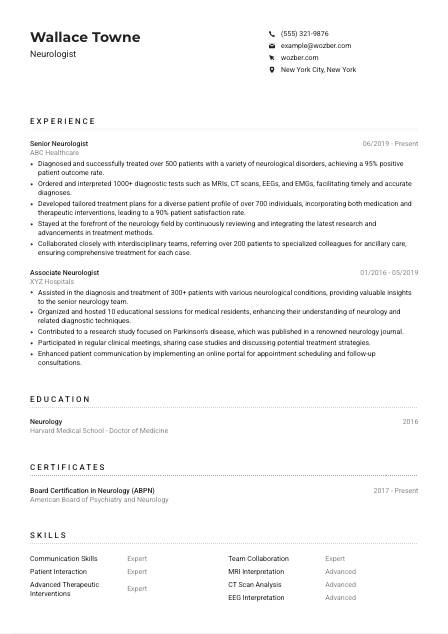
Add your city and state when location is relevant to the opening. In the example, "New York City, New York" supports local alignment for a New York-based role, but treat that as a tailoring choice rather than a universal rule for every neurology application.
Include a LinkedIn profile or professional webpage if it expands on your clinical background, publications, speaking, or hospital affiliations. For neurologists involved in subspecialty care, research, or teaching, a well-kept profile can reinforce expertise beyond what fits in a one- or two-page resume.
This section does not need flair. It needs accuracy, professional consistency, and enough context to move the reviewer smoothly into your training, credentials, and clinical experience.




The experience section carries the most weight on a neurologist resume. Hiring teams want to see the disorders you have managed, the diagnostic tools you use confidently, the treatment planning you own, and the scale of your clinical work. This is where your resume should move from title and tenure into actual patient care scope.
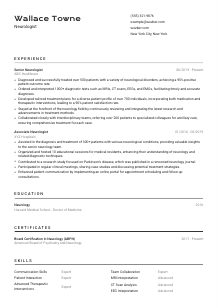
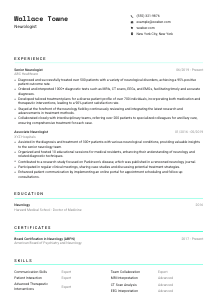
Read the responsibilities closely and reflect them through your own casework. If the role emphasizes diagnosing neurological disorders, interpreting MRIs, CT scans, EEGs, and EMGs, and developing individualized treatment plans, your bullets should show those exact parts of your practice. The sample does this well by tying direct patient diagnosis, diagnostic testing, and tailored treatment planning to measurable clinical volume.
Start with your current or most recent role so reviewers see your present level of responsibility first. In neurology, recent experience often carries special weight because it shows current diagnostic exposure, treatment approach, and familiarity with evolving care standards and interdisciplinary workflows.
Use numbers where they reflect real practice. Patient counts, number of diagnostic studies interpreted, satisfaction scores, referral volume, or publication output all help define your scope. In the example, "treated over 500 patients" and "interpreted 1000+ diagnostic tests" quickly communicate an established clinical load and comfort with core neurology diagnostics.
Prioritize bullets that show disorder management, diagnostic interpretation, treatment decisions, collaboration with neurosurgery or rehabilitation teams, inpatient or outpatient setting, and any subspecialty exposure. General medical tasks or unrelated committee work should only stay if they show something valuable about your neurological practice, teaching, or patient outcomes.
Choose language that shows clinical ownership. Verbs such as "diagnosed," "interpreted," "managed," "developed," "coordinated," and "referred" read naturally in physician resumes because they describe real actions tied to patient care and clinical decision-making.
A well-built experience section should show how you think, how you treat, and where you add value in patient care. When the bullets are specific, a hiring team can quickly picture you managing a neurology service, clinic panel, or consult load.
Education on a neurologist resume is not a background detail. It confirms the medical degree that qualifies you to practice and provides the training context behind your clinical decisions. Present it so reviewers can immediately trace your path from medical school into neurology.
Make sure your MD or DO is easy to find, since it is a stated requirement in the job description. If you completed an accredited neurology residency, include that training clearly as well, even if your original resume draft placed more focus on the degree itself.
List institution, degree, field or specialty where relevant, and graduation year in a consistent order. Clean structure matters in physician hiring because medical staff offices and interviewers often review education alongside board status, licensing, and work history.
Use the exact degree name, such as "Doctor of Medicine" or "Doctor of Osteopathic Medicine." In the example, "Doctor of Medicine" aligns directly with the posting requirement, which helps both ATS parsing and human review.
You do not need to recreate medical school transcripts. Include academic distinctions, neuroscience-focused research, or specialized training only when they strengthen your candidacy for the target role, especially if you are earlier in your attending career or applying to academic settings.
Research publications, poster presentations, or teaching activity can belong here or in experience, depending on where they fit best. The example's Parkinson's research is useful because it reinforces engagement with the field beyond routine clinical duties.
This section should make your medical foundation easy to follow. When the degree, specialty path, and relevant academic work are clearly presented, the rest of the resume reads with more authority.
In physician hiring, certifications are not optional polish. They are core eligibility markers. For neurologists, board certification and active licensure often determine whether an application can move forward at all, so this section should be easy to find and impossible to misread.
If the posting asks for ABPN board certification in Neurology and an unrestricted state medical license, list those first. They are fundamental screening items, and many employers check them before they spend time on research, publications, or softer differentiators.
Include credentials that support your work as a physician in this specialty. For most neurologist resumes, that means board certification, medical licensure, and any subspecialty or advanced clinical certifications that genuinely affect patient care scope.
Hiring teams need to know whether a credential is current. Use a format that makes active status obvious, such as "2017 - Present" for board certification or licensure, as shown in the example resume.
Neurology evolves through new treatment protocols, diagnostic standards, and disease-specific advances. If you have continuing education or focused certifications relevant to epilepsy, stroke, movement disorders, neuromuscular medicine, or another area central to the target role, include them selectively.
When board status and licensure are clear, reviewers can focus on your patient care strengths instead of searching for basic qualification markers. That saves time and strengthens your application early.
A neurologist skills section should read like a concise clinical toolkit, not a generic mix of soft traits and broad medical buzzwords. The best lists combine diagnostic capabilities, treatment-related strengths, and the interpersonal skills required for complex patient conversations, longitudinal care, and multidisciplinary work.
Start with the language already used in the role description. Here, that includes diagnostic testing, treatment planning, communication, empathy, patience, and interdisciplinary collaboration. Those are the capabilities the employer has already said matter in day-to-day practice.
Show both sides of the role. Technical entries might include EEG interpretation, EMG analysis, MRI review, CT scan analysis, or therapeutic planning. Pair them with skills that matter in neurology clinics and consult services, such as patient communication, counseling, and team collaboration. The sample resume handles that balance well.
Keep the list selective and relevant to your current scope. A compact section built around your strongest diagnostic and clinical competencies is more convincing than a long inventory of loosely related abilities. Focus on the tools, clinical judgments, and communication strengths that support the kind of neurologist role you want next.
Every item here should connect to work you can discuss in detail, whether that means interpreting studies, managing treatment plans, or guiding patients through difficult diagnoses. Relevance matters more than volume.
Language ability matters in medicine when it changes how you communicate with patients, families, and care teams. For neurologists, that can affect informed consent, follow-up adherence, symptom history quality, and rapport in high-stress conversations. Treat this section as clinical context, not filler.
If the job requires proficient English, list English clearly and state your level plainly. That confirms you can manage documentation, patient discussions, interdisciplinary rounds, and the communication demands of clinical practice.
Order languages by relevance to the role rather than by personal preference. If English is mandatory, it should appear first. In the example, "English - Native" addresses the requirement directly and without ambiguity.
Extra languages can strengthen your profile when they are useful in the patient population you serve. Spanish, for instance, may help with history taking, family conversations, and continuity of care in many clinical settings, even when it is not formally required.
Terms such as "Native," "Fluent," "Intermediate," and "Basic" are usually enough. Avoid overstating skill levels, especially in healthcare, where communication accuracy can affect patient understanding and safety.
Multilingual ability carries more weight in diverse community settings, urban hospital systems, and roles with cross-border research or collaboration. Include languages when they support the actual communication demands of the job, not just to fill space.
If a language skill helps you explain treatment, build trust, or work more effectively with colleagues and families, it belongs here. Keep the section factual and clinically relevant.
Your summary should quickly tell a reviewer what kind of neurologist you are and what scope of work you bring. In a few lines, it should connect years of experience, diagnostic strengths, treatment approach, and any distinguishing clinical or academic focus that matches the opening.
Before writing, identify the central asks in the role. For this job, those include post-residency experience, diagnostic testing, treatment planning, current neurological knowledge, and communication with patients and colleagues. Your summary should reflect that mix rather than staying broad.
Start with your title, years of experience, and a short description of your practice. The example does this effectively with "Neurologist with over 7 years of experience," then moves into diagnosis and treatment of diverse neurological disorders.
Choose details that strengthen your case for the target role, such as advanced diagnostic interpretation, individualized treatment planning, interdisciplinary care, teaching, or research engagement. Keep them tied to actual practice rather than generic claims about dedication or excellence.
Aim for a short paragraph that can be read in seconds. Three to five lines is usually enough to establish your clinical profile, highlight your most relevant strengths, and set up the evidence that appears in the experience section.
When this section is specific, the rest of the resume lands faster. A hiring team should finish it already knowing your experience level, diagnostic range, and the kind of neurological care you are prepared to deliver.
A neurologist resume works best when it presents the same things your practice depends on every day: clear judgment, accurate documentation, and credible clinical scope. If your experience shows the disorders you manage, the diagnostic studies you interpret, the treatment plans you build, and the teams you work with, reviewers can quickly understand where you would fit in their service.
Wozber's free resume builder can help you organize that experience into an ATS-friendly resume format, and its ATS resume scanner can highlight missing requirements, wording gaps, and opportunities to align your content more closely with the job description. The finished resume should make one thing easy to judge: whether you are ready to step into the neurologist role and handle its patient care demands with confidence.




