



Use Wozber and land your dream job
Create Resume
No registration required
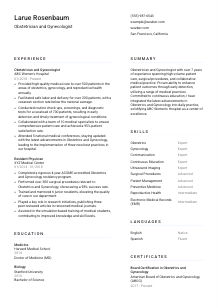
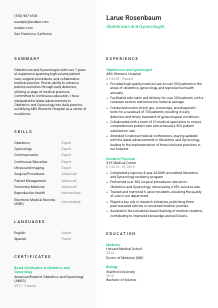
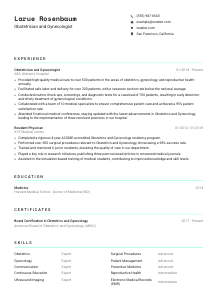
Delivering bundles of joy, but your resume doesn't shine? Explore this Obstetrician and Gynecologist resume example, created with Wozber free resume builder. Learn how to present your women's health expertise to match job requirements, shaping a career path as exceptional as your patients' journeys.
Obstetrics and gynecology work is reviewed through a clinical lens from the start. Hiring teams want to see a physician who can manage routine preventive care, high-stakes labor and delivery, surgical intervention, and patient communication with equal steadiness. Your resume needs to make that range visible quickly, especially the parts of your practice that affect patient outcomes, procedural scope, and multidisciplinary care.
Early resume screening often turns on whether your training, licensure, board status, and core OB-GYN responsibilities are easy to find without digging. Wozber's free resume builder helps structure that information in an ATS-friendly resume format, so keywords such as board certification, residency training, cesarean delivery, and reproductive health are mapped clearly to the work you have actually done. That gives a hiring team a faster read on your clinical readiness.
In medicine, the top of the resume should confirm right away who you are and whether basic eligibility questions are already covered. For an Obstetrician and Gynecologist, that means a clean header that reflects licensure-ready professionalism and makes it easy to contact you for credentialing, interviews, and follow-up.
Use your full name at the top in a clear, prominent format. Keep it simple and professional. In a physician resume, your name functions less like a brand statement and more like the label on a credential file, so readability matters more than styling.
Place your professional title directly under your name. If you are applying for an Obstetrician and Gynecologist position, use that exact wording unless a more specific variation is more accurate for your background. This helps reviewers connect your practice area to the role immediately and supports ATS matching as well.
Include your phone number and a professional email address, and check both carefully. Hiring for physicians often moves through several coordinators, department leaders, and credentialing contacts, so any typo can slow the process. A professional profile or website is optional, but only include it if it adds relevant publications, affiliations, or clinical information that supports your application.
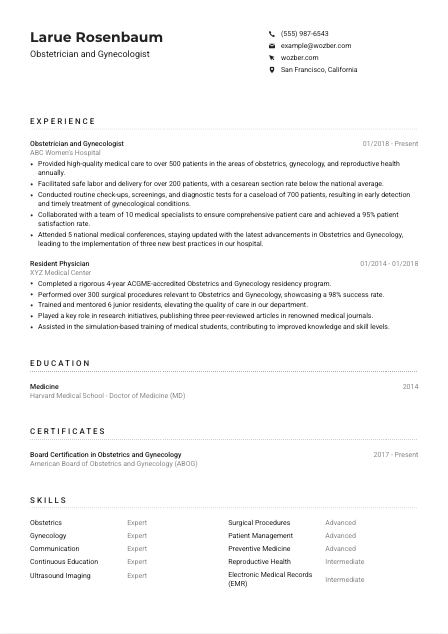
City and state are useful when the employer is hiring for a specific practice location or wants to avoid relocation delays. The example resume lists San Francisco, California, which works because the target role is tied to that state. Treat this as tailoring guidance, not a rule for every OB-GYN resume.
If you maintain a faculty page, research profile, or professional site, include it only when it is current and aligned with your resume. A physician website can strengthen your application when it highlights peer-reviewed publications, speaking engagements, quality initiatives, or subspecialty interests. Skip personal links that do not add clinical value.
This section should answer the basics without friction: who you are, what role you practice in, where you are based if relevant, and how the employer can reach you. For a clinical hire, that kind of clarity supports faster movement into the serious review of your credentials and experience.




This is the section most likely to separate one OB-GYN physician from another. Titles and employers matter, but the real distinction comes from what kind of patient volume you handled, which procedures you performed, how you worked with other specialists, and what outcomes or operational contributions followed from your care.
Read the job description like a clinical checklist and identify the duties that need direct proof. Here, that includes obstetric care, gynecologic care, reproductive health, routine screenings, labor and delivery, cesarean sections, collaboration with specialists, and continuing education. Then make sure your bullet points show where you have done that work. The example bullet about providing care to more than 500 patients annually is effective because it mirrors the employer's need while adding scope.
List positions in reverse chronological order with job title, employer, and dates. For physicians, this helps readers track progression from residency into attending practice or later career growth. If you trained in an ACGME-accredited residency and that training is central to eligibility, make sure it is clearly visible in the sequence rather than buried elsewhere.
Replace generic duty statements with bullets that show caseload, procedures, outcomes, or practice impact. Numbers carry weight in OB-GYN hiring when they reflect real clinical work, such as annual patient volume, delivery counts, surgical volume, patient satisfaction, reduced complications, or implementation of updated protocols. The sample resume does this well with delivery volume, screening caseload, and cesarean performance context.
If your background includes research, teaching, committee work, or broader medical experience, keep the most relevant clinical material first. Employers need to see whether you can manage prenatal visits, reproductive health concerns, gynecologic conditions, inpatient coverage, and surgical responsibilities. Supporting achievements are valuable, but they should not crowd out the core practice story.
Start bullets with direct verbs such as "managed," "performed," "diagnosed," "facilitated," "counseled," or "collaborated." Those choices read naturally in clinical resumes because they describe actual physician work. In the example, verbs like "facilitated," "conducted," and "collaborated" help the reader picture day-to-day responsibility rather than abstract competence.
By the end of this section, a reviewer should understand your clinical setting, procedural strength, patient volume, and the kinds of outcomes you influence. For an Obstetrician and Gynecologist, that means your resume should read like a record of responsible practice, not a list of department-level duties.
OB-GYN hiring starts with formal medical training, and the education section needs to confirm that foundation without forcing the reader to hunt for it. Degrees, residency training, and any advanced clinical preparation should be organized so your path into independent practice is obvious.
Start with the degree that qualifies you to practice medicine. This posting asks for an MD or DO from an accredited institution, so that should appear first and be easy to read. In the example, the Doctor of Medicine entry does exactly that, which immediately aligns with the stated requirement.
List degree, institution, field, and graduation year in a consistent structure. Medical employers are not looking for creative formatting here. They want to confirm the basics quickly, especially when they are reviewing multiple physicians with similar titles and overlapping hospital experience.
If residency is not already obvious in your experience section, mention it in education or make sure the training program is unmistakable elsewhere on the resume. This role specifically calls for at least 3 years of postgraduate training in an ACGME-accredited Obstetrics and Gynecology residency program, so that detail should not be left implied. The sample resume handles this through the resident physician role, which is a solid way to show accredited training in context.
Include fellowships, focused clinical training, or notable coursework only when they strengthen your candidacy for the target position. Examples might include minimally invasive gynecologic surgery, maternal-fetal medicine exposure, reproductive endocrinology training, or simulation-based obstetric emergency preparation. Keep it relevant to the actual practice scope of the role.
Honors, academic awards, or research recognition can add value, especially early in your career or for academic health systems. Choose distinctions that support your medical trajectory, such as teaching awards, research publications, or honors in women's health. Leave out academic achievements that no longer add professional context.
Your education section should leave no doubt that your medical degree and specialty training support the work described in the posting. When the training path is clear, the employer can focus on how you practice rather than whether you meet the baseline qualifications.
For physicians, certifications are not decorative credentials. They are core hiring filters. In an Obstetrician and Gynecologist resume, board certification, board eligibility, state licensure, and other current credentials need to be visible, current, and directly connected to the role you want.
Pull the required certifications and license language straight from the posting and confirm that your resume reflects it. Here, board certification or eligibility in Obstetrics and Gynecology and a valid, unrestricted medical license are essential. If you hold them, list them plainly and early in this section.
Prioritize credentials that matter to OB-GYN practice. ABOG board certification, active state licensure, fellowship recognition, or hospital privileges tied to your scope of practice are far more relevant than broad medical courses that do not affect your candidacy. The sample resume stays focused by listing board certification and the California medical license first.
Add issue dates, renewal ranges, or "Present" when appropriate. This is especially useful in medicine because currency matters. An employer reviewing your resume wants to know whether your certification and license status supports active practice without needing a second step to clarify timing.
If you have continuing medical education, advanced procedural training, or specialty updates that strengthen your application, include the most relevant ones selectively. This works well when the role values current clinical practice patterns, quality improvement, or research participation. Keep the emphasis on training that affects patient care, procedural competence, or specialty knowledge.
Clear certification and licensure details reduce uncertainty in physician hiring. When your board status and active license are easy to find, the employer can move quickly from compliance questions to the substance of your clinical experience.
A physician skills section should read like the summary of a real practice, not a grab bag of broad strengths. For an Obstetrician and Gynecologist, the best skills list combines clinical capabilities, procedural competence, and patient-facing judgment in a way that matches the role's care setting.
Start with the skills named or implied in the posting. In this case, that includes obstetrics, gynecology, reproductive health, surgical procedures, communication, interpersonal ability, and patient management. Add only those you can support elsewhere on the resume through actual work, training, or outcomes.
Order the section so the most relevant skills appear first. If the role emphasizes labor and delivery, gynecologic procedures, screenings, and patient management, those should come before less critical items. The example list works because it puts core specialty skills like Obstetrics and Gynecology ahead of secondary tools such as EMR.
The strongest OB-GYN resumes do not treat soft skills and technical skills as separate worlds. Patient counseling, informed consent conversations, collaboration with specialists, and continuity of care matter alongside ultrasound, surgery, and preventive medicine. Choose a mix that reflects how you actually practice, and keep the list selective enough that every item feels credible.
This section should reinforce the parts of your experience that matter most for the position, especially specialty care, procedures, and patient communication. A focused skills list helps the reader connect your clinical background to the day-to-day demands of the role.
Language ability matters differently in healthcare than it does in many other professions. For an OB-GYN physician, communication affects consent, patient education, prenatal counseling, symptom reporting, and trust. If you speak more than one language, present it in a way that reflects patient-care usefulness rather than filling space.
This posting explicitly requires the ability to speak, read, and write in English, so list English clearly and indicate your true proficiency. If English is your native language or you use it as your primary clinical language, make that easy to see.
Additional languages can strengthen your resume when they are relevant to the patient population or care environment. Spanish, for example, may be especially useful in many obstetric and gynecologic settings because it supports patient education, reproductive health discussions, and continuity of care without an interpreter in every interaction. The example resume includes fluent Spanish in a way that adds practical value.
Choose accurate labels such as "Native," "Fluent," "Intermediate," or "Basic." In a clinical setting, overstating language ability can create real risks, especially during counseling, discharge instructions, or labor and delivery communication. Precision matters more than impressiveness here.
If multilingual communication is one of your real strengths, let it support the rest of the resume naturally. It is particularly relevant in practices with diverse patient populations, community health settings, and hospitals serving multilingual families. You do not need to overexplain it, but it should connect clearly to patient care.
If you are improving a language that could be useful in practice, you can include it at a lower proficiency level when that claim is honest. This can be worthwhile if the employer serves a multilingual community, but only if you present it modestly and accurately. Clinical credibility always comes first.
When listed with care, language ability shows more than communication range. It can point to stronger patient rapport, clearer counseling, and better access to care across a broader patient population, all of which matter in obstetrics and gynecology.
The summary should help the employer understand your clinical profile in a few lines. For an Obstetrician and Gynecologist, that usually means years in practice, patient or procedural scope, major strengths across obstetric and gynecologic care, and one or two differentiators such as surgical capability, collaborative care, or quality improvement work.
Before writing, identify the few things this employer needs confirmed first. In this posting, those include specialty training, board status or eligibility, surgical proficiency, broad OB-GYN care, and strong patient management. Build your summary around the points you can prove most convincingly elsewhere on the resume.
Your first sentence should establish that you are an Obstetrician and Gynecologist and indicate your years of experience or stage of practice. The sample summary does this well by naming the specialty and noting more than 7 years of experience, which immediately positions the candidate within the field.
Use the next lines to highlight what defines your work. That might be high-volume women's health care, labor and delivery management, gynecologic surgery, preventive screening, reproductive health, interdisciplinary collaboration, or implementation of updated clinical practices. Keep the language grounded in work you have actually done, not broad claims about excellence.
Aim for 3 to 5 lines with enough detail to distinguish you from another physician with similar credentials. Mention measurable scope where it helps, but do not turn the summary into a second experience section. It should function as a clear clinical snapshot that prepares the reader for the deeper detail that follows.
A good OB-GYN summary gives the employer a fast read on your practice profile, strengths, and level of responsibility. If it is written well, the rest of the resume feels like confirmation of a physician already presented with clarity.
Your resume should now show the essentials an Obstetrician and Gynecologist employer looks for first: medical training, board status, licensure, procedural capability, patient-care scope, and the way you work with colleagues across care settings.
Wozber's free resume builder can help you organize that material into an ATS-compliant resume, and its ATS resume scanner can surface missing requirements or wording gaps before you apply. The result should be a document that makes your clinical background, specialty alignment, and day-one readiness easier to judge.




