



Use Wozber and land your dream job
Create Resume
No registration required
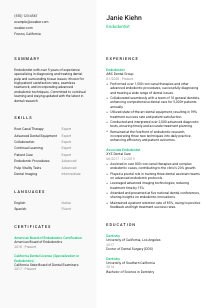
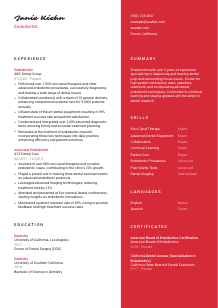
Rooting for your dental career, but your resume seems a bit shallow? Check out this Endodontist resume example, created with Wozber free resume builder. Learn how to highlight your root canal wizardry to match job standards, leading your dental journey deeper, without cavities of uncertainty!
Endodontic hiring quickly separates dentists with general clinical depth from specialists who can manage complex pulpal diagnosis, perform predictable root canal therapy, and work comfortably within a referral-based model. Your resume needs to show that kind of specialist practice clearly, with clinical scope, treatment volume, diagnostic judgment, and the way you support patient outcomes alongside general dentists and other dental specialists.
When those details are tailored to the posting, the resume reads less like a general dentistry profile and more like an endodontic specialist ready for the caseload, technology, and credentialing standards of the role. Wozber's free resume builder helps organize that information into an ATS-compliant resume, so board status, licensure, advanced procedures, and clinical experience are easy to identify early.
The top of an Endodontist resume should confirm professional identity and practical eligibility fast. Hiring teams usually look here first to confirm title, contact information, and any location detail that affects scheduling, licensing, or relocation before they move into your clinical background.
Place your full name prominently and keep the formatting clean and clinical, just as you would want patient documentation or treatment notes to read. Avoid nicknames or decorative styling. This section should immediately reflect the professionalism expected of a specialist handling complex endodontic cases.
Add "Endodontist" directly beneath your name so the role is unmistakable from the first line. That matters when employers are screening for a specialist rather than a general dentist with occasional endodontic experience. If your background includes associate roles or referral-based practice, the title keeps your positioning clear.
Use a reliable phone number and a professional email address, ideally in a simple format such as firstname.lastname@email.com. In healthcare hiring, small details carry weight. If a recruiter or practice administrator is coordinating interviews around clinic hours, they should be able to reach you quickly without second-guessing your information.
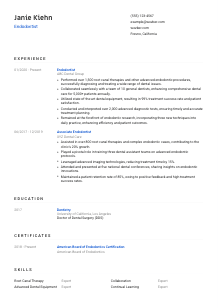
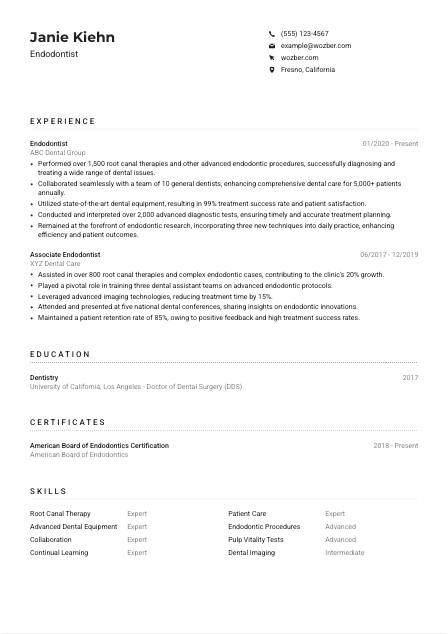
If the employer specifies a city or relocation requirement, reflect that in your personal details. Here, listing Fresno, California directly addresses a stated requirement and removes an early point of uncertainty. Use this only when it is relevant to the role you are targeting, not as a blanket rule for every application.
A LinkedIn profile or professional website can support your application when it adds useful context, such as board certification, conference activity, publications, or practice focus. Keep it current and aligned with your resume so your training, license status, and specialist experience tell the same story across both.
These details do more than identify you. They confirm that you are applying as an Endodontist, that you are reachable, and that any practical requirement such as location is already addressed before your clinical qualifications are reviewed.




For an Endodontist, experience is where the resume either gains credibility or stays too general. Employers look for the kind of case exposure, diagnostic responsibility, procedural volume, collaboration, and technology use that point to confident specialty practice rather than broad dental experience alone.
Read the job description closely and mark the responsibilities that define the practice. For this role, that includes root canal therapy, diagnostic testing, collaboration with dentists, advanced equipment, and continued adoption of new techniques. Those priorities should shape which accomplishments you feature and what language you use in your bullet points.
List positions in reverse chronological order with employer, title, and dates clearly shown. For specialists, progression matters. A hiring team should be able to see whether you moved from associate-level endodontic work into higher-volume or more autonomous practice, and how long you have been working in the specialty.
Focus each bullet on work that reflects endodontic practice directly. That can include procedure volume, diagnostic interpretation, retreatment work, referral coordination, imaging use, or patient outcome measures. The sample resume does this well by tying accomplishments to core duties such as performing over 1,500 root canal therapies and interpreting more than 2,000 diagnostic tests, which gives real clinical scale to the role.
Numbers make your experience credible when they reflect real practice indicators. Include treatment counts, success rates, patient volume, reduction in treatment time, retention rates, or the size of the referring dental network when those measures are accurate. In the example, a 99% treatment success rate and 5,000+ patients supported annually make the candidate's practice environment and results easier to understand.
Prioritize experience that strengthens your case as an Endodontist. General clinical duties, broad administrative tasks, or unrelated early-career details should stay brief unless they directly support your specialty profile. Every bullet should help answer the same question: can this dentist step into an endodontic caseload, work with referring providers, and deliver high-standard specialty care?
Your experience section should read like a record of specialist treatment work, clinical judgment, and measurable patient care. When the bullets reflect endodontic volume, outcomes, and collaboration clearly, employers can picture you in the chair, not just on paper.
Endodontic hiring starts with the expected academic foundation, then moves quickly to specialist preparation. Your education section should make it easy to see that you completed the dental degree required for practice and, where relevant elsewhere in the resume, the advanced training that supports your endodontic work.
Use the full degree title listed in your credentials, such as Doctor of Dental Surgery (DDS) or Doctor of Dental Medicine/DMD, especially when the posting names those qualifications directly. Matching the wording helps both human reviewers and ATS filters recognize that you meet a non-negotiable requirement.
Keep each education entry straightforward: degree, field, school, and graduation year. This is not the place for long descriptions. The hiring team mainly needs fast confirmation that your dental education is accredited, complete, and easy to verify.
If the role specifically requires a DDS or DMD, place that degree first and make sure it is impossible to miss. In the provided resume, the DDS is listed clearly at the top of the education section, which immediately aligns with the employer's stated requirement.
For experienced Endodontists, education can stay concise. If you are earlier in your career, limited extra detail can help, such as endodontics-focused coursework, honors, research, or dental association involvement. Keep it tied to specialty training and clinical development rather than listing broad academic activity.
Conference presentations, research recognition, and notable academic awards can be useful if they relate to endodontic techniques, dental materials, imaging, or treatment outcomes. Mention them selectively so they reinforce your specialist profile instead of distracting from your clinical experience.
This section should confirm the educational base behind your clinical work without forcing the reader to hunt for it. Clear degree information strengthens the rest of your resume by showing that your endodontic experience rests on the required academic foundation.
In a specialist dental resume, certifications often carry immediate hiring weight. Active licensure, endodontic specialization, and board status tell an employer whether you can legally practice, whether your training is recognized, and how closely you match the standards of a specialty-focused role.
List the certifications and licenses that the role explicitly asks for before anything optional. For this posting, that means active dental licensure with endodontic specialization and board certification or eligibility with the American Board of Endodontics. These belong near the top because they directly affect eligibility.
Choose credentials that strengthen your profile as an Endodontist. State licenses, board credentials, sedation permits if relevant to your practice, and specialty-related clinical training belong here. Leave out general certificates that do not add much to your ability to perform endodontic diagnosis and treatment.
Include issue dates, renewal windows, or "Present" where appropriate so employers can quickly tell whether your credentials are active. The example resume handles this well by showing both board certification and California licensure as current, which removes unnecessary follow-up questions during screening.
If you have recent advanced training in CBCT use, magnification systems, complex retreatment, trauma management, or new endodontic protocols, include it when it adds real value. This supports the part of the role that calls for staying current with evolving techniques, tools, and research.
For an Endodontist, certifications are not decorative. They confirm legal practice status, specialty standing, and current professional development, which often determines whether the rest of the resume gets full attention.
A skills section works best when it mirrors the actual work of the specialty. Endodontic employers are scanning for procedural strengths, diagnostic tools, and collaboration abilities that support treatment quality, patient care, and smooth coordination with the broader dental team.
Start with the technical and professional skills most visible in the job description. For this role, that includes root canal therapy, endodontic procedures, diagnostic testing, dental imaging, advanced equipment use, and collaboration with other providers. Build the section from work you have actually performed, not from generic dentistry terms.
List the skills that would matter most in daily specialty practice first. An Endodontist resume should usually lead with treatment and diagnostic capabilities, then include supporting strengths such as patient communication, interdisciplinary coordination, and continual learning. The sample skill list does this effectively by placing root canal therapy and advanced dental equipment ahead of broader traits.
Use a concise set of skills that can be backed up elsewhere in the resume. A shorter list with clear endodontic relevance works better than a long inventory of vague strengths. Each skill should connect naturally to your experience, credentials, or summary so the resume feels consistent from section to section.
When this section is tightly aligned with endodontic practice, it supports both ATS matching and quick human review. The right mix of procedural, diagnostic, and collaborative skills makes your specialty focus obvious at a glance.
Communication matters in endodontics because treatment explanations, consent discussions, and collaboration with referring dentists all depend on precision. The languages section should clarify whether you can meet the communication expectations of the role and whether you bring added value in a multilingual patient population.
If the posting names a required language, list it first with an honest proficiency level. Here, English needs to appear clearly because the employer specifically asks for professional fluency. That tells the reader you can handle patient communication, clinical documentation, and provider coordination in the expected setting.
Use direct labels such as Native, Fluent, Advanced, or Professional Working Proficiency. In healthcare, vague language can create doubt. Be precise enough that an employer can understand how comfortably you can explain procedures, discuss risks, and communicate treatment plans.
Additional languages can strengthen your resume when they help you serve a broader patient base or communicate in a diverse community. In the example, Spanish is a meaningful addition because it suggests wider patient accessibility, though it should be treated as an advantage rather than a universal requirement for every Endodontist role.
Only list languages you can use confidently in professional interactions. If you include a language, be prepared to discuss treatment options, post-procedure instructions, and patient concerns at the level your rating suggests.
Some endodontic practices serve referral networks and patient populations where multilingual communication is especially useful. When that applies, the languages section can quietly strengthen your application by showing you can support smoother care delivery across patient and provider interactions.
This section works best when it supports real communication needs in practice. Clear language proficiency helps employers understand how you will interact with patients, colleagues, and referring dentists from day one.
The summary should establish your specialty identity in a few lines, not repeat your whole resume. For an Endodontist, the strongest version combines years of practice, core clinical focus, and one or two concrete outcomes or strengths that match the role's patient care and referral environment.
Before writing, identify the few requirements that most define the role. Here, that includes specialty training, clinical experience, endodontic procedures, diagnostic capability, and current technique adoption. Those points should shape the opening lines of your summary rather than broad statements about being passionate or dedicated.
Start with your title and years of relevant practice, such as an Endodontist with 5+ years of experience in diagnosing and treating pulpal and periapical disease. This quickly distinguishes you from general dental candidates and anchors the rest of the summary in specialty work.
Choose details that matter in endodontic hiring, such as treatment volume, patient satisfaction, collaboration with general dentists, advanced imaging use, or the integration of newer techniques into practice. The provided summary points in the right direction by mentioning specialist focus, patient satisfaction, teamwork, and continued learning.
Aim for a short paragraph that can be absorbed in seconds. Three to four lines is usually enough to establish your specialty focus and strongest qualifications without duplicating the experience section. Save fuller detail, metrics, and case scope for the bullets below.
Your summary should tell the reader, quickly and credibly, what kind of Endodontist you are. If it highlights specialty scope, experience level, and a few meaningful strengths, the rest of the resume has a clear clinical frame to build on.
An effective Endodontist resume makes the essentials easy to find: specialist training, active licensure, board status, clinical volume, diagnostic skill, and the ability to work well within a referral network. When each section is tailored to the role, employers can quickly understand both your eligibility and the kind of endodontic care you are prepared to deliver.
Wozber's free resume builder can help you shape that information into an ATS-friendly resume format, and its ATS resume scanner can highlight missing requirements, strengthen keyword alignment, and improve ATS optimization across sections. The result should make one thing clear immediately: you are ready to contribute as an Endodontist in real clinical practice.