



Use Wozber and land your dream job
Create Resume
No registration required
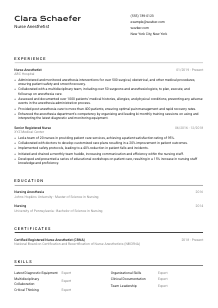
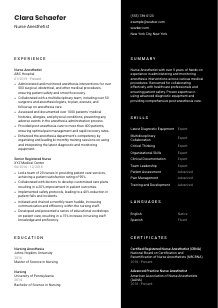
Administering potent sedatives, but your resume feels wide awake? Settle into this Nurse Anesthetist resume example, created with Wozber free resume builder. Learn how to match your critical care know-how to job requirements, ensuring your career stays as steady as your patients' heart rates!
Nurse anesthetists work in high-stakes clinical settings where judgment, vigilance, and procedural consistency directly affect patient safety. A resume for this role needs to make that practice visible fast, especially your anesthesia case experience, pre-op assessment work, intraoperative monitoring, and post-anesthesia care across surgical, obstetrical, or other procedural environments.
Screening often turns on whether your record clearly shows licensed anesthesia practice rather than broader nursing experience. Wozber's free resume builder helps organize that distinction in an ATS-friendly resume format, so your CRNA credentials, acute care background, and hands-on monitoring experience are easy to find and easy to trust.
Healthcare hiring moves quickly when the basics are clear. In a Nurse Anesthetist resume, your header should confirm who you are, how to reach you, and whether you meet straightforward filters such as role title and location.
Use your full name in a clean, prominent format. This is simple, but in clinical hiring it matters. Keep the header easy to scan so the reviewer can move immediately to your credentials, licensure, and experience without distractions.
Place "Nurse Anesthetist" directly beneath your name if that is the role you are targeting. Matching the posting's title helps frame the rest of your resume correctly, especially when employers are separating CRNAs from RNs, perioperative nurses, or other advanced practice candidates.
List a phone number you answer, a professional email address, and only links that support your candidacy. In most cases, that means a LinkedIn profile or professional website with consistent employment dates, credentials, and clinical background.
If a posting specifies a city or relocation requirement, reflect that in your personal details. Here, listing New York City, New York directly supports the stated requirement. For other jobs, only include location details that help remove doubt about availability or licensure fit.
A digital profile should reinforce your resume, not repeat it loosely. If you include LinkedIn, make sure it matches your CRNA certification, acute care history, and current role scope. Consistency matters when employers are reviewing licensure and advanced practice timelines.
Your header should remove basic questions before the clinical review even starts. When name, title, contact details, and required location are clear, the reader can focus on your anesthesia background.




This section carries the most weight for a Nurse Anesthetist. Hiring teams want to see case volume, care settings, collaboration with surgeons and anesthesiologists, and signs that you can assess patients carefully, manage anesthesia delivery, and support recovery without losing sight of safety.
Start by identifying the parts of your background that line up with the target role's clinical demands. For Nurse Anesthetist positions, that usually means anesthesia administration, patient assessment, intraoperative monitoring, pain management, recovery care, and acute care experience. If your background includes both RN and CRNA work, make sure the anesthesia scope is more prominent.
List roles in reverse chronological order with job title, employer, and dates. That straightforward structure helps the reader follow your move from general nursing or critical care into advanced anesthesia practice. If you held a senior nursing role before becoming a CRNA, the layout should make that progression obvious.
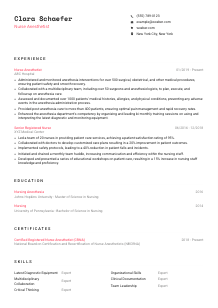
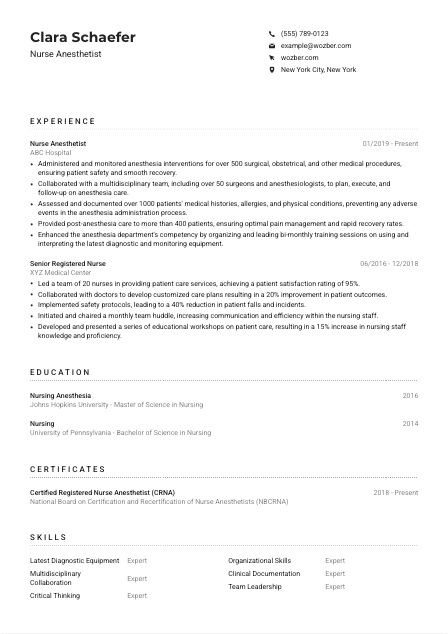
Write bullets that show what you handled and what happened as a result. The sample resume does this well with points such as administering and monitoring anesthesia for more than 500 procedures and providing post-anesthesia care for more than 400 patients. Those statements show range, volume, and patient-care ownership in a way generic duty lists never do.
Quantification works best when it reflects real healthcare scope. Case counts, patient volume, team size, reduction in adverse events, recovery outcomes, training frequency, or patient satisfaction all add credibility. The example's 1000+ patient assessments and collaboration with 50+ surgeons and anesthesiologists quickly communicate scale and multidisciplinary exposure.
Keep older or less relevant experience brief unless it strengthens the story. Prior nursing work can still help if it shows acute care judgment, team leadership, safety protocol implementation, or patient outcome improvement. What you want to avoid is letting unrelated duties crowd out anesthesia planning, monitoring equipment use, and perioperative patient management.
By the end of your experience section, the reader should be able to picture you in the OR, procedure suite, or recovery setting with confidence. Make your case volume, clinical judgment, and anesthesia-specific responsibilities easy to follow.
For Nurse Anesthetists, education is not a filler section. It establishes that you completed the formal academic path required for advanced anesthesia practice and gives the employer a quick check against a non-negotiable qualification.
If the posting calls for graduation from an accredited Nurse Anesthesia program with a master's degree, make that visible without forcing the reviewer to infer it. List your graduate degree in Nursing and the anesthesia specialty clearly, as shown in the example with a Master of Science in Nursing focused on Nursing Anesthesia.
Present each entry with degree, field, school, and graduation year. This makes credential review faster and keeps the focus on the qualification itself. For advanced practice roles, clarity beats extra formatting every time.
The distinction between a general nursing degree and graduate anesthesia training matters. If your program title, specialty track, or field says Nursing Anesthesia, keep that wording explicit. That is especially helpful for ATS matching and for human reviewers scanning eligibility requirements.
Most experienced CRNAs do not need a long academic detail section. Still, if you are earlier in your career, selective additions such as advanced pharmacology, pathophysiology, anesthesia principles, or relevant clinical honors can support your training depth. Keep them tied to anesthesia practice, not general student activity.
Research, capstone work, or professional association involvement can be worth noting if they relate to anesthesia safety, perioperative care, or evidence-based practice. Use them sparingly and only when they sharpen your professional profile rather than lengthen the section.
Your education should quickly answer one question: have you completed the specialized academic preparation required to practice as a Nurse Anesthetist. If that answer is unmistakable, the section is doing its job.
In this profession, credentials are operational requirements. Your resume should show current certification and licensure in a way that leaves no uncertainty about whether you can practice in the setting and state involved.
When a role asks for CRNA certification, list it prominently. The National Board on Certification and Recertification of Nurse Anesthetists credential is central to eligibility, so it belongs near the top of this section and should be spelled out clearly if space allows.
Start with the credentials that establish your legal and professional standing to provide anesthesia care. In this case, that includes CRNA certification, Registered Nurse licensure, and Advanced Practice Nurse Anesthetist licensure or state-recognized equivalent. Additional certifications can follow after those essentials.
Include dates or a current status marker such as "Present" when relevant. That makes it easier to confirm that your certification and licensure are active and maintained, which matters in regulated clinical hiring more than decorative formatting ever will.
Nurse anesthesia practice depends on staying current with recertification, continuing education, and clinical standards. Your certifications section can quietly reinforce that by showing active credentials and recent maintenance, especially if the employer emphasizes current best practices.
A hiring team should be able to confirm practice eligibility in seconds. When your CRNA certification and nursing licensure are current, visible, and clearly labeled, you remove one of the biggest barriers in Nurse Anesthetist screening.
The skills section works best when it reflects how Nurse Anesthetists actually practice. Focus on technical and clinical strengths that support safe anesthesia care, sound judgment, teamwork in procedural settings, and accurate patient monitoring.
Use the job description to identify the competencies the employer is emphasizing. Here, diagnostic and monitoring equipment, patient assessment, multidisciplinary collaboration, and post-anesthesia care stand out. Those are stronger resume skills than broad traits that could belong to almost any healthcare role.
List skills using language that sounds native to anesthesia care. "Patient Assessment," "Pain Management," "Clinical Documentation," and "Latest Diagnostic Equipment" all work because they connect directly to pre-op evaluation, intraoperative vigilance, and recovery support. The sample resume balances technical, clinical, and collaboration skills well.
Do not overfill this section. Put your most role-defining abilities first, especially those tied to anesthesia administration, monitoring, acute care judgment, and interdisciplinary coordination. A shorter list with clear relevance reads better than a long inventory of generic strengths.
If the skills section supports the rest of your resume with recognizable anesthesia competencies, it is doing its job. Every skill listed should make sense in an operating room, procedure area, or post-anesthesia setting.
Language skills matter in healthcare when they affect patient communication, documentation, and teamwork. For a Nurse Anesthetist, the required language should be listed clearly, and any additional language should support the populations you may serve.
If a posting states that English proficiency is essential, list English clearly and do not bury it. In a clinical role, this supports informed patient interaction, charting accuracy, and clear communication with surgeons, anesthesiologists, nurses, and recovery staff.
Additional languages can be valuable, especially in diverse hospital systems and urban care settings. Spanish, for example, may help with patient comfort and communication in pre-op or recovery, but it should be presented as an added strength rather than a substitute for core clinical qualifications.
Choose labels such as Native, Fluent, Conversational, or Basic with care. In healthcare, overstating language ability can create real communication risk, so accuracy matters more than appearance.
Only include languages that you can realistically use in patient or team communication. This section is most helpful when it points to better understanding at the bedside, smoother handoffs, or stronger rapport with patients and families.
For most Nurse Anesthetist resumes, languages are a supporting section. They should complement your anesthesia credentials and clinical background, not compete with them for attention.
Handled well, language details show that you can communicate clearly in the clinical environment and serve a broader patient population when needed. Keep the emphasis practical and credible.
Your summary should read like a concise clinical profile, not a generic career statement. In a few lines, it should establish your level of Nurse Anesthetist experience, your patient-care scope, and the kind of anesthesia work you are qualified to handle.
Before writing the summary, identify the parts of your background that matter most for the target position. For Nurse Anesthetists, that usually includes anesthesia administration, perioperative assessment, monitoring equipment proficiency, collaboration with procedural teams, and post-anesthesia recovery care.
A direct first line works best. The sample's opening, "Nurse Anesthetist with over 5 years of hands-on experience," succeeds because it immediately sets seniority and profession. Use your own years honestly and keep the phrasing clean.
Choose the strengths that best match the employer's priorities. You might highlight safe anesthesia delivery across multiple procedure types, strong patient assessment, or advanced monitoring and pain management capabilities. Keep the focus on clinical practice, not personality descriptors.
Aim for three to five lines that sound like a clinician, not a template. Mentioning collaboration with healthcare professionals and a track record of patient safety, as the example does, works because those are central to anesthesia practice. Tight wording makes the summary easier to scan and more believable.
After reading your summary, the employer should already understand your level of anesthesia experience and the clinical environment you can step into. That sets up the rest of the resume to confirm the details.
A Nurse Anesthetist resume works when it makes specialized preparation, current credentials, and hands-on anesthesia practice easy to see. Case volume, patient assessment, monitoring expertise, collaboration with surgeons and anesthesiologists, and recovery care should all appear where they matter most.
Use Wozber to organize those details into an ATS-compliant resume with language that matches the posting and reflects your real clinical scope. The finished resume should make one thing clear without delay: you are prepared to deliver safe, informed anesthesia care from pre-op through recovery.