



Use Wozber and land your dream job
Create Resume
No registration required
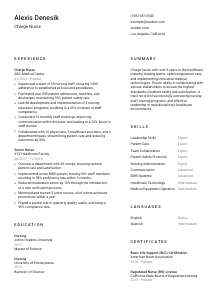
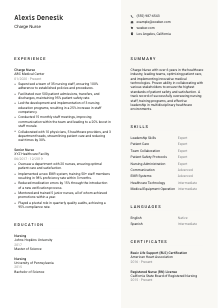
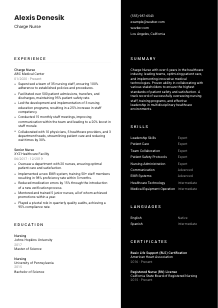
Leading medical teams, but your resume lacks vital signs? Check out this Charge Nurse resume example, created with Wozber free resume builder. Learn how to chart your leadership experience in a way that matches job expectations, keeping your career in the best healthcare condition!
Charge Nurses sit at the point where bedside care and unit operations meet. Your resume needs to show more than solid clinical experience. It should make clear that you can direct staff, keep patient flow moving, uphold policy, and steady a floor when admissions, discharges, transfers, and team coordination all hit at once.
Screening for this role often turns on whether your resume quickly separates you from a staff nurse with strong clinical skills but limited supervisory scope. Using Wozber's free resume builder to tailor your wording and structure into an ATS-compliant resume helps hiring teams see leadership range, EMR fluency, and day-to-day coordination work early, so your readiness for charge responsibilities is easier to recognize.
In hospital hiring, the top of the resume needs to settle practical questions fast. For a Charge Nurse opening, that means clear identity, current contact details, and any location detail that removes friction for a role tied to a specific state or facility market.
Use your full name in a clean, readable format at the top of the page. Keep it simple and professional. In nursing leadership hiring, clarity matters, and your header should look as orderly as the shift reports and documentation you are trusted to manage.
Place "Charge Nurse" directly under your name when that is the role you are pursuing. This immediately frames the rest of the resume around staff oversight, patient flow coordination, policy enforcement, and multidisciplinary collaboration instead of leaving the reader to infer your direction from past job titles alone.
List a reliable phone number and a professional email address, then verify both. Charge Nurses are trusted with handoffs, escalation communication, and urgent coordination with physicians and department leaders. Small errors in your own contact information can undermine that impression of reliability.
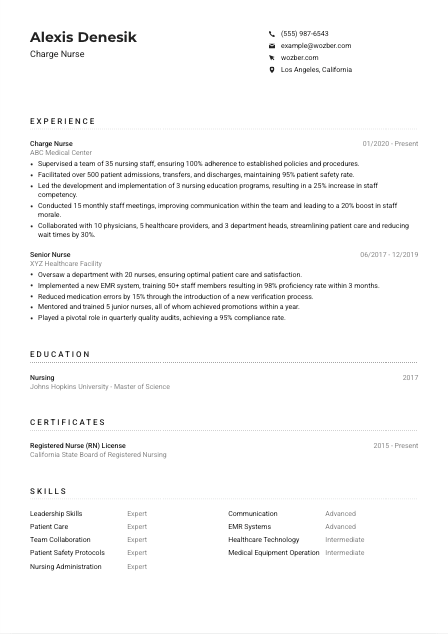
If a role requires local availability or an active license in a specific state, add your city and state. In the example, "Los Angeles, California" supports the posting's location requirement and helps remove questions about immediate eligibility. Only include this when it is useful for the role you are targeting.
Include LinkedIn or a professional website only if it supports your nursing leadership profile. A strong profile might reinforce unit leadership experience, quality work, EMR implementation exposure, certifications, or committee involvement. Keep the information consistent with your resume so your professional record reads as one coherent story.
This section should answer the first administrative questions without distraction. When your header is clean, role-specific, and accurate, the reader can move straight to your clinical leadership background.




For Charge Nurse hiring, experience is where leadership becomes credible. Hiring teams want to see how you managed staff, supported safe patient care, handled throughput, worked across disciplines, and improved unit performance in real settings, not just that you have been present on a busy floor.
Read the posting closely and mark the responsibilities that define charge-level work. Here, that includes supervising nursing staff, coordinating admissions and discharges, leading staff meetings, contributing to education programs, and working with physicians and department heads. Those should shape which accomplishments you surface first and how you describe them.
List roles in reverse chronological order with job title, employer, and dates. This helps reviewers track your progression from clinical nursing into formal leadership or senior-level responsibilities. For this kind of role, a clear move from staff or senior nurse duties into charge oversight is especially persuasive.
Each bullet should show what you were responsible for, what you did, and what changed because of it. Strong Charge Nurse bullets often reference team size, patient safety, compliance, staff development, throughput, or coordination outcomes. The example does this well by tying supervision of 35 nursing staff to full policy adherence and linking collaboration with physicians and department heads to shorter wait times.
Quantify where the numbers are meaningful to the work. Good measures for a Charge Nurse resume include staff supervised, admissions or discharges managed, audit scores, medication error reduction, training completion, patient safety results, or throughput improvements. Metrics like "500 patient admissions, transfers, and discharges" or a "15% reduction in medication errors" feel credible because they match how unit performance is often tracked.
Keep the section focused on clinical leadership, patient care oversight, team coordination, and operational improvement. If an older achievement does not help prove readiness to supervise staff, manage workflow, improve compliance, or support patient outcomes, trim it. Space is better spent on leadership actions, EMR use, quality initiatives, and examples of cross-functional coordination.
A Charge Nurse resume stands out when the experience section shows real supervisory responsibility with measurable unit impact. After reading it, a hiring manager should be able to picture you leading a shift, guiding staff, and keeping care delivery on track.
Education matters in nursing because it anchors both licensure and progression into leadership. For Charge Nurse roles, your degrees should be presented clearly enough that the reviewer can confirm the academic requirement immediately and then move on to your unit-level experience.
If the posting asks for a BSN or higher, make sure that credential is impossible to miss. List your nursing degree clearly, especially when it is the baseline qualification for the role. If you hold graduate education in nursing, it can strengthen the impression of leadership depth and clinical maturity.
Present each entry with degree, field of study, school, and graduation year. Nursing resumes benefit from straightforward formatting because reviewers are often moving quickly between licensure, clinical background, and leadership experience. Make the education section easy to verify at a glance.
If you have education beyond the minimum, include it without overexplaining. In the example, a Master of Science in Nursing strengthens the profile because the job requires a BSN or higher. That kind of credential can support your case for staff oversight, quality improvement participation, and education program involvement.
Most experienced nurses do not need to list courses, but it can help if your training directly supports the target role. Coursework in nursing leadership, healthcare administration, quality improvement, or informatics may be worth adding when you are earlier in your leadership path or when the posting emphasizes education and systems work.
Add honors, leadership activities, or major academic projects only if they reinforce your nursing trajectory. Useful examples might include student leadership, capstone work tied to patient safety, or academic recognition in clinical practice. Keep the emphasis on material that still strengthens your case for charge responsibilities.
This section does not need to do all the heavy lifting, but it should confirm that you meet the academic requirement and show any added preparation that supports leadership in a clinical setting.
For a Charge Nurse, certifications are not decorative credentials. They confirm that you can legally practice, step into patient care oversight, and meet the baseline safety expectations of the unit. Present them clearly and keep them current.
Start with the credentials named in the posting. Here, that means an active RN license in the state of practice and current BLS certification. These should appear prominently so there is no doubt that you meet the nonnegotiable clinical requirements.
Lead with licensure and core clinical certifications, then list any additional credentials that support leadership or specialty practice. Hiring teams reviewing Charge Nurse resumes will look first for current practice eligibility, then for signs of broader professional development.
Include the issuing body and the date range or active period, especially for licenses and time-sensitive certifications. In the example, listing the California RN license and BLS certification as current helps confirm immediate readiness for the role without forcing the reviewer to hunt for status details.
If you hold additional certifications in areas like ACLS, telemetry, medical-surgical nursing, leadership, or quality, include the ones that strengthen your target application. They can support your profile when the unit expects escalation judgment, staff guidance, or broader clinical oversight beyond routine bedside care.
Your licenses and certifications should confirm that you are current, qualified, and ready to step into charge-level responsibility. Keep this section precise, current, and easy to scan.
A Charge Nurse skills section should read like the toolkit of someone who can lead a shift, manage clinical workflow, and support safe care across a team. It works best when it balances operational leadership with the systems and care skills the unit depends on every day.
Pull skills from the posting, then confirm that each one is backed up elsewhere in your resume. For this job, that includes leadership, communication, multidisciplinary collaboration, EMR proficiency, healthcare technology familiarity, patient safety, and nursing supervision. Skills should reflect the work, not just desirable traits.
List the skills most central to charge-level performance first. Leadership is more convincing when your experience shows team oversight, staff meetings, evaluations, or mentoring. EMR systems matter more when you have handled documentation workflows, training, or adoption. Keep the section tightly connected to what you have actually done.
Aim for a concise list that covers both clinical and supervisory strengths. The example balances leadership skills, patient care, team collaboration, safety protocols, nursing administration, and EMR systems, which aligns well with the posting. Avoid padding the list with vague soft skills if they do not support the unit leadership story your experience already tells.
This section should echo the capabilities your experience proves. When the skills list is specific and role-aligned, it strengthens the picture of you as a nurse who can lead people, manage systems, and keep patient care standards high.
Language ability can matter more in healthcare than in many other fields because communication affects patient understanding, team coordination, and discharge quality. For a Charge Nurse, language skills are most useful when they strengthen care delivery in the setting you want to work in.
If the posting names a language requirement, list it clearly. This role requires proficient English, so English should appear in your languages section or be otherwise obvious through the resume. For clinical leadership positions, that signals you can handle patient communication, staff direction, and documentation without ambiguity.
Prioritize languages that directly affect patient care or team coordination. In many hospital environments, fluent or native English will be foundational, and any additional language commonly used in the patient population can add practical value.
Extra language capability can strengthen your application when it helps with patient rapport, bedside explanation, discharge teaching, or collaboration with families. In the example, Spanish is a useful secondary language because it can support communication in many care settings, though it is not a universal requirement for every Charge Nurse opening.
Use clear labels such as Native, Fluent, Advanced, Intermediate, or Basic. Overstating language ability can create problems in clinical communication, especially when patient education, escalation, or urgent coordination are involved.
If the facility serves a multilingual community, language skills can become more relevant than they first appear. Include them when they genuinely improve your ability to lead care, support patient satisfaction, or reduce communication barriers on the unit.
Language skills are most persuasive when they connect to patient care and team effectiveness. Keep them accurate, relevant, and tied to the environment where you plan to practice.
The summary is where you establish your level before the reader reaches the detailed experience section. For a Charge Nurse, that means a short paragraph that combines years of nursing experience with leadership scope, operational strengths, and the patient care standards you help maintain.
Before writing, identify the patterns that run through your background. That might include charge coverage, team supervision, patient safety work, staff development, EMR implementation, or quality improvement. Those themes should guide the summary instead of a generic statement about being hardworking or compassionate.
Start with your title or nursing background, years of experience, and the environments or responsibilities that best frame your seniority. A useful opening might reference several years in acute care or hospital nursing plus experience leading teams, coordinating patient flow, or supervising unit operations.
Bring in two or three details that match the target job. For this posting, that could mean nursing staff oversight, collaboration with multidisciplinary teams, education programs, quality initiatives, and EMR proficiency. The sample summary works because it connects leadership, patient care optimization, healthcare technology, and stakeholder collaboration without drifting into empty generalities.
Stay within 3 to 5 lines and make every phrase carry information. Mention experience level, leadership focus, and one or two concrete areas of impact. If you are using Wozber's AI resume builder, it can help tighten phrasing and align your summary with the posting's terminology so the opening reads clearly in both human review and ATS optimization.
A well-written summary should tell the reader, in a few lines, that you have the clinical foundation and supervisory range to handle charge responsibilities. It sets the standard for everything that follows.
A Charge Nurse resume works when it shows you can direct nursing staff, support safe patient care, and keep unit operations moving under pressure. Every section should point back to that combination of clinical judgment, team leadership, and operational control.
Use Wozber to build an ATS-friendly resume template that reflects the language of the role, highlights licensure and leadership experience, and keeps your structure easy to scan. By the time you apply, your resume should make one conclusion easy to reach: you are ready to lead the floor, support the team, and protect care quality from the start of the shift.




