



Use Wozber and land your dream job
Create Resume
No registration required
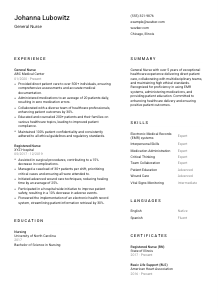
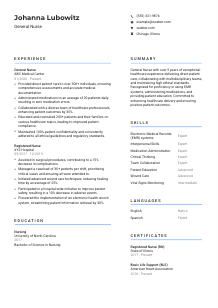
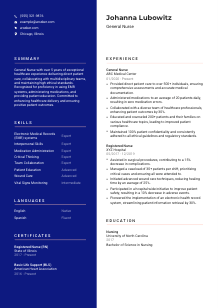
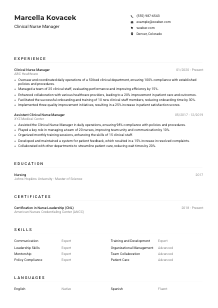
Tending to patients, but your resume feels unwell? Check out this General Nurse resume example, created with Wozber free resume builder. It shows how to weave your nursing skills into job requirements, keeping your career as healthy as those you care for!
General nursing work is judged in real time. You assess patients, document accurately, administer medications safely, coordinate with physicians and allied staff, and explain care clearly to patients and families. A resume for this field needs to make that clinical judgment visible fast, especially through direct care scope, documentation habits, and patient-facing responsibility.
When the resume is tailored well, hiring teams can quickly separate broad healthcare experience from hands-on nursing practice that matches the unit's needs. Wozber's free resume builder helps shape that experience into an ATS-compliant resume by aligning your wording with the posting and keeping the structure easy to parse, so your background reads as ready for direct patient care rather than adjacent support work.
Healthcare employers do not need a decorative introduction. They need accurate contact information, a clear professional title, and any logistics that affect scheduling, licensure, or start date. In nursing, even this section should feel orderly and dependable.
Use your full name in a clean, readable format at the top of the page. In nursing hiring, your resume often moves quickly between recruiters, nurse managers, and HR, so your name should be immediately visible without competing design elements.
Place "General Nurse" or "Registered Nurse" directly beneath your name when it matches your target opening and license status. This helps frame the rest of the resume around bedside care, patient assessment, medication administration, and documentation, instead of leaving readers to guess your clinical lane.
Your phone number and email should support quick follow-up for interviews, shift discussions, and credential checks. Use an email address that looks professional and make sure your voicemail is appropriate for employer callbacks.
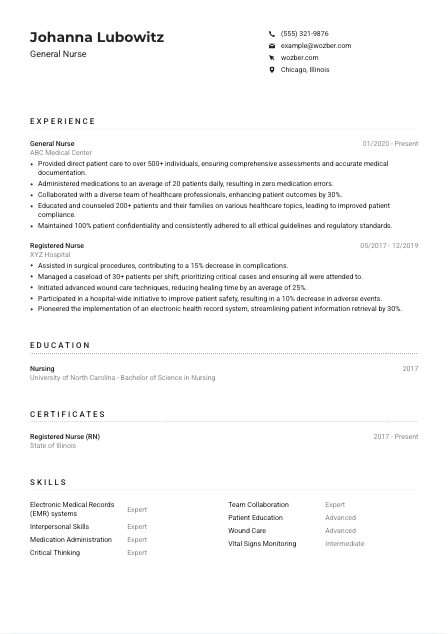
If the employer specifies local availability or relocation, include your city and state. For the example role, listing "Chicago, Illinois" addresses the stated location requirement right away. If you are relocating, make that clear without adding a full street address.
A LinkedIn profile can support your application if it reflects your nursing background accurately, including license details, care settings, and recent roles. Keep titles, dates, and major responsibilities consistent with the resume so there is no confusion during screening.
Your personal details should read like a reliable handoff. Clear title, accurate contact information, and any location detail tied to the posting make the administrative side of hiring easier before anyone evaluates your clinical work.




For a General Nurse, experience is where employers look for proof of safe practice. They want to see what kind of patients you cared for, what clinical tasks you handled independently, how you documented care, and whether your work improved outcomes, compliance, or team efficiency.
Start by marking the responsibilities that define the role. In this case, direct patient care, assessment, medication administration, dressing changes, vital signs monitoring, patient education, EMR documentation, and multidisciplinary collaboration should all appear somewhere in your experience if they reflect your background. This keeps your bullets tied to day-to-day nursing practice instead of generic healthcare support.
Lead with your most recent nursing position and include employer, title, and dates clearly. Hiring teams want to track your clinical progression quickly, especially when comparing general nursing experience, unit exposure, and continuity of bedside responsibilities across hospitals or clinics.
Each position should show what you did and what changed because of your work. Good nursing bullets mention patient volume, procedures, safety, education, documentation, and team coordination. The sample resume does this well by pairing direct care with outcomes such as improved patient compliance and stronger collaboration across the care team.
Quantify where the numbers are natural. Patient caseload, medication volume, reduction in adverse events, healing time, compliance rates, or documentation efficiency all give hiring teams a clearer picture of your scope. For example, "administered medications to an average of 20 patients daily with zero medication errors" is much stronger than simply saying you handled medications.
Prioritize experience that supports the target role, even if you have broader healthcare exposure. General Nurse openings usually favor recent hands-on care, accurate charting, patient communication, and team-based treatment support. If you helped implement an electronic record system, improved wound care, or managed a high patient load, place those details high in the section because they connect directly to common nursing hiring priorities.
Your experience section should make it easy to picture you on shift. Show the patients you supported, the clinical tasks you handled, the systems you documented in, and the outcomes you helped improve.
Nursing education is a licensing foundation, not a background detail. Employers check it to confirm that your clinical training supports the level of responsibility in the role, especially when the posting specifies a BSN, ADN, or equivalent nursing preparation.
List your nursing degree clearly and use the full credential name, such as Bachelor of Science in Nursing or Associate Degree in Nursing. For this opening, a BSN directly matches the stated requirement, while an ADN can also work when paired with relevant experience if the employer allows that path.
Include degree, school, field, and graduation year in a simple structure. Nurse recruiters and HR teams often review many resumes quickly, so this section should confirm your academic background without extra narrative.
If the job description asks for a nursing degree, use the same professional wording where it fits your actual education. The sample resume's "Bachelor of Science in Nursing" makes the match immediate and avoids vague labels that slow screening.
Most experienced nurses do not need a long list of classes. Include academic honors, clinical distinctions, or relevant coursework only if you are early in your career or if the training supports a specialty area tied to the role, such as medical-surgical care, patient education, or community health.
If you have continuing education that materially supports your nursing practice, mention it when relevant, but keep formal licenses and certifications in their own section. This helps your education stay focused on degree qualification while still showing growth in clinical knowledge.
Education should answer one question quickly: do you have the academic nursing foundation required for the role? State it clearly, keep it clean, and let it support the clinical story told elsewhere in the resume.
In nursing, credentials are operational requirements. A hiring manager cannot move forward if your RN license is missing, unclear, or appears inactive. This section should confirm that you meet the legal and clinical standards to practice.
Lead with your Registered Nurse credential and the issuing state when relevant. For the example role, an Illinois RN license directly supports eligibility to practice in the stated location. If you hold a multistate license or are in the process of endorsement, note that accurately.
After the RN license, list credentials that matter for patient care and unit readiness, such as BLS, ACLS, PALS, wound care, or specialty training if applicable. Choose certifications that strengthen your case for the target role rather than listing every course you have completed.
Include dates when they help confirm that your credentials are current. In regulated clinical hiring, this matters. The sample resume's date range format works well because it shows continuing validity at a glance.
Review this section before every application. Expired certifications, inconsistent state information, or outdated abbreviations can create unnecessary delays in credential review. For nursing roles, current documentation is part of professional credibility, not just resume housekeeping.
A reviewer should be able to confirm your legal ability to practice and your current clinical readiness in seconds. Put the RN license first, keep dates accurate, and support it with care-relevant certifications.
A General Nurse is hired for a mix of clinical execution and patient-facing judgment. Your skills section should reflect the work you actually perform, from EMR documentation and medication administration to patient communication and collaboration with the wider care team.
Start with the posting, then cross-check against your real experience. If the role calls for EMR proficiency, strong verbal and written communication, patient assessment, or multidisciplinary collaboration, those should appear only if you can back them up in your work history. Nursing skills carry more weight when the experience section proves them.
Order the list around the role's practical demands. For a general nursing opening, that often means EMR systems, medication administration, vital signs monitoring, wound care, patient education, critical thinking, and team collaboration. The sample resume uses this kind of balance by pairing technical nursing tasks with interpersonal strengths.
Avoid turning the section into a long inventory of generic strengths. A shorter list of clinically meaningful skills is more useful than broad claims. Choose the tools, care tasks, and communication strengths that are most likely to matter in daily nursing work for the target setting.
Your skills should support the same picture shown in your experience: a nurse who can document accurately, deliver safe care, communicate clearly, and work effectively with patients and clinical colleagues.
Language ability matters in nursing because patient understanding affects safety, consent, education, and follow-through. This section becomes especially useful when the employer explicitly asks for advanced English or when the patient population includes multiple commonly spoken languages.
If the posting calls for advanced English, list English prominently and use an honest proficiency level. This tells employers you can handle charting, patient education, verbal handoffs, and written communication at the standard the role requires.
Extra languages can strengthen your application when they help with patient trust, education, and day-to-day communication. In a large urban care setting, fluency in Spanish or another widely spoken language may support smoother interactions with patients and families, even when it is not formally required.
Choose levels that reflect what you can actually do in a clinical setting. If you can explain medications, take basic histories, or answer patient questions comfortably in another language, say so accurately. Do not overstate fluency when patient understanding is at stake.
List only the languages that add real value to your nursing work. One or two credible entries are enough if they support communication, education, or culturally responsive care.
For nurses, language ability is not just a nice addition. It can improve understanding of discharge instructions, medication use, and preventive care. Frame it as a practical strength tied to patient outcomes, not as a general personal trait.
Used well, languages show that you can communicate care clearly across a broader patient population. That matters most when it supports safer education, stronger trust, and better follow-through.
The summary is where you establish your nursing profile in a few lines. It should quickly answer what kind of nurse you are, how much relevant experience you bring, and which clinical strengths are most relevant to the role you want next.
Start with your title, licensure context if useful, and years of relevant nursing experience. A direct opening such as "General Nurse with 5+ years of experience" immediately frames your background around patient care rather than general healthcare exposure.
Mention two or three capabilities that map closely to the job, such as direct patient care, EMR documentation, medication administration, patient education, or multidisciplinary collaboration. The sample summary works because it stays close to the role's actual responsibilities instead of drifting into generic statements about passion and dedication.
A summary becomes more credible when it hints at outcomes. You do not need a long metric here, but phrases tied to improved patient outcomes, safe medication practice, efficient documentation, or high standards of confidentiality make the profile stronger and more specific to nursing work.
Aim for a compact paragraph that can be read in seconds. Nurse managers and recruiters should be able to grasp your care setting, key strengths, and level of experience before moving into your employment history.
Your summary should frame you as a capable practicing nurse from the first lines. Keep it grounded in clinical work, aligned with the posting, and specific enough to make the rest of the resume feel consistent.
A General Nurse resume works best when every section supports the same hiring picture: you can assess patients, document accurately, administer care safely, communicate clearly, and contribute to a coordinated care team. That is what employers need to see quickly.
Use the job description to guide emphasis, not to copy phrases blindly. Wozber's free resume builder can help you organize that tailoring in an ATS-friendly resume format, surface missing requirements, and tighten role-specific wording so your experience reads clearly to both screening systems and clinical hiring teams.
When the resume is aligned at that level, it becomes much easier to judge your readiness for the floor, the clinic, or the next patient assignment.




