



Use Wozber and land your dream job
Create Resume
No registration required
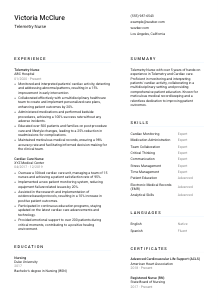
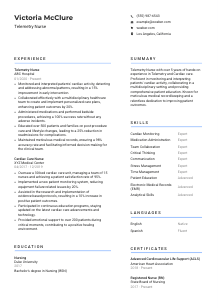
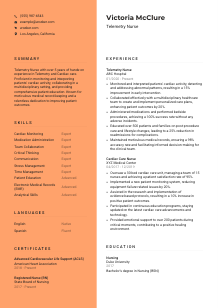
Monitoring heartbeats, but your resume feels arrhythmic? Check out this Telemetry Nurse resume example, built with Wozber free resume builder. It shows how to smoothly align your critical care skills with job requirements, setting your nursing career to a steady, strong rhythm!
Telemetry nursing is reviewed through a clinical lens from the first line of the resume. Hiring teams want to see whether you have handled monitored cardiac patients, recognized rhythm changes quickly, documented accurately, and worked calmly with physicians and the wider care team when a patient's condition shifted. If those details stay vague, even experienced RNs can look interchangeable with general med-surg candidates.
Resume tailoring changes that first read by putting your cardiac monitoring background, licensure, and bedside scope where both recruiters and an ATS can find them fast. Wozber's free resume builder helps you organize that information into an ATS-compliant resume that uses the language hospitals already use for telemetry, so your application is easier to read as true telemetry nursing experience rather than broad inpatient care.
Healthcare hiring often starts with basic eligibility. Before anyone gets to your patient outcomes or cardiac care experience, your resume needs to show that you are reachable, professionally presented, and aligned with any location or licensing expectations tied to the opening.
Use your full name exactly as you would want it to appear in hospital records, interview scheduling, and credentialing communication. Keep it prominent and easy to scan. For nursing roles, clarity matters more than design flourishes.
Place "Telemetry Nurse" directly below your name when that is the role you are pursuing. That simple line immediately positions your background around monitored cardiac care and helps separate you from broader RN profiles in ATS searches and recruiter review.
Include one reliable phone number and a professional email address you check regularly. In hospital hiring, missed calls can mean delayed interviews, unit follow-up, or credentialing requests. Make the basics effortless for the recruiter to use.
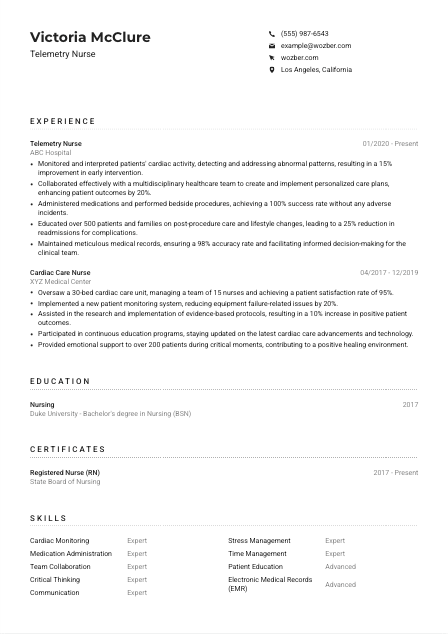
Some nursing openings include residency or local availability requirements. In the example here, listing Los Angeles, California directly supports a stated geographic preference. Use this approach when a posting clearly names a city, state, or relocation expectation.
A LinkedIn profile or professional portfolio can help if it reinforces your nursing background, certifications, leadership work, or continuing education. Keep any link current and consistent with your resume, especially around job titles, dates, and credentials.
Your personal details should answer the first practical questions fast: who you are, how to reach you, what role you want, and whether you meet obvious location expectations. That keeps the focus on your telemetry qualifications instead of avoidable admin gaps.




This is the section hiring managers read for proof that you can care for monitored cardiac patients in a fast-moving unit. Generic RN bullets do not carry much weight here. Your experience needs to show rhythm interpretation, intervention, collaboration, medication administration, patient education, and the outcomes tied to your work.
Review the job description and mark the responsibilities that define the unit's daily work. For a telemetry opening, that usually includes monitoring cardiac activity, recognizing abnormal patterns, coordinating care plans, administering medications, managing lines, and documenting progress. Use those same ideas to decide which bullets stay and which ones should be rewritten.
For every position, list your title, hospital or facility name, and employment dates in reverse chronological order. That structure lets the reader quickly place your telemetry or cardiac care background, understand your level of recency, and track the progression of your inpatient experience.
Focus each bullet on what you did in the unit and what changed because of it. Strong telemetry bullets mention monitored rhythms, escalation of abnormal findings, medication administration, bedside procedures, discharge teaching, or multidisciplinary planning. The example resume does this well by pairing core telemetry duties with measurable improvements such as earlier intervention and lower readmissions.
Quantification helps when it reflects real hospital performance. Use measures like early intervention rates, readmission reduction, documentation accuracy, patient volume, patient satisfaction, procedure safety, or unit scope. The sample's 15% improvement in early intervention and 25% reduction in complications-related readmissions are effective because they tie directly to telemetry nursing outcomes.
Keep the section centered on experience that supports the opening. If you have broader RN work, frame it through monitoring, acute care judgment, cross-functional teamwork, or patient education rather than unrelated achievements. For a telemetry application, the closer your bullets stay to monitored cardiac patients and clinical response, the stronger your positioning will be.
By the end of the experience section, a nurse manager should be able to picture you on the unit. Your bullets should show that you can interpret telemetry, act on changes in patient status, document carefully, and contribute to safer cardiac care from admission through discharge.
Education in nursing is not a decorative section. It confirms that you meet the role's baseline qualification and helps employers sort candidates who match degree requirements from those who do not. For telemetry openings, keep it clean, direct, and aligned with the posting's wording.
List the nursing degree that best matches the posting. If the role asks for a BSN or an ADN with a commitment to complete a BSN, make that clear in your education section. In the example, the BSN is an immediate match, so it earns straightforward visibility.
Include degree name, school, field of study, and graduation year. That is usually enough for an experienced telemetry nurse. Clear formatting also supports ATS parsing and keeps the section easy to review during credential checks.
Use the formal degree language from the posting where it accurately matches your background, such as "Bachelor's degree in Nursing (BSN)." This is useful for ATS alignment and reduces ambiguity, especially when hospitals screen large applicant pools.
If you are early in your career, selected coursework, honors, or clinical placements in cardiac care, acute care, or critical care can strengthen this section. For experienced nurses, those details usually matter less than recent unit experience and active certifications.
Additional coursework in cardiac care, ECG interpretation, hemodynamic monitoring, or evidence-based practice can reinforce your commitment to the specialty. Include it when it helps explain your progression into telemetry work or supports a hospital's preference for ongoing development.
Your education section should quickly confirm that you meet the nursing degree requirement and, when relevant, show progression toward more specialized cardiac care. Save the space for details that strengthen your case for telemetry work.
For telemetry nursing, certifications are a hiring checkpoint, not a bonus line. Recruiters and nurse leaders need to see your RN license and life support credentials quickly because these determine whether you can move forward in the process and work safely in a cardiac setting.
Start with the non-negotiables named in the job description. Here, that means an active RN license plus current BLS and ACLS. These should appear clearly and early in the section because they are essential for moving through screening.
Order this section by hiring importance, not by personal preference. An RN license, BLS, and ACLS should come before optional specialty credentials because they answer immediate eligibility questions for hospital hiring teams.
List the issuing body and the current or renewal dates for each credential. In clinical hiring, date visibility matters because it shows compliance and reduces back-and-forth during verification. The example handles this well by showing both issuer and active timeframe.
If you hold a telemetry, cardiac, progressive care, or medical-surgical certification, include it after the required credentials. A certification like Telemetry Certification is not mandatory for every role, but it can strengthen your case by showing focused commitment to monitored cardiac patients.
A recruiter should not have to hunt for your RN license or current life support credentials. When this section is ordered well, it removes doubt about eligibility and reinforces that you are prepared for telemetry practice now.
A telemetry nurse skills section should read like the work of the unit, not like a generic nursing checklist. Prioritize the technical and clinical abilities that support monitored cardiac patients, then add the communication and judgment skills that matter at the bedside and during handoff.
Start with the abilities the employer actually named. In this posting, analytical thinking, communication, and critical thinking are explicit requirements, and they sit naturally beside role-specific skills such as cardiac monitoring and EMR documentation. Use the posting to decide which skills deserve space.
List hard skills such as cardiac monitoring, medication administration, invasive line management, patient education, and electronic medical records alongside core nursing strengths like communication and clinical judgment. The example works because it pairs technical telemetry skills with collaboration and stress management rather than relying on one category alone.
Lead with the skills that matter most in telemetry practice and are easiest to connect back to your experience bullets. A tight, prioritized list is more credible than a long inventory. Organize it so a reader quickly sees cardiac care capability before broader transferable strengths.
Your skills should support the story told in your experience section. When the list reflects actual telemetry workflows and bedside responsibilities, it strengthens both ATS alignment and the clinical credibility of your resume.
Language ability matters in nursing because it affects patient teaching, documentation clarity, and communication with families and colleagues. For telemetry roles, English proficiency is often required outright, and additional languages can be valuable when they improve education, discharge planning, or rapport with a diverse patient population.
If the posting specifies strong English speaking and writing skills, list English with an honest proficiency level. This directly addresses a stated requirement and is especially important in roles involving detailed charting, patient education, and rapid communication during changes in condition.
Include additional languages when you can use them in clinical conversation, education, or family communication. In many hospital markets, Spanish can be especially helpful for bedside teaching and discharge instructions, but include only languages you can use confidently in real patient interactions.
Choose realistic labels such as Native, Fluent, Conversational, or Basic. In healthcare settings, overstating language ability can create risk during medication teaching, consent discussions, or urgent updates, so precision matters.
When a hospital serves a multilingual community, language skills can be a practical advantage rather than a nice extra. Use them to strengthen your application if they reflect the patient population you are likely to serve, while keeping English first when it is the stated requirement.
Additional languages can support trust, reduce misunderstandings, and improve patient education around cardiac conditions, post-procedure care, and lifestyle changes. That makes the section more than a personal detail. It becomes part of how you deliver better care.
List the languages you can truly use in a healthcare setting and be clear about proficiency. That helps employers understand how you communicate with patients, families, and the interdisciplinary team when clarity matters most.
Your summary should quickly place you in the right clinical lane. For telemetry nursing, that means stating your experience level, specialty area, and a few high-value strengths that show you can monitor cardiac patients, respond appropriately, and contribute to patient outcomes without drifting into a long career biography.
Pull the few requirements that define the role most clearly, then reflect them in your own words. For this kind of opening, that usually means telemetry or cardiac care experience, clinical judgment, communication, and patient monitoring. Keep the focus tight rather than trying to summarize every nursing skill you have.
Start with a direct statement such as your years of nursing experience and your telemetry or cardiac care specialization. The example summary does this effectively by leading with more than 5 years in telemetry and cardiac care, which immediately establishes relevance.
Use the next lines to mention the work that defines your value, such as interpreting cardiac activity, collaborating on care plans, educating patients and families, or maintaining accurate medical records. If you have a standout result, such as improved intervention timing or reduced readmissions, include one metric to sharpen the summary.
Aim for a short paragraph of about 3 to 5 lines. Avoid broad claims about passion or dedication unless they are backed by practice details. A concise summary with telemetry-specific language gives the reader a faster and more accurate picture of where you fit.
Your summary should make one thing clear right away: you are a nurse with telemetry-specific experience and the clinical range to work safely with monitored cardiac patients. If that comes through in a few clean lines, the rest of the resume lands much better.
A telemetry nurse resume works best when every section supports the same clinical message: you can monitor cardiac patients, respond to rhythm changes, coordinate care, educate patients, and document with precision. That is what separates a targeted application from a general RN resume.
Wozber's free resume builder and ATS resume scanner can help you tighten that alignment, surface missing requirements, and present your experience in an ATS-friendly resume format that hospitals can review easily. The finished resume should make your telemetry readiness clear before the interview even starts.




