




Use Wozber and land your dream job
Create Resume
No registration required
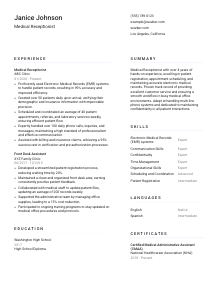
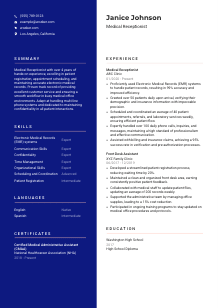
Scheduling appointments, but your resume isn't getting any calls? Check out this Medical Receptionist resume example, created with Wozber free resume builder. Learn how to present your patient care and administrative skills in line with job expectations, making sure your healthcare career stays in the waiting room, not on hold!
A Medical Receptionist sits at the point where patient service, office workflow, and record accuracy meet. Hiring teams notice quickly whether a resume reflects real front-desk experience in a clinical setting, such as handling high patient volume, keeping EMR data accurate, managing calls without slowing check-in, and protecting confidential information in everyday tasks.
Resumes for this role are often screened first for operational basics: medical office experience, EMR use, insurance knowledge, and communication strong enough for patient-facing work. Wozber's free resume builder helps you shape those details into an ATS-compliant resume that uses the language employers expect, so your background reads clearly as medical front-desk support rather than general administrative work.
Front-desk healthcare hiring starts with practical details. Your header should make it easy to confirm who you are, what role you are targeting, and whether you meet any stated logistics, without distracting from your clinical office experience.
Use your full name as the visual anchor at the top of the page. Keep it slightly larger than the rest of the text so the resume is easy to scan during fast review, especially when a hiring manager is moving through several candidates for a busy reception desk opening.
Place "Medical Receptionist" directly under your name if that is the role you are applying for. Matching the posted title helps position your background correctly, especially if your earlier titles were broader, such as Front Desk Assistant or Medical Office Assistant.
List a phone number you answer reliably and a professional email address. Accuracy matters here. If a clinic wants to move quickly after seeing experience with patient intake, scheduling, or insurance verification, a typo in your contact details can cost you the interview.
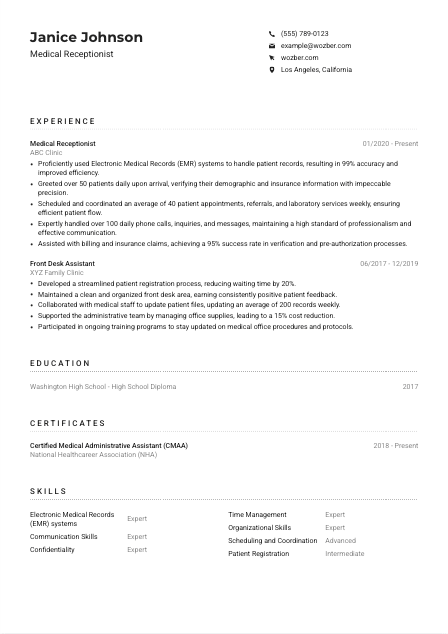
If the employer specifies a city or region, include it in your header. In the example, "Los Angeles, California" directly supports a stated location requirement. When a posting names geography this clearly, adding it removes a basic hiring question before anyone reaches your experience section.
A LinkedIn profile can help if it reinforces your medical office background, certifications, and work history. If you include it, make sure the titles, dates, and healthcare setting details match your resume so there is no confusion around your front-desk or patient-service experience.
This section should confirm the basics in seconds: your identity, your target role, and any stated logistics such as location. Keep it simple, accurate, and aligned with medical office hiring.




For a Medical Receptionist, experience is where employers look for proof that you can keep patient flow moving while staying accurate with records, insurance, and communication. Generic admin bullets do not carry much weight here. Concrete clinical front-desk work does.
Read the job description for the daily tasks behind the title. Here, the important points are patient check-in, demographic and insurance verification, appointment scheduling, referrals, lab coordination, EMR updates, call handling, and billing support. Those are the themes your bullets should echo if you have done them.
Start with your most recent role and give each entry the essentials: job title, employer, and employment dates. This lets the reader follow your path through medical office or front-desk work and quickly confirm whether you meet experience requirements such as 2+ years in a clinical setting.
Focus each bullet on what you handled and what it improved. The sample does this well with points like greeting more than 50 patients daily, coordinating 40 appointments and referrals weekly, and managing high call volume. That tells a hiring manager far more than simply saying "responsible for reception tasks."
Metrics are especially helpful in reception roles because they show pace, accuracy, and reliability. Useful measures include daily patient volume, phone volume, record accuracy, pre-authorization success rate, scheduling load, or wait-time reduction. In the example, 99% accuracy in patient records and a 95% verification and pre-authorization success rate give the work real credibility.
Prioritize bullets that show medical office operations, patient interaction, EMR use, insurance handling, and coordination with clinical staff. If you include work from outside healthcare, trim it to transferable points such as scheduling, confidential record handling, or customer service under pressure, rather than giving it equal space.
A hiring manager should come away knowing you can manage patient-facing traffic, documentation, and communication without losing accuracy. That is the standard your experience section needs to make visible.
Medical Receptionist roles often have a straightforward education requirement, but it still matters because it is an early screen. Present it clearly so the reviewer can confirm the credential and move on to the more decisive parts of your resume, such as medical office experience and EMR work.
If the posting asks for a high school diploma or equivalent, make sure that wording appears plainly in your education section. In this case, the example resume's High School Diploma directly satisfies the requirement without forcing the reader to infer it.
List the credential, school name, and graduation year in a simple format. Medical office hiring rarely needs a long education section for this role, so clean presentation is more useful than extra detail.
Use the actual credential title, such as "High School Diploma," instead of vague shorthand. That helps both ATS parsing and human review, especially when the employer has listed education as a firm requirement.
If you are newer to medical office work, coursework in medical terminology, healthcare administration, patient registration, or insurance processes can add context. Include it only when it meaningfully supports your readiness for front-desk healthcare tasks.
Honors, office-related training, or school activities can help if they reinforce organization, communication, or healthcare interest. If you already have several years of clinic experience, keep this section brief and let your work history carry more weight.
For this role, education confirms that you meet the posted baseline. Once that is clear, the rest of the resume should do the heavier lifting around patient service, scheduling, EMR accuracy, and insurance support.
Certifications are not always mandatory for a Medical Receptionist, but they can help distinguish candidates who already understand healthcare administration, patient intake, and insurance workflows. The key is relevance, not volume.
Choose credentials tied to patient administration, scheduling, records, billing, or healthcare office procedures. A certification like Certified Medical Administrative Assistant fits naturally because it supports the kind of responsibilities shown in the posting.
Lead with certifications that directly reinforce the role's daily work. For medical reception, that usually means administrative healthcare credentials rather than broad customer service or generic office certificates.
Show the award or active dates, especially for certifications that can expire or require renewal. Current dates tell employers that your knowledge of front-desk procedures and healthcare administration is still active.
If you plan to stay in medical office operations, look for certification or continuing education that deepens your understanding of EMR workflows, insurance verification, HIPAA-related handling, patient communication, or referral coordination. Those areas connect directly to what many practices need at the desk.
Relevant credentials add another layer of trust to your resume, especially when they support the operational side of the role. They work best when they clearly connect to patient intake, records, and insurance processes.
The skills section should read like the toolkit of someone who can handle a medical front desk, not a generic office assistant list. Choose skills that connect to patient intake, scheduling, records, communication, and insurance-related workflows.
Start with the role requirements and responsibilities. Here, that includes EMR proficiency, communication, medical terminology, insurance protocols, record maintenance, scheduling, and phone handling. Then keep only the skills you can support elsewhere in the resume.
Put the clearest matches near the top. For this opening, Electronic Medical Records systems, communication skills, confidentiality, scheduling, and insurance-related knowledge deserve priority because they sit at the center of the work.
Avoid padding this section with every soft skill you have ever used. A tighter list is stronger. Skills such as patient registration, multi-line phone handling, time management, and organizational skills are useful here because they map directly to front-desk medical office tasks.
When this section is tailored well, it supports the rest of the resume instead of repeating generic strengths. A clinic should immediately recognize the core tools and abilities needed to keep patient intake and scheduling running smoothly.
Language ability matters in reception roles because the front desk handles first contact, patient questions, scheduling details, and sensitive information. Show language proficiency in a way that reflects real communication needs in a healthcare setting.
If the posting asks for professional English, list English with an honest proficiency level that meets that expectation. In this case, "Native" clearly supports a requirement for professional English communication.
Order your languages based on job value, starting with the one named in the posting. That makes it easy for the reader to confirm a basic communication requirement before looking at added strengths.
Extra languages can be valuable in clinics serving diverse communities. The example's intermediate Spanish could be an advantage in some medical offices because it may support smoother patient interaction at check-in or during scheduling, even when it is not formally required.
Terms like Native, Fluent, Advanced, or Intermediate work well when they are accurate. Be honest. Front-desk communication involves names, insurance details, appointment instructions, and messages to clinical staff, so overstating your level can create problems quickly.
Language skills matter most when they improve service, reduce communication friction, or help patients feel understood during intake and follow-up. If a language has practical value in the community the practice serves, it is worth including.
For a Medical Receptionist, language skills are most useful when they support smoother check-in, clearer phone communication, and better patient experience. Present them in that practical context.
Your summary sits at the top of the resume, so it should quickly tell a clinic what kind of front-desk professional you are. Keep it grounded in medical office work, patient interaction, and the systems or workflows you handle well.
Use the posting to decide what belongs in the opening lines. For this role, experience in a medical office, EMR proficiency, insurance knowledge, communication, scheduling, and patient record accuracy all deserve consideration.
Start with a direct line that names you as a Medical Receptionist and gives your years of relevant experience. That immediately helps the reader place your background in the right category.
Include two or three specifics that show how you work. The example summary is effective because it mentions patient registration, appointment scheduling, electronic medical records, high-volume phone handling, and confidentiality. Those details sound like the actual job, not generic office support.
Aim for 3 to 5 lines. Use that space to cover your setting, strengths, and a few role-specific capabilities rather than broad claims about being hardworking or passionate. The summary should make someone expect well-organized experience bullets below.
A clear summary gives the reader an immediate sense of your medical office background and the kind of patient-facing workload you can handle. Once that is in place, the rest of the resume can add scale, accuracy, and results.
Once each section reflects the actual work of a Medical Receptionist, your resume becomes much easier to shortlist for the right reasons: medical office experience, EMR fluency, patient communication, scheduling control, and insurance support. Wozber can help you bring that together with ATS-friendly resume templates, an ATS resume scanner, and tailored wording that aligns your background with the posting.
The final check is simple. A reviewer should be able to see, quickly and clearly, that you can keep the front desk organized, patients informed, and records accurate from day one.




