




Use Wozber and land your dream job
Create Resume
No registration required
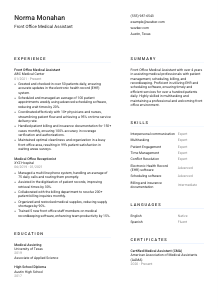
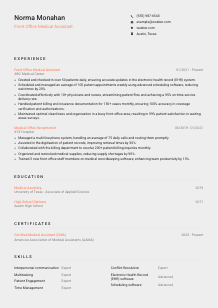
Juggling patient files but your resume feels misplaced? Check out this Front Office Medical Assistant resume example, created with Wozber free resume builder. Learn how to blend your patient charm with job requisites, positioning your medical journey right at the reception desk!
Front office medical assistant work is judged in real time. Patients notice whether check-in runs smoothly, clinicians notice whether schedules stay on track, and billing teams notice whether insurance details are captured correctly the first time. Your resume should make that pace visible by showing how you handle patient intake, phones, scheduling, documentation, and coordination without letting accuracy slip.
A tailored resume changes how quickly a hiring team can place you in the flow of the practice. When your wording reflects the posting's language around EHR use, scheduling, insurance verification, and patient communication, Wozber's free resume builder helps you shape an ATS-compliant resume that reads clearly in both screening systems and human review. The key is making it easy to see that you can keep the front desk running while supporting timely patient care.
Front office hiring starts with practical details. Medical practices need to know they can reach you easily, that you understand the role you are applying for, and, in some cases, that you already meet location expectations for the position.
Use your full name as the main heading in a clean, readable format. Keep it simple and professional so the eye lands on it immediately, especially in fast resume reviews where hiring staff may be scanning dozens of applications between patient-facing tasks.
Place "Front Office Medical Assistant" directly under your name if that is the role you are pursuing. Matching the posted title helps frame your experience around front-desk patient operations rather than more general medical assisting or receptionist work.
Include a phone number you answer reliably and a professional email address. In healthcare support roles, responsiveness matters. If a practice manager wants to move quickly, outdated contact details can cost you an interview.
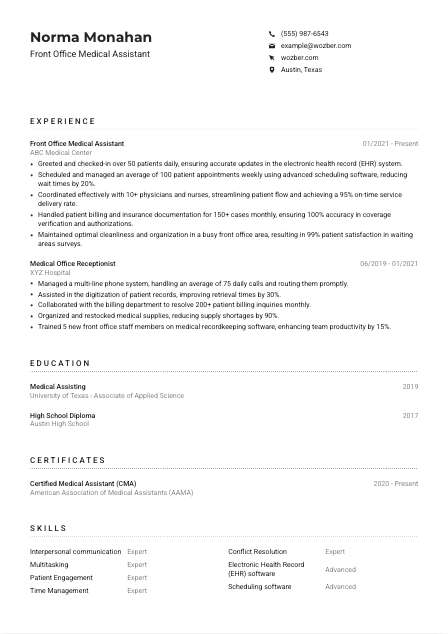
If the posting asks for a candidate based in a specific area, show your city and state in this section. Here, listing Austin, Texas directly addresses a stated requirement and removes an avoidable question about commute or relocation timing.
A LinkedIn profile or professional website can be useful when it reinforces your healthcare background, certifications, software familiarity, or patient-service experience. Only include it if the content is current and consistent with your resume.
For a front office medical assistant, these details do more than identify you. They show that you are organized, reachable, and already aligned with the practical needs of the opening.




This section does most of the hiring work for a front office medical assistant resume. Practices want to see whether you have handled patient volume, appointment flow, records, phones, and insurance tasks in an actual healthcare setting, preferably without losing speed or accuracy.
Read the job description closely and mark the operational tasks that define the role. For this type of opening, that usually means patient check-in, appointment scheduling, multi-line phones, EHR updates, insurance verification, billing support, and coordination with clinicians. Those are the experiences to bring forward first.
List each role with your job title, employer, and employment dates, starting with the most recent. This layout works well for both hiring managers and ATS parsing, and it lets your current healthcare experience lead the conversation.
Do not stop at listing tasks. Show how you performed them. Instead of writing "responsible for scheduling," write bullets that show scale, workflow, or outcome, such as managing weekly appointment volume, updating records accurately, or supporting smoother patient flow. The example resume does this well by tying check-in, scheduling, and billing work to daily and monthly activity.
Front office medical assistant work offers useful metrics. Patient check-ins per day, calls handled, appointments scheduled, billing volume, authorization accuracy, wait-time reduction, or on-time service rates all help a hiring team understand your scope. Numbers like 50 patients daily or 100 appointments weekly immediately make the experience more credible and easier to compare.
Prioritize experience that proves you can support the front office of a medical practice. Bullets about patient intake, EHR use, scheduling software, insurance documentation, and cross-team coordination belong near the top. Less relevant work should either be trimmed back or framed around transferable healthcare operations skills.
A strong experience section should leave little doubt that you can handle the rhythm of a busy medical office. When your bullets show patient volume, software use, and coordination outcomes, the resume starts to sound like daily practice rather than generic office support.
For this role, education is not filler. Employers often want proof that you completed a medical assistant program or a related credential path, especially when the role includes patient intake, records handling, scheduling, and insurance documentation.
Check whether the posting asks for a completed Medical Assistant program, a degree, or another formal healthcare credential. In this opening, completion of a Medical Assistant program matters, so that qualification should be easy to find in your education section.
Include the school, degree or program name, field of study, and graduation year. Clear formatting helps hiring teams confirm your training quickly, especially if they are screening for accredited medical assisting education before they look deeper into your experience.
If you earned an Associate of Applied Science in Medical Assisting or completed a comparable program, place that entry first. That tells the reader you have the formal preparation expected for front office medical support, not just general administrative experience.
If you are early in your career, relevant coursework can add useful context. Classes in medical terminology, insurance procedures, EHR systems, patient scheduling, or healthcare administration help connect your training to front-desk responsibilities.
Honors, healthcare volunteer work, or extracurricular activity can support this section if they reinforce patient service, medical office exposure, or professionalism. Keep these additions brief and relevant so the main credential remains the focus.
In a front office medical assistant resume, education should quickly answer one practical question: do you have the healthcare training this office expects? Put that answer near the top and keep it clear.
Certification carries weight in medical office hiring because it points to formal standards, current knowledge, and a verified training path. When a posting specifically asks for certification from an accredited institution, this section becomes a screening checkpoint.
Lead with certifications that directly support medical assistant work, such as CMA or other recognized credentials tied to accredited training. In the provided example, "Certified Medical Assistant (CMA)" clearly reinforces the stated requirement and belongs near the top of the resume.
Only include certifications that matter to the job. A short list of directly relevant healthcare credentials is stronger than a long list of unrelated courses or expired training that does not affect patient-facing front office work.
Include the year earned and, if relevant, the current validity period. Medical practices often want to confirm that credentials are active and recent enough to reflect current standards in patient documentation, office procedure, and compliance.
Healthcare offices value candidates who keep licenses and certifications current. If you are due for renewal or can add training that supports insurance workflows, EHR use, or medical administration, staying current strengthens both your resume and your candidacy.
When certification is part of the requirement, do not make an employer search for it. Present it clearly so they can confirm your professional standing in seconds.
This section should read like the operating toolkit of someone who can run a patient-facing front desk. That means balancing software proficiency with communication skills, organization, and the ability to keep multiple moving parts under control.
Pull the most relevant skill terms from the job description and use them where they accurately match your background. Here, that includes Electronic Health Record systems, scheduling software, communication, multitasking, and work in a fast-paced healthcare environment. Exact or near-exact wording helps with ATS optimization and keeps your resume aligned with how the practice describes the role.
Front office medical assistants need both technical and interpersonal range. Include hard skills such as EHR platforms, scheduling tools, billing support, insurance documentation, and phone systems, alongside soft skills like patient communication, time management, and conflict resolution. The example resume handles this balance well by pairing EHR and scheduling software with patient engagement and multitasking.
Resist the urge to list every skill you have. Keep the section tight and relevant to patient intake, appointment flow, records, insurance, and office coordination. A shorter list built around healthcare operations is easier for hiring teams to scan and more persuasive than a broad inventory.
The best skills section for this role sounds like the front desk in motion. If a practice can quickly see software ability, patient communication, and workflow control, this section is doing its job.
Communication sits at the center of front office medical assistant work. You are often the first person patients speak with, the person confirming details over the phone, and the staff member helping messages move clearly between patients, nurses, and physicians.
If the posting specifically requires English proficiency, list English prominently with an honest proficiency level. That matters in check-in conversations, appointment scheduling, billing explanations, and insurance follow-up where details need to be understood clearly the first time.
Extra language ability can be a real advantage in clinics and medical offices serving diverse communities. If you speak Spanish or another commonly used language in your area, include it when you can use it comfortably in patient-facing situations.
Terms such as "Native," "Fluent," or "Conversational" are usually enough. Keep the wording simple so hiring teams can quickly understand your level without guessing how well you can handle phone calls, front-desk questions, or basic patient guidance.
Only list languages that add value in practice. In healthcare support roles, language skills matter most when they help with patient instructions, appointment coordination, or reducing confusion during intake and billing interactions.
For this profession, language skills are not decorative. They reinforce your ability to welcome patients, handle sensitive conversations professionally, and keep communication moving across a busy front office. That is where they become a hiring advantage.
Language skills matter here because the role depends on clear, calm communication. List them in a way that helps an employer picture you handling patient interaction and office coordination with confidence.
Your summary should quickly place you in the day-to-day realities of the role. A hiring manager should come away knowing your level of experience, the kind of medical office work you have handled, and which front-desk strengths you bring most consistently.
Before writing the summary, identify the few requirements that define the role most clearly. For a front office medical assistant, that often means healthcare front-desk experience, patient scheduling, EHR use, insurance or billing support, and the ability to manage a fast-moving office rhythm.
Begin with your title and years of relevant experience. A line such as "Front Office Medical Assistant with 4+ years in medical office operations" immediately tells the reader that you belong in this hiring lane and understand the environment.
Use the next sentence to mention the functions most relevant to the target job, such as patient check-in, scheduling, billing support, insurance verification, and EHR proficiency. The sample summary works because it connects years of experience to daily operational tasks rather than staying vague.
Aim for a compact paragraph with real substance. Two to four sentences is usually enough. Mention one or two measurable points if they fit naturally, such as handling high patient volume or supporting timely service, and avoid broad claims that are not backed up elsewhere in the resume.
A well-written summary should quickly tell a medical office what kind of front desk support you can provide. When it reflects actual workflow, software use, and patient-facing experience, the rest of the resume lands more cleanly.
A front office medical assistant resume should make three things easy to spot: your healthcare training, your control of front-desk workflow, and your ability to keep patient information, scheduling, and communication accurate under pressure.
Use Wozber's free resume builder to organize that experience into an ATS-friendly resume template, then refine the language with its ATS resume scanner and AI resume builder tools so the wording matches the job description naturally. The finished resume should make it clear that you can walk into a busy practice and keep the front office moving.




