




Use Wozber and land your dream job
Create Resume
No registration required
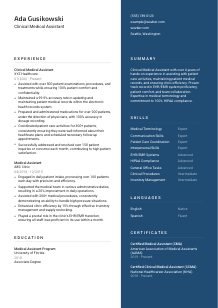
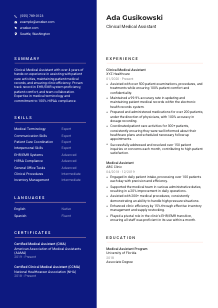
Juggling vitals and vaccines, but your resume feels under the weather? Perk up with this Clinical Medical Assistant resume example, created with Wozber free resume builder. Learn how to present your patient care and administrative acumen in line with job specifics, ensuring your career pulse stays healthy and thriving!
Clinical Medical Assistants work where patient interaction, clinical support, and documentation meet. Hiring teams look for candidates who can keep exams and treatments moving, chart accurately in the EHR, protect privacy under HIPAA, and stay steady in a busy clinic. Your resume needs to show that you can handle both the patient-facing side of care and the day-to-day operational demands that keep a practice running.
A tailored resume changes what stands out first. In this field, it helps employers quickly separate general healthcare support experience from hands-on clinical medical assisting that includes procedures, medication support, patient follow-up, and record accuracy. Wozber's free resume builder helps you shape that story in an ATS-compliant resume, so core qualifications like certification, EHR work, and patient care coordination are easy to spot.
This section is straightforward, but it still carries practical weight in healthcare hiring. Clinics need clear contact details, the right professional title, and in some cases confirmation that location or relocation will not slow down onboarding.
Place your full name at the top in a clean, readable format. In a clinical setting where hiring managers may be reviewing many applications across medical assistants, front-desk staff, and other support roles, clear identification matters.
If you are applying for a Clinical Medical Assistant position, use that title beneath your name when it matches your background. It immediately frames your experience around clinical support, patient care, and physician-directed tasks instead of a broader administrative profile.
List a current phone number and a professional email address. One typo can cost you an interview, especially in clinic hiring where scheduling often moves quickly and communication needs to be reliable.
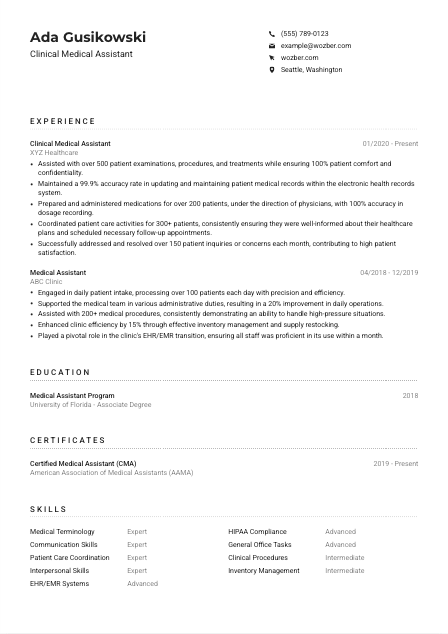
If a job specifies a city or relocation expectation, show that clearly in this section. Here, listing Seattle, Washington directly addresses the employer's stated requirement and removes uncertainty about availability for an on-site clinic role.
A LinkedIn profile or professional website is useful if it reinforces your clinical background, certifications, and work history. Keep it updated so it matches your resume, especially around titles, employment dates, and credentials such as CMA or CCMA.
Personal details should answer the practical basics without distraction. When this section is accurate and aligned with the posting, the reader can move straight to your clinical experience, certifications, and patient care background.




For Clinical Medical Assistants, the experience section carries most of the decision-making weight. This is where employers look for patient volume, clinical duties, EHR accuracy, medication support, follow-up coordination, and the pace of the environments you have handled.
Read the description closely and mark the work that appears central to the role. In this case, that includes assisting with examinations and procedures, updating medical records, administering medications under physician direction, coordinating follow-up care, and helping with clinic operations. Those themes should show up clearly in your bullets where they reflect real experience.
Start with your most recent position and work backward. In healthcare hiring, recent clinical experience usually carries the most weight because it reflects your current comfort with patient flow, charting systems, and physician support routines.
Do not stop at generic phrases like "assisted patients" or "handled records." Show scope and execution. The example resume does this well with bullets such as assisting in more than 500 patient examinations and maintaining a 99.9% accuracy rate in EHR updates. That kind of detail shows both volume and reliability.
Quantify where the numbers are meaningful for this profession. Patient counts, procedure volume, documentation accuracy, medication administration accuracy, monthly inquiry resolution, and operational improvements all help a hiring team understand your pace and consistency. Metrics like 100 patients per day or a 15% efficiency gain feel credible here because they reflect real clinic workflow.
Keep the section focused on duties and outcomes that matter for clinical medical assisting. Prioritize patient intake, exams, treatment support, chart maintenance, HIPAA-conscious communication, scheduling, inventory, and team-based care. If a bullet does not strengthen your case for this kind of clinic environment, leave it out.
Your experience section should let the employer picture you in the exam room, at the nurses' station, and inside the EHR. When the bullets show patient care, documentation accuracy, and clinic support in concrete terms, your readiness becomes much easier to judge.
Clinical Medical Assistant roles usually ask for a completed medical assistant program, so your education section needs to confirm that quickly. Keep it concise, but make sure the training behind your clinical work is easy to see.
Place your most relevant education first, especially if you completed a Medical Assistant program from an accredited institution. The example's Associate Degree in a Medical Assistant Program works because it directly answers a stated requirement in the job description.
List school, degree, field of study, and graduation year or date in a consistent format. Clear structure helps both ATS parsing and human review, especially when the employer wants to confirm training before looking deeper into certifications or experience.
Use the actual program or field name rather than a vague label. "Medical Assistant Program" tells the reader much more than a general associate degree title and links your education directly to clinical and administrative responsibilities in practice.
If you are early in your career, relevant coursework in anatomy, pharmacology, medical terminology, clinical procedures, or EHR documentation can add useful context. For more experienced candidates, your work history usually carries more weight, so keep this section lean.
Honors, strong academic projects, or externship achievements can help if they relate to patient care, clinical procedures, or healthcare operations. Use them when they add real value, not just extra lines.
This section should confirm that you meet the educational baseline without slowing the reader down. Once that foundation is clear, the focus can stay on the clinical experience and certifications that make you competitive.
Certifications carry real weight in medical assisting because they signal current professional standards and recognized training. When a posting prefers credentials such as CMA or CCMA, this section should be easy to find and easy to read.
List certifications that directly support your ability to work in a clinical setting. For this role, credentials from AAMA or NHA are especially relevant because the employer named them as preferred. The example resume includes both CMA and CCMA, which gives immediate credibility.
Prioritize certifications tied to patient care, clinical procedures, medication support, or healthcare compliance. Avoid padding this section with unrelated courses that do not strengthen your case for a clinical medical assistant opening.
Include the issue date and, when relevant, the active date range. In regulated healthcare environments, current certification status matters. It helps the employer confirm that your credentials are valid and up to date.
If you complete new training in areas like phlebotomy, EKG, infection control, or other clinic-relevant skills, add it when it reflects your real practice. Medical assisting roles vary by clinic, and added credentials can broaden your appeal when they match the work.
Well-presented certifications do more than fill a requirement. They show that your training is current, recognized, and relevant to the level of patient care and clinical support the role requires.
A Clinical Medical Assistant skills section should reflect how the job is actually done. Employers want to see clinical capability, documentation accuracy, patient communication, and the operational skills needed to keep a practice moving.
Start with the terminology the employer already uses. Here, that includes medical terminology, EHR or EMR systems, HIPAA compliance, communication, teamwork, and general office tasks. Mirroring that language helps both ATS matching and human review when the skills are real parts of your work.
Lead with the abilities most central to clinical medical assisting rather than a random list. Patient care coordination, EHR documentation, clinical procedures, medication support, and communication with patients and care teams usually deserve priority over less central skills.
Organize your skills so they read as a coherent clinical profile. The example works because it mixes core healthcare knowledge like medical terminology and HIPAA compliance with operational strengths such as inventory management and office tasks. Keep the list tight enough that every item supports the job target.
A well-built skills section should sound like the work you actually do during a clinic day. When the list reflects patient interaction, charting, compliance, and team support, it reinforces the experience section instead of repeating it.
Language ability matters in healthcare because instructions, intake questions, consent discussions, and follow-up details all depend on clear communication. Keep this section practical and tied to patient care rather than treating it as a side note.
If the posting requires fluent English, list it clearly with an accurate proficiency level. That is especially important in roles involving patient education, scheduling, chart updates, and physician-directed communication throughout the day.
Additional languages can be a genuine advantage in clinics serving diverse communities. In the example, fluent Spanish strengthens the profile because it suggests broader communication range during intake, follow-up, and patient questions, even though English is the stated requirement.
Use realistic labels such as Native, Fluent, Advanced, or Conversational. In healthcare, overstating language ability can create real communication risks, so accuracy matters.
Highlight languages that are likely to improve patient understanding, comfort, or access to care. This matters most when your role includes explaining next steps, answering concerns, or helping coordinate follow-up appointments.
When relevant, let language skills support your overall clinical profile. They can strengthen patient rapport, reduce miscommunication, and help the care team move more smoothly through intake and education workflows.
This section works best when it connects directly to patient communication and clinic operations. Clear, honest language details can add real value, especially in busy, community-facing healthcare settings.
The summary sits at the top of the resume, so it should quickly establish your level of experience and your strongest clinical selling points. For this role, that usually means patient care support, EHR confidence, clinic coordination, and reliable work with physicians and care teams.
Open with your title and years of relevant experience. A line like the example's "Clinical Medical Assistant with over 4 years of hands-on experience" works because it tells the employer right away that you are not coming from a loosely related support role.
Use the next sentence to name the responsibilities you handle well, such as assisting with patient care activities, maintaining medical records, supporting procedures, or coordinating follow-up care. Keep the focus on the parts of the job the employer needs filled.
Choose details that carry weight in this profession, such as EHR or EMR proficiency, patient comfort, HIPAA compliance, medication documentation, or team-based care. The example summary earns attention because it stays close to daily clinic realities rather than drifting into vague strengths.
Aim for 3 to 5 lines. That is enough room to establish your experience, clinical focus, and a few relevant strengths without repeating the rest of the resume. Save the fuller evidence for your experience bullets.
A focused summary helps the reader place your background before they reach the details. When it names your experience level, patient care scope, and key clinical strengths, the rest of the resume lands with more context and more credibility.
A Clinical Medical Assistant resume should make three things easy to confirm: you can support patient care, document accurately, and handle the pace of a clinic without losing sight of privacy, communication, or follow-up. If those strengths are visible across your summary, experience, skills, and certifications, you are presenting the right profile for this kind of role.
Before you submit, review the posting one more time and match your wording to the employer's terminology where it reflects your actual experience. Wozber's free resume builder and ATS optimization tools can help you refine that alignment, strengthen role-specific phrasing, and produce an ATS-friendly resume format that keeps your clinical qualifications clear from top to bottom. That gives hiring teams a cleaner read on your readiness for the work.




