



Use Wozber and land your dream job
Create Resume
No registration required
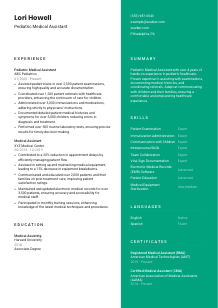
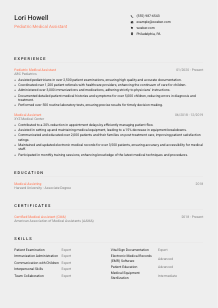
Easing little patients' fears, but your resume feels under the weather? Administer a shot of inspiration with this Pediatric Medical Assistant resume example, created with Wozber free resume builder. Learn how to showcase your nurturing nature and clinical skills to match the job description, so your career blossoms as bright as a child's smile!
Pediatric Medical Assistants work in a setting where clinical accuracy and bedside manner show up in the same moment. One appointment might mean taking vitals from a nervous toddler, documenting symptoms clearly for the pediatrician, preparing immunizations, and helping a parent understand next steps before the family leaves the room. Your resume needs to reflect that mix of hands-on medical support, calm communication, and reliable follow-through.
Hiring teams move quickly when a resume makes pediatric experience, certification status, and EMR work easy to spot. Using Wozber's free resume builder helps you shape that information into an ATS-friendly resume format that mirrors the language of the job posting, so the reader can quickly see whether you can support exams, vaccinations, documentation, and family communication in a busy pediatric practice.
In a pediatric clinic, small details matter. The same applies to the top of your resume. Your contact information should immediately show who you are, what role you do, and whether you are practical to hire for the opening.
Place your full name at the top, then use the target title directly beneath it. If you are applying for a pediatric-focused role, "Pediatric Medical Assistant" is the clearest choice. This immediately connects your background to the work of supporting pediatricians, handling child-focused patient care, and assisting families through visits.
Add a phone number you answer regularly and a professional email address. A simple format such as firstname.lastname@email.com works well. In healthcare hiring, missed calls for interviews or credential follow-up can slow an application down, so accuracy matters as much here as it does in charting.
If the posting names a location requirement, include your city and state. For this example, listing "Philadelphia, PA" directly addresses the employer's request and removes uncertainty about relocation. If you are applying elsewhere, use the same approach only when location is relevant to the role.
A LinkedIn profile is useful when it matches your resume and reinforces your work history, certifications, and healthcare setting experience. For Pediatric Medical Assistants, it can help confirm consistency across job titles, dates, and training rather than serving as a portfolio piece.
Most Pediatric Medical Assistants do not need a personal website. Add one only if it strengthens your application, such as a professional profile, community health work, or pediatric patient education content. If it does not add relevant healthcare context, leave it off and keep the section focused.
Keep your personal details straightforward, professional, and aligned with the opening. The header should make it easy to contact you and easy to place you in the pediatric clinical environment the employer is hiring for.




This section carries the most weight for a Pediatric Medical Assistant. Clinics want to see that you have handled real patient volume, supported providers during exams and procedures, documented accurately, and worked well with children and caregivers under the pace of daily practice.
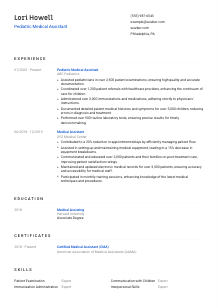
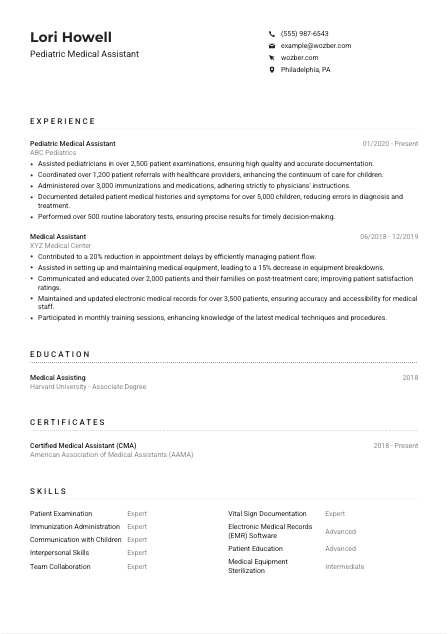
Pull the core duties from the job description and reflect them in your bullets where they match your background. For this role, that includes assisting with examinations, administering immunizations or medications, recording histories and vital signs, running routine lab work, sterilizing equipment, and coordinating referrals. The sample resume does this well by tying prior work directly to pediatric exams, immunizations, documentation, and referral coordination.
List positions in reverse chronological order and include your title, employer, and dates for each role. That format helps the reader quickly confirm whether you meet the request for at least 1 year of pediatric Medical Assistant experience. If part of your background is in general practice or another setting, keep it, but make the pediatric work stand out first.
Do not stop at describing tasks. Show what your work supported. "Coordinated over 1,200 patient referrals" is stronger than "Responsible for referrals" because it reflects pace and continuity of care. In pediatric settings, outcomes often show up through smoother visits, fewer documentation errors, timely follow-up, vaccination support, or better family communication.
Numbers help hiring managers understand how much hands-on experience you have had. Use metrics that are natural to medical assisting, such as number of patient exams supported, immunizations administered, charts updated, lab tests performed, or referral volumes managed. The example resume uses this effectively with figures like 2,500 patient examinations and 3,000 immunizations, which quickly communicate high-volume pediatric practice exposure.
Choose bullets that sound like the job you want next. Pediatric employers look for experience with children, family communication, documentation discipline, and support during routine procedures. Even if a previous role was broader, emphasize the parts that translate directly, such as patient education, EMR updates, medication administration, or maintaining sterile equipment in a clinical setting.
Your experience should show more than familiarity with a clinic. It should make clear that you can step into a pediatric workflow, support the provider efficiently, document accurately, and help families move through care with confidence.
Medical assistant education is a baseline requirement in many pediatric openings, so this section needs to be clear and credible. Employers want to confirm that your training prepared you for clinical procedures, documentation standards, and patient care responsibilities in an outpatient setting.
List the education that supports your eligibility for the role first. An accredited Medical Assistant training program is especially important here because the posting calls for it directly. If your degree or diploma is in Medical Assisting, state that plainly so the connection is immediate.
Include the institution, degree or diploma, field of study, and graduation year. Recruiters and practice managers do not need extra design here. They need to find the credential quickly and move on to your clinical experience and certification status.
If your program name is not obviously tied to Medical Assisting, use the field of study to make that visible. For example, the sample resume lists an associate degree in Medical Assisting, which helps the reader connect the education directly to the employer's training requirement.
You do not need to list classes if your clinical background already carries the application. Still, relevant coursework can help earlier-career candidates, especially subjects such as pediatric care, pharmacology, anatomy, clinical procedures, or immunization protocols. Include it only if it adds real context.
Volunteer work, pediatric clinic exposure, or health-focused student involvement can support this section when you are light on experience. Keep it relevant to patient care, clinical learning, or child health. General campus activities are less useful unless they clearly connect to healthcare service.
Your education should quickly answer one question: were you trained for the clinical and administrative demands of medical assisting? When that answer is clear, the reader can focus on how you've applied that training in pediatric practice.
Certification is often a hard filter for Medical Assistant roles, especially in patient-facing pediatric practices where compliance, medication handling, and clinical standards matter. This section should make your credentials easy to find and easy to trust.
When a posting asks for a CMA or RMA, list those credentials at the top of the section. That mirrors the employer's screening criteria and reduces the chance that a required certification gets overlooked. In the provided example, both CMA and RMA appear clearly, which is especially helpful when the employer accepts either credential.
Only include certifications that matter to the job. For a Pediatric Medical Assistant, core medical assisting credentials carry far more weight than unrelated courses. If you hold additional healthcare certifications that support pediatric outpatient work, such as BLS, include them after the main credential requirements.
Add the year earned and, if relevant, indicate that the credential is current. That is useful in healthcare because expired certifications can become an immediate hiring barrier. The example's "2018 - Present" style makes current standing easy to understand at a glance.
If you are completing continuing education or maintaining renewal requirements, include recent updates when they strengthen your application. Pediatric offices value assistants who stay current with clinical procedures, safety expectations, and documentation standards, especially when the role includes immunizations, medications, or routine lab work.
By the time someone finishes this section, your certification status should be unmistakable. For healthcare hiring, that kind of clarity can move your resume forward faster than extra wording elsewhere.
Pediatric Medical Assistant roles call for a practical mix of clinical ability and child- and family-facing communication. Your skills section should reflect the actual workflow of the job, not a generic healthcare keyword list.
Start with the capabilities the employer names. Here, that includes EMR proficiency, strong interpersonal communication, documenting histories and vital signs, assisting with exams, medication or immunization support, routine lab work, and equipment sterilization. Those are the terms most likely to matter in screening and ATS optimization because they describe the day-to-day work.
Pediatric care depends on both. A resume should show that you can handle technical tasks such as immunization administration and EMR charting while also communicating calmly with children and explaining next steps to parents or guardians. The sample skills list does this well by pairing hands-on clinical tasks with communication and interpersonal strengths.
Place the most role-critical skills first, especially those tied to direct patient care and documentation. For this profession, that usually means pediatric exam support, vital signs, immunizations, EMR systems, patient education, and sterile technique before broader items like teamwork. The list should read like a snapshot of how you function in a pediatric clinic.
Your skills section should confirm that you can keep up with the clinical flow of a pediatric office while helping children and families feel informed and supported throughout the visit.
Language ability can matter more in pediatric care than candidates sometimes realize. Medical Assistants often help explain instructions, calm anxious children, and reinforce what parents need to do after the visit, so communication skills have direct clinical value.
If the posting specifies English competence, place English at the top of this section with an accurate proficiency level. That gives the employer an immediate answer on a stated requirement and supports roles that depend on precise charting and clear patient interaction.
Additional languages can be an advantage in pediatric practices that serve diverse families. In the example, Spanish adds practical value because it can support parent communication and care instructions. Include extra languages when you can genuinely use them in conversation, intake, or patient education.
Stick to plain descriptions such as Native, Fluent, Intermediate, or Basic. Healthcare teams need realistic expectations about how well you can communicate with patients and caregivers, especially when discussing symptoms, medications, or follow-up instructions.
When a clinic serves multilingual families, relevant language ability can strengthen your application. That does not mean every Pediatric Medical Assistant needs multiple languages, but it is worth highlighting when it improves patient access and family understanding in your target market.
Only claim a level you can support in a real clinical conversation. Overstating fluency can become a patient-care problem very quickly. Accurate language listing shows professionalism and protects trust in a healthcare setting.
Used well, language skills show that you can support clearer communication with children and caregivers. In pediatric care, that can improve comfort, understanding, and follow-through after the visit.
The summary needs to establish your clinical identity fast. For a Pediatric Medical Assistant, that means a few lines that connect your experience, core responsibilities, and patient-facing strengths without drifting into generic healthcare language.
Start with your role and years of experience so the reader immediately knows your professional lane. A line such as "Pediatric Medical Assistant with 4+ years of experience" sets context quickly and works well for both recruiters and ATS parsing.
Mention two or three responsibilities that match the posting closely, such as assisting with examinations, documenting histories and vital signs, administering immunizations, or coordinating referrals. This gives your summary clinical substance and keeps it tied to the actual work of a pediatric office.
A short metric or clear accomplishment can strengthen the section immediately. The sample summary references hands-on pediatric experience, and you can sharpen yours further with a figure tied to exams, vaccinations, chart volume, or referral coordination if that reflects your background accurately.
End with a brief line about how you work with children and caregivers. Pediatric employers value Medical Assistants who can lower anxiety, communicate clearly, and support a positive visit experience alongside the clinical tasks. Keep the tone direct and professional rather than overly personal.
A well-built summary should let a pediatric practice understand, within seconds, that you have the clinical background, certification base, and family-facing communication style the role depends on.
Your resume should now present the parts of pediatric medical assisting that matter most in hiring: pediatric setting experience, accredited training, current certification, EMR familiarity, accurate clinical support, and clear communication with children and families.
Use Wozber to turn that experience into an ATS-compliant resume with language that matches the role, whether you are refining bullets, checking terminology with the ATS resume scanner, or building the final version in an ATS-friendly resume template. The result should make it easy for a pediatric employer to see that you can step into the clinic and contribute from day one.