



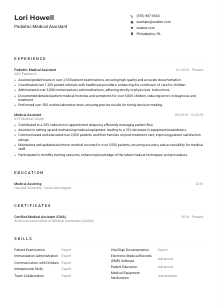
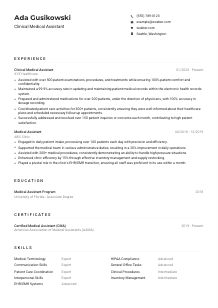
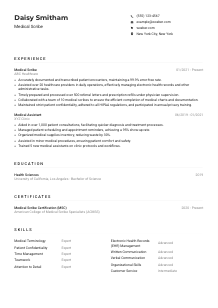
Use Wozber and land your dream job
Create Resume
No registration required
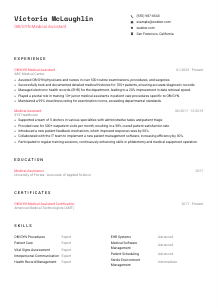
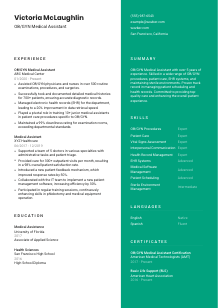
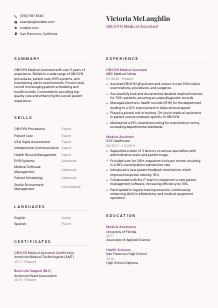
Delivering care, but your resume is in labor? Prep it for a check-up with this OB/GYN Medical Assistant resume example, created with Wozber free resume builder. Learn how to match your clinical know-how to the job details, and nurse your profile back to professional wellness with some targeted TLC!
OB/GYN medical assistants work in a setting where patient comfort, accurate intake, sterile technique, and calm coordination all happen at once. Hiring teams look for candidates who can move confidently between clinical support and front-end patient flow, whether that means documenting histories correctly, assisting during exams, or keeping follow-up care from slipping through the cracks. Your resume needs to show that you understand this pace and can support women's health care with consistency and professionalism.
A tailored resume helps separate general medical assistant experience from OB/GYN-ready experience, especially when an ATS is screening for specialty terms such as EHR use, specimen handling, vital signs, and exam assistance. Wozber's free resume builder helps you align your wording with the posting while keeping the document in an ATS-friendly resume format, so the hiring team can quickly see your clinical relevance, software fluency, and patient care range.
For an OB/GYN Medical Assistant, the top of the resume should feel orderly and dependable. This section is simple, but it still carries practical screening value, especially when the employer has clear expectations around title alignment, communication, and location.
Use your full name in a clean, readable format so it is easy to find during a quick review. In healthcare hiring, clarity matters more than styling. Keep the presentation polished and professional, the same way you would want patient documentation to appear.
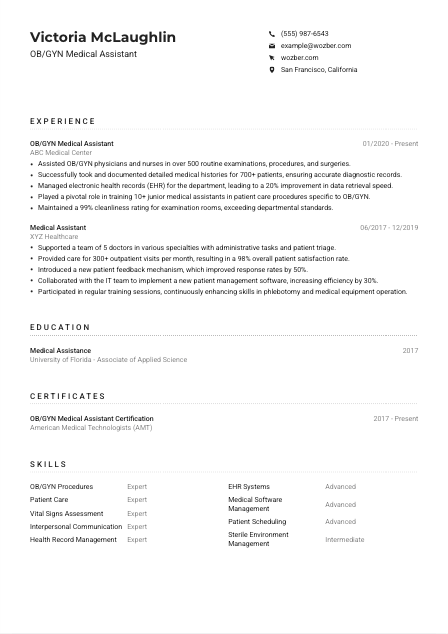
Place "OB/GYN Medical Assistant" under your name if that reflects the role you are pursuing and your actual background. This immediately frames your experience in the right specialty. In the example resume, that title removes any guesswork and keeps the application closely aligned with the posting.
Include a reliable phone number and a professional email address. Double-check every character. In a clinical office that depends on timely scheduling and clear communication, a missed callback because of a typo is an avoidable problem.
If the employer asks for a local candidate or someone willing to relocate, say so plainly in this section when it applies. Here, San Francisco is a posting-specific requirement, so listing "San Francisco, California" can remove an early screening question. If you are relocating, state that honestly rather than leaving the employer to assume.
Include LinkedIn or a professional profile only if it supports your application with matching titles, certifications, or healthcare experience. Keep it current. If the profile shows unrelated content or outdated roles, leave it off instead of creating inconsistency.
Your personal details should confirm that you are reachable, professionally presented, and ready for the role's basic logistics. That allows the rest of the resume to stay focused on patient care, clinical support, and specialty experience.




Experience carries the most weight in this kind of hire because the employer needs someone who can step into patient care routines quickly. Your bullets should show how you supported providers, handled documentation, maintained room readiness, and kept clinical operations moving safely and efficiently.
Read the job description closely and mark the repeated duties and tools. For this role, that includes assisting with exams and procedures, taking medical histories and vital signs, handling specimens, supporting pre- and post-operative care, managing EHR records, and maintaining sterile rooms. Those themes should appear clearly in your experience section when they match your background.
List each position in reverse chronological order with job title, employer, dates, and concise accomplishment bullets. For medical assistant work, hiring teams want to see setting and specialty quickly, such as OB/GYN department, outpatient clinic, hospital unit, or multispecialty practice. That context helps them judge how transferable your experience is.
Start bullets with specific action verbs and tie them to work that matters in an OB/GYN setting. Good bullets show exam support, patient intake accuracy, room preparation, documentation quality, care coordination, or physician support during procedures. The sample resume does this well by naming routine examinations, surgeries, patient histories, and training of junior assistants rather than relying on vague claims about being hardworking.
Numbers make clinical workload and contribution easier to understand. Use counts, percentages, or time-saving results where they are truthful and relevant, such as patient volume, number of procedures assisted, satisfaction scores, turnaround improvements, or record retrieval speed. For example, managing EHR workflows that improved data retrieval by 20% says far more than simply "used EHR systems."
Keep the focus on patient care, women's health support, clinical documentation, scheduling, laboratory assistance, and sanitation standards. If you have broader medical assistant experience outside OB/GYN, keep the bullets that transfer well, such as triage, outpatient volume, software adoption, or patient communication. Leave out unrelated achievements that do not strengthen your case for this specialty.
After reading your experience section, the employer should be able to picture you taking intake, preparing rooms, assisting providers, and keeping records accurate in a busy OB/GYN workflow. That is the level of relevance this section should create.
Education will not outweigh hands-on experience for most OB/GYN medical assistant roles, but it still sets the baseline for your training and field preparation. Present it clearly, with enough detail to support your certification path and healthcare foundation.
List the education that best supports your work as a medical assistant, especially programs in medical assisting, allied health, or health sciences. Even when the posting emphasizes certification and experience more than degree requirements, a relevant associate credential helps show formal preparation for clinical and administrative duties.
Include school name, degree, field of study, and graduation year. That is usually enough. In the example resume, "Associate of Applied Science" in Medical Assistance gives the employer a quick, useful read on training without adding unnecessary detail.
If your degree, diploma, or training program connects directly to medical assisting or women's health care, keep that wording visible. Education does not need to do the work of the certifications section, but it should reinforce that your background was built for clinical practice rather than general office support.
If you are early in your career, changing specialties, or have limited direct OB/GYN experience, relevant coursework can help. Topics such as anatomy, patient care procedures, medical terminology, infection control, or phlebotomy can add useful context. If you already have several years of strong specialty experience, extra coursework is usually less important.
Honors, projects, or extracurriculars belong here only if they relate to healthcare delivery, patient care, or clinical training. A high school entry can remain if it is recent or if it includes a health sciences focus, as in the example, but it should not distract from stronger postsecondary credentials once your experience grows.
This section should confirm formal training and relevant preparation without pulling attention away from clinical experience and certification. Keep it concise and clearly tied to medical assisting work.
For an OB/GYN Medical Assistant, certifications often move from helpful to essential very quickly. When the posting specifically asks for an OB/GYN medical assistant certification or a related recognized credential, this section becomes one of the first places a reviewer will check.
List the certification that directly addresses the posting's requirement first. If you hold an OB/GYN Medical Assistant certification or another credential recognized for the role, use the exact name so both recruiters and ATS software can match it easily.
Focus on certifications that support patient care, safety, and specialty readiness. For this role, an OB/GYN-specific credential is central, while certifications such as BLS can reinforce your preparation for clinical environments. A short, relevant list is more effective than padding the section with unrelated courses.
Name the issuing organization and note when the credential was earned or renewed. In healthcare hiring, current status matters. The example resume does this clearly with both the OB/GYN certification and BLS, helping the employer see that the credentials are active rather than historical.
If you have renewed certifications, continuing education, or updated specialty training, include the most relevant items. Clinical procedures, safety protocols, and software workflows change over time, so ongoing learning signals that you stay current with standards of care and office practice.
A clear certifications section tells the employer that you meet the role's formal requirements and take professional standards seriously. In a specialty clinic, that clarity matters from the first scan.
The best skills sections read like a concise map of how you function in clinic. For an OB/GYN Medical Assistant, that means balancing clinical procedures, software use, patient interaction, and room readiness instead of listing broad healthcare buzzwords.
Start with the requirements the employer names directly. Here, that includes EHR proficiency, patient management software, interpersonal communication, OB/GYN patient care procedures, vital signs, exam assistance, and sterile environment maintenance. If you genuinely have those skills, use similar wording so your resume aligns naturally with the posting.
Show both the clinical and interpersonal side of the work. Hard skills may include OB/GYN procedures, specimen collection, health record management, scheduling systems, and sterile technique. Soft skills should stay role-specific, such as patient communication, empathy during sensitive visits, and coordination with physicians and nurses.
Choose the skills you can support elsewhere in the resume. The sample resume is strongest where the skills section echoes the experience section, including EHR systems, patient care, vital signs assessment, and OB/GYN procedures. That consistency helps the employer trust the list instead of reading it as a collection of keywords.
A focused skills section should make it easy to see that you can handle both the clinical demands and the patient communication side of OB/GYN care. Relevance matters more than volume here.
Language ability can matter more in healthcare than many candidates realize. In OB/GYN settings, patients often need reassurance, clear instructions, and sensitive communication during exams, follow-up care, and procedural visits, so this section can support both clinical service and patient experience.
If the posting asks for strong English proficiency, list English clearly and use an accurate proficiency label. Since charting, patient education, scheduling, and provider communication all depend on precise language, this is a practical requirement, not a formality.
Place English first when it is explicitly required, then list any additional languages that could help in patient-facing care. In many clinics, a second language can improve comfort during intake, consent discussions, and follow-up instructions. The example resume lists Spanish after English, which is a useful addition when it reflects real fluency.
Terms such as "Native," "Fluent," or "Conversational" give a clearer picture than vague claims. Be accurate. In a healthcare setting, overstating language ability can create risks in patient communication and documentation.
Even when the posting only names English, additional languages may still strengthen your application if the patient population is diverse. They are especially valuable when they support smoother intake, clearer explanations, or more comfortable interactions in sensitive care settings.
If your multilingual ability has helped with patient communication, education, or front-desk coordination, it can reinforce your fit for community-facing clinics. Keep the point grounded. Language skills matter most when they improve clarity, trust, and continuity of care.
Used well, this section shows that you can communicate clearly with both patients and care teams. In OB/GYN work, that can improve comfort, understanding, and follow-through.
Your summary should give the hiring manager a fast read on your clinical background, specialty exposure, and the kind of support you provide in an OB/GYN setting. Keep it compact, but specific enough to distinguish you from a general medical assistant candidate.
Start with a direct line that identifies you as an OB/GYN Medical Assistant or a Medical Assistant with relevant women's health experience, followed by your years in practice. This gives immediate context and helps frame the rest of the resume. The sample summary does this cleanly with "over 5 years of experience."
Use the next sentence to reference the strengths most relevant to the opening, such as exam assistance, vital signs, patient histories, EHR systems, specimen handling, scheduling, or sterile room maintenance. Choose the areas that best match your actual background instead of trying to mention every requirement.
A short summary becomes stronger when it includes measurable or operational context. That might be patient volume, procedure support, documentation accuracy, workflow improvement, or years in a specialty clinic. Keep the detail brief, but specific enough to sound practiced rather than generic.
Aim for a few sentences, not a paragraph-long biography. Avoid broad claims about passion or dedication unless they are backed by real clinical strengths. The best summaries sound like someone ready to contribute on day one in provider support, patient intake, and follow-up coordination.
When this section is working, a hiring manager can quickly tell that you understand OB/GYN clinic work and have the experience to support it. That makes the rest of the resume easier to trust.
A well-tailored OB/GYN Medical Assistant resume should show more than general healthcare support. It should make your patient intake work, procedure assistance, EHR fluency, sterile technique, and follow-up coordination easy to recognize in a few seconds.
Use Wozber's free resume builder to shape each section around the posting, strengthen ATS optimization with the right specialty language, and present everything in an ATS-compliant resume that is clean, focused, and easy to review. The final result should make one thing clear fast: you can step into an OB/GYN clinic and contribute with confidence.




