



Use Wozber and land your dream job
Create Resume
No registration required
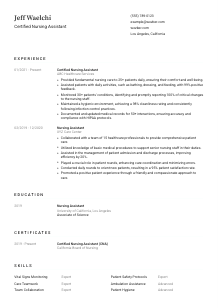
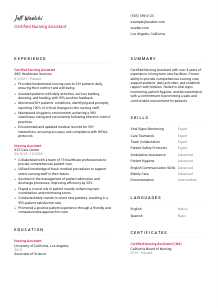
Caring bedside, but your resume feels bedridden? Check out this Certified Nursing Assistant resume example, created with the Wozber free resume builder. Learn how to spotlight your hands-on expertise so it matches job expectations, keeping your career path healthy and thriving, just like the patients you care for!
Daily CNA work is practical, physical, and closely observed. Hiring teams want to see that you can support activities of daily living, notice changes in patient condition, follow infection control procedures, and document care accurately while working under nursing supervision. Your resume should make that bedside reliability visible from the first few lines.
A tailored CNA resume also helps separate general caregiving experience from hands-on clinical support in a healthcare setting. Using Wozber's free resume builder to align your wording with the posting and create an ATS-compliant resume makes core terms like ADLs, vital signs, patient hygiene, and documentation easier to surface, so employers can quickly see where your experience matches the floor's real care needs.
In healthcare hiring, small details can affect whether your application moves forward. Your Personal Details section should confirm that you are easy to contact, professionally presented, and, when relevant to the posting, already based where the employer needs coverage.
Use your full name in a clear, readable format at the top of the page. For CNA roles, this is simple but important. A clean header supports fast review in high-volume hiring environments where nurse managers and recruiters may be scanning several resumes at once.
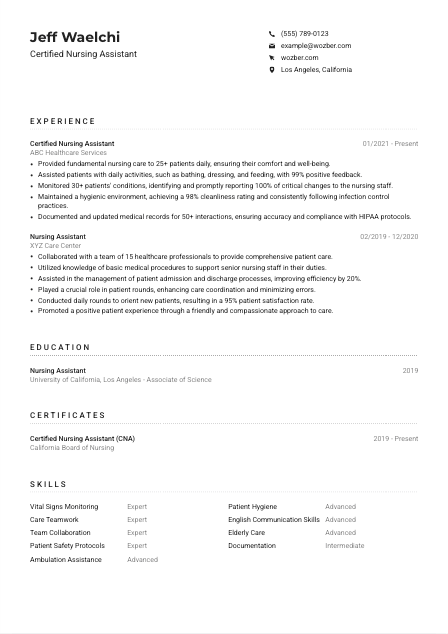
Place "Certified Nursing Assistant" directly under your name when that matches your certification and the role you are applying for. This immediately tells the reader that you are pursuing bedside support work, not a broader caregiver or medical assistant position, and it reinforces the target title for ATS matching.
List a reliable phone number and a professional email address you check often. Healthcare employers often move quickly when scheduling interviews, orientation, or shift discussions, so accuracy matters more than style here. If you include a website or LinkedIn profile, make sure the information matches your resume exactly.
Some CNA openings are tied to local staffing needs, shift availability, or state-specific hiring requirements. In the example posting, Los Angeles, California is explicitly requested, so listing that location helps remove an immediate screening question. If a job asks for local candidates, add your city and state clearly.
A LinkedIn profile can be useful if it reinforces your healthcare experience, certifications, or long-term care background. Skip extra links if they do not add anything relevant to patient care, clinical support, or your work history. Every item in this section should make it easier to contact you or confirm your professional background.
For a CNA resume, personal details should answer basic logistical questions quickly: who you are, how to reach you, and whether you meet any location-related requirement in the posting. That gives the employer a smooth handoff into your care experience and certifications.




CNA experience is judged through the work you actually handled on the floor. Employers look for signs that you can support routine care, monitor patients, communicate with nurses, and keep records accurate in environments where consistency matters every shift.
Before writing bullets, mark the recurring care tasks in the description. For this role, that includes ADL support, vital signs monitoring, ambulation assistance, patient hygiene, reporting changes in condition, infection control, and medical record documentation. Those should appear naturally in your experience if you have done them.
Lead with your most recent healthcare position and include employer name, title, and dates. This format helps hiring teams quickly understand your current level of bedside experience, whether you have worked in long-term care, and how recently you handled direct patient support responsibilities.
Each bullet should show what you did, for whom, and how well you did it. The sample resume does this effectively with lines such as providing nursing care to 25+ patients daily and assisting with bathing, dressing, and feeding while earning 99% positive feedback. That kind of wording connects routine CNA duties to patient volume and service quality.
Use metrics that fit CNA work naturally: number of patients assisted per shift, patient satisfaction results, documentation volume, cleanliness or compliance scores, or process improvements tied to admissions, discharges, or rounds. The point is not to force numbers into every line, but to show scale, consistency, and care quality where you can.
Prioritize work that supports your case for direct patient care. If you have non-healthcare experience, keep it brief unless it adds something useful such as communication, de-escalation, physical stamina, or teamwork in structured environments. Your strongest space should go to the work that proves you can function well with patients, families, and nursing staff.
A CNA experience section should read like a record of dependable patient support. When your bullets show ADLs, observation, hygiene, teamwork, and documentation with real scope or outcomes, employers can quickly picture you working safely and effectively in their care setting.
Education usually plays a supporting role on a CNA resume, but it still helps establish your training base. Keep it clear and relevant, especially if your coursework, program, or school background connects directly to patient care or nursing support.
List the education most connected to healthcare, nursing assistance, or patient care first. Even when a posting emphasizes certification more than degree requirements, relevant formal training helps show that your care skills were built on structured instruction rather than informal experience alone.
Include the school name, degree or diploma, field of study, and graduation year or completion date. Hiring teams do not need a long academic narrative here. They need a quick read on your training background and whether it supports your hands-on clinical work.
Use the correct degree or program title instead of broad healthcare wording. In the example, "Associate of Science" with a nursing assistant field clearly supports the target role. Precise wording helps avoid confusion with other clinical paths such as LVN, RN, or medical assisting training.
If you have limited work experience, include a few practical course areas such as patient care fundamentals, infection prevention, anatomy, medical terminology, or basic clinical procedures. That gives employers more context for your readiness to handle routine CNA responsibilities.
Honors, scholarships, or healthcare-related student activities can strengthen this section when they reflect discipline, reliability, or commitment to patient care. For experienced CNAs, keep these details brief so your work history and certification remain the main focus.
Your education section does not need to carry the resume, but it should clearly support your clinical foundation. A concise, relevant entry helps the reader connect your formal training to the patient care work described elsewhere in the resume.
For CNA hiring, certifications are not a side note. They are a core qualification. This section should make your active credential easy to find, easy to verify, and directly connected to the position you want.
Place your Certified Nursing Assistant certification prominently and use the exact credential name. Since the posting specifically requires CNA certification, this should never be buried. It is one of the first qualifications a recruiter or facility administrator will look for.
Focus on certifications that support direct patient care, compliance, or safety. For many CNA resumes, that may simply be the CNA credential and, if relevant, items such as CPR or Basic Life Support. Keep the section targeted rather than turning it into a general training archive.
Add the issuing organization and the dates or active status so employers can quickly confirm that your credential is current. The sample entry naming the California Board of Nursing with an active date range is a good model for state-linked clarity.
Healthcare employers notice expired credentials fast. Review this section whenever you renew a license, complete required training, or add patient-safety certifications that matter for the unit, facility type, or population you serve.
A hiring team should be able to confirm your CNA qualification in seconds. When this section is current, specific, and easy to scan, it removes doubt about your eligibility and supports the rest of your bedside care story.
The best CNA skills sections are practical. They reflect the tasks you can perform, the care environment you can work in, and the communication standards needed to support patients and nursing staff during real shifts.
Start with the concrete abilities the employer names. Here, that includes basic medical procedures, vital signs monitoring, ambulation assistance, patient hygiene, teamwork, and communication in English. These are stronger resume choices than broad phrases that could apply to almost any job.
Lead with the skills most central to CNA work, such as ADL support, patient safety protocols, infection control, vital signs, mobility assistance, and documentation. The sample resume also includes long-term care-relevant skills like elderly care and care teamwork, which help show setting-specific readiness.
Choose skills you can back up through your work history. A shorter list of accurate, role-specific capabilities is more persuasive than a long inventory of vague claims. If you add ratings, make sure they reflect your real level and are consistent with the responsibilities shown in your experience bullets.
Your skills section should reinforce the work you are ready to perform from day one. When the list mirrors actual CNA duties and care standards, it strengthens both ATS alignment and the employer's confidence in your practical capability.
Language ability matters in healthcare because misunderstanding can affect comfort, safety, and care coordination. For CNAs, clear communication with patients, families, and nursing staff is part of the job, so list languages in a way that reflects real working ability.
If the employer specifically asks for English communication, include English clearly with your proficiency level. In this case, effective English communication is a stated requirement, so it should be easy to spot on the resume.
List the language most important to the job first, then add others you can genuinely use. For many CNA roles, English comes first, followed by any additional language that may help with patient rapport or family communication in the local community.
Extra languages can be useful in long-term care, rehabilitation, or community-based settings where patients and families have varied backgrounds. In the sample, basic Spanish adds context that could be helpful in patient-facing work, even though it is not the main hiring requirement.
Use honest levels such as native, fluent, intermediate, or basic. In patient care, overstating language ability can create problems during handoffs, explanations, or family interactions, so precision matters more than impressiveness.
Do not overbuild this section if language is not a major filter for the job. For most CNA applications, it should support your patient-care profile rather than compete with your certification, experience, or clinical skills.
For a CNA, language skills matter when they improve patient understanding, comfort, and coordination with the care team. Present them clearly, rate them honestly, and keep the emphasis on how you communicate in real care settings.
Your summary should quickly establish the kind of CNA you are, the setting you have worked in, and the care tasks you handle well. A short, specific summary helps the reader understand your patient-care background before they reach the detailed bullets below.
Review the posting and identify the two or three themes that matter most. For this opening, those themes include direct patient care, support with daily living activities, communication with nursing staff, and safe, documented care in a healthcare setting.
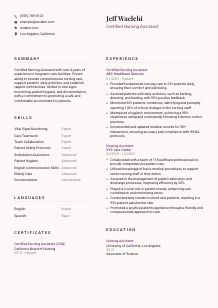
Start with a direct line that names your credential and years of experience. The sample summary uses "Certified Nursing Assistant with over 4 years of experience in long-term care facilities," which works because it establishes certification, tenure, and care setting immediately.
Mention the care skills and outcomes that best match the employer's needs, such as vital signs monitoring, patient hygiene, rapport with families, documentation, or maintaining a safe environment. Pick strengths that are also supported in your experience section so the summary feels grounded.
Aim for 3 to 5 lines. Skip generic personality statements and use the space for practical value: years of experience, care setting, core procedures, and the way you support patient well-being and nursing workflows. Every sentence should help place you in a CNA assignment quickly.
A well-written CNA summary gives the reader an immediate sense of your certification, setting, and bedside strengths. When it is concise and job-aligned, it frames the rest of the resume around the kind of patient care work you are prepared to deliver.
A Certified Nursing Assistant resume works best when every section points back to the realities of the job: helping patients with daily care, monitoring condition changes, supporting nurses, maintaining a clean and safe environment, and documenting accurately. When those responsibilities are clear in your experience, skills, certification, and summary, the hiring team can quickly understand how you would contribute on the floor.
Use Wozber's free resume builder to organize that information in an ATS-friendly resume format, refine wording around the posting, and check alignment with an ATS resume scanner. The finished resume should make one thing easy to judge: that you are ready to provide reliable, compassionate care in a clinical setting.




