




Use Wozber and land your dream job
Create Resume
No registration required
Juggling diagnoses but feeling puzzled by your resume? Check out this Nurse Practitioner resume example, created with Wozber free resume builder. Learn how to present your advanced care skills to match job requirements, ensuring your career graph is as healthy and robust as your patients' vital signs!
Nurse Practitioner resumes are read through a clinical lens long before anyone reaches the interview stage. Hiring teams want to see whether you can assess patients independently, interpret findings, manage acute and chronic conditions, prescribe within protocol, and communicate treatment plans clearly to patients and care teams. If that clinical judgment is buried under vague nursing language, the resume undersells you.
Resume tailoring changes how quickly your scope of practice comes into focus. When your wording mirrors the posting's clinical priorities and licensure requirements, an ATS-compliant resume is more likely to surface the right experience instead of blending you in with broader nursing profiles. Wozber's free resume builder helps organize that alignment cleanly, so your background reads as Nurse Practitioner work from the first scan.
In healthcare hiring, the first lines of the resume still matter because they confirm practical details fast. For a Nurse Practitioner, that means presenting your identity, role, contact information, and location in a way that supports credential review and interview scheduling without distractions.
Use your full name as the most visible text at the top of the page. Keep the formatting clean and professional so the document reads like a clinical application, not a design exercise. A simple, easy-to-read heading works best in hospital systems, clinics, and multi-provider practices where resumes are reviewed quickly.
Place "Nurse Practitioner" directly under your name if that is the role you are pursuing. This immediately frames your resume around advanced practice responsibilities rather than general nursing support. If your certification is specialty-specific, you can reflect that elsewhere, but the main title should match the opening you want.
List a current phone number and a professional email address with no formatting quirks. Recruiters and clinical coordinators often move quickly when scheduling screenings, especially for patient-facing roles. One typo in a phone number or email can delay the process more than any wording issue in the resume.
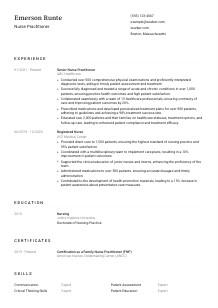
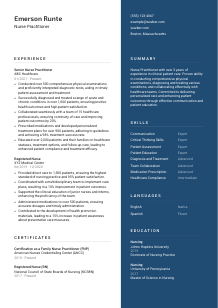
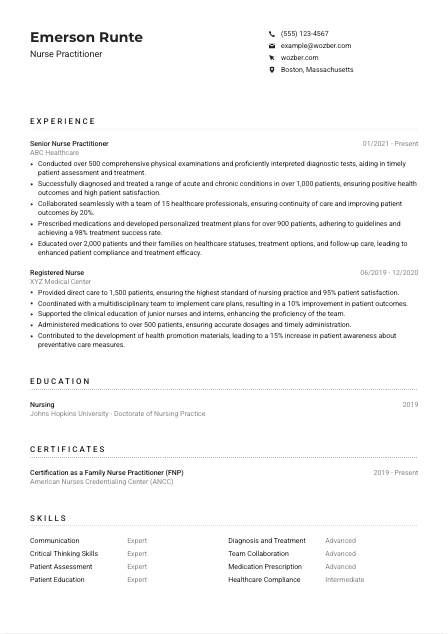
If the employer requires local presence or state-based practice eligibility, show your city and state. In the example, listing "Boston, Massachusetts" immediately supports the posting's location requirement. That kind of detail belongs here because it answers a practical screening question before anyone has to ask.
A LinkedIn profile or professional website can help if it reinforces your clinical background, leadership work, publications, or specialty focus. Keep it consistent with your resume, especially around titles, employers, education, and certifications. If it does not add meaningful information, leave it off.
Keep this section brief, accurate, and easy to scan. It should confirm that you are reachable, professionally presented, and logistically aligned with the opening.




This section carries the most weight because it shows how you practice. For Nurse Practitioners, employers look for signs of autonomous clinical work, diagnostic reasoning, treatment planning, patient volume, interdisciplinary coordination, and outcomes tied to quality of care.
Read the job description closely and pull out the core responsibilities you already perform. For this role, that includes physical exams, diagnostic interpretation, diagnosis and treatment, preventive counseling, prescribing, and patient education. Your bullets should make those activities visible in your own words so the connection is immediate.
List your positions in reverse chronological order and give the most space to advanced practice or closely related clinical roles. If you moved from RN work into an NP role, that progression is valuable, but your current scope should dominate. Focus on settings, patient populations, and responsibilities that support the opening rather than listing every nursing task you have handled.
Each bullet should combine a clinical action with a result, scale, or measurable contribution. The example does this well by pairing responsibilities with numbers, such as conducting more than 500 physical examinations and developing treatment plans for over 900 patients. That kind of detail tells the reader how often you performed the work and how much responsibility you carried.
Quantify what naturally reflects Nurse Practitioner performance. Useful measures include patient volume, treatment success, patient satisfaction, continuity of care improvements, follow-up compliance, reduced complications, or team-based outcome gains. Metrics work best when they stay tied to real clinical work, as in the sample's improvement in patient outcomes and high treatment success rate.
Keep the section centered on care delivery, clinical decision-making, and collaboration with physicians, nurses, and other providers. Awards or unrelated achievements can dilute the picture if they do not support your readiness for patient assessment, diagnosis, prescribing, or care coordination. Every bullet should strengthen your case for safe, effective advanced practice.
By the end of your experience section, a hiring team should understand your clinical scope, your patient-care results, and how you work within a broader care model. That is what moves a Nurse Practitioner resume forward.
Education is a core screening point for Nurse Practitioners because the degree level is tied directly to eligibility for practice. This section should make your nursing education easy to confirm and easy to connect to the role's stated requirements.
If the posting asks for a Master's or Doctorate in Nursing, list that credential clearly and use the full degree name. Matching the language matters when employers are screening for minimum qualifications. In the example, both the Doctorate of Nursing Practice and Master of Science in Nursing make the candidate's academic preparation obvious.
Use a simple format that includes degree, field, school, and graduation year. Healthcare recruiters and credentialing teams are often checking this section for compliance first, not reading it for storytelling. Make the facts easy to locate and consistent with your licensing and certification timeline.
Do not assume the degree title alone says enough. Include "Nursing" as the field of study when appropriate so there is no ambiguity during review or ATS parsing. Clear labeling helps distinguish advanced nursing education from adjacent healthcare degrees.
If you are a newer Nurse Practitioner, you can include specialty clinical rotations, capstone work, or honors that strengthen your candidacy. Keep these details tied to real practice areas such as family medicine, primary care, chronic disease management, or patient education. Once you have established NP experience, those academic details become less important than clinical results.
Academic awards, student leadership, and nursing associations can be helpful when they reinforce your development in the profession. Include them only if they support your current clinical profile or show early leadership in patient care. For experienced candidates, this section should stay focused on degree credentials first.
This section should confirm that you meet the educational standard for advanced practice nursing without forcing the reader to search for it. Clear degree information helps the rest of your resume carry more weight.
For Nurse Practitioners, certifications are not a side note. They are part of what makes you employable in the first place, especially when employers need to confirm national certification and active licensure before moving a candidate into credentialing.
Start with the certifications and licenses that directly support Nurse Practitioner practice. This posting specifically asks for NP certification through a national body such as ANCC or AANP, along with current RN and NP licenses. Make those items easy to find and name them exactly.
If you hold several credentials, list the ones most relevant to your target practice area first. Family, adult-gerontology, pediatric, psychiatric, or other specialty certifications should be arranged based on the job you are pursuing. The goal is to show active, relevant qualification rather than a long inventory.
Dates matter because employers need to know whether your credential is current. The example handles this well with entries such as "2019 - Present," which quickly communicates active standing. If a certification is expired or in renewal, do not leave that unclear.
Nurse Practitioner hiring often intersects with compliance, privileging, and payer enrollment, so outdated information can slow down the process. Review this section regularly and update renewals, added certifications, and license changes as they happen. Ongoing education also strengthens your profile when it relates to the population or setting you serve.
A recruiter or clinical employer should be able to confirm, at a glance, that you are credentialed to practice and aligned with the role's specialty needs. That clarity matters in healthcare hiring.
A Nurse Practitioner skills section should reinforce the work you already proved in experience. The best entries point to clinical judgment, patient management, communication, and team-based care rather than reading like a generic soft-skills list.
Start with the capabilities the employer actually named. Here, that includes interpersonal communication, critical thinking, and English proficiency, along with clinical responsibilities such as assessment, diagnosis, treatment planning, and patient education. If the skill appears in the posting and you use it in practice, it belongs in your shortlist.
Nurse Practitioner hiring usually depends on both sides of the role. You need clinical skills such as patient assessment, diagnostic interpretation, chronic disease management, prescribing, and preventive care, but also communication skills that support counseling, care coordination, and family education. The sample's mix of patient assessment, diagnosis and treatment, communication, and team collaboration is a solid model.
Choose the skills you can support elsewhere in the resume through bullets, certifications, or summary language. A shorter list of relevant competencies is stronger than a long list of broad traits. If you use proficiency ratings, make sure they are realistic and consistent with your actual scope of practice.
When someone scans your skills, they should immediately recognize the profile of a practicing Nurse Practitioner, not a general healthcare applicant. Relevance matters more than volume.
Language ability can affect patient education, trust, and care continuity, especially in diverse communities. For Nurse Practitioners, the key is to present language proficiency in a way that supports patient-facing communication without overstating your level.
If the job calls for effective English skills, list English first and label your proficiency clearly. This answers a direct hiring requirement and supports the communication demands of patient interviews, counseling, charting, and interdisciplinary coordination.
Additional languages can strengthen your profile when they help you serve a broader patient population. In many outpatient, community, and urban care settings, multilingual ability can improve patient understanding and follow-up compliance. Include them when they are genuine working strengths, not minor classroom exposure.
Mark each language accurately with levels such as Native, Fluent, Intermediate, or Basic. Overstating proficiency can create problems in patient-facing roles where clear communication is critical. Precise labeling is more useful than optimistic labeling.
If your background includes work with multilingual communities, this section can reinforce that experience. A language like Spanish, as shown in the example, may be especially relevant in settings where patient education and trust depend on direct communication. Keep the emphasis on care impact, not personal interest.
Language development can become a real clinical asset over time, particularly in primary care and community health environments. If you are actively improving a language that supports your patient population, reflect that honestly as your level changes. Treated carefully, this section can add practical depth to your patient-care profile.
Your language section should show that you can communicate safely and effectively with the patients you serve, and that any additional language ability adds real value in care settings.
The summary is your opening clinical snapshot. It should quickly establish your level of experience, the kind of care you provide, and the strengths that matter most for the specific Nurse Practitioner opening.
Start with the experience and scope that matter most for the opening. If the employer needs someone who performs exams, interprets diagnostics, treats acute and chronic conditions, and educates patients, your summary should reflect that practice directly. The sample's focus on clinical patient care and broad treatment responsibility is a useful reference point.
Open with your title and years of relevant experience, such as "Nurse Practitioner with 3+ years of clinical patient care experience." This places your level immediately and helps distinguish you from candidates whose background is primarily RN-based. Keep the wording direct and factual.
Choose the competencies that most clearly match the role. For many NP openings, that means patient assessment, diagnosis and treatment, collaborative care, prescribing, preventive counseling, or patient education. If you mention outcomes, make them specific, such as improved patient results or strong treatment adherence.
Aim for a short paragraph of 3 to 5 lines. Skip broad statements about passion or dedication unless they are tied to the work you actually do. The best summaries read like a concise handoff from one clinical professional to another.
After reading these opening lines, the employer should already understand your practice level, your patient-care strengths, and why your background fits the opening. That is the standard to aim for.
A well-tailored Nurse Practitioner resume makes your practice scope, credentials, and patient-care outcomes easy to follow from top to bottom. When your education, certification, experience, and skills all point to the same clinical story, employers can quickly see where you fit and what level of responsibility you can carry.
Wozber's AI resume builder can help you sharpen that story, align your language with the posting, and present it in an ATS-friendly resume format that supports ATS optimization without flattening the human side of your work. The result should make one thing clear fast: you are ready to step into the role and care for patients with confidence and clinical judgment.