



Use Wozber and land your dream job
Create Resume
No registration required
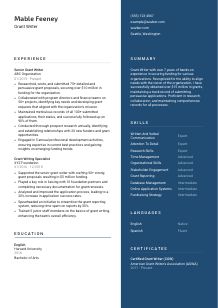
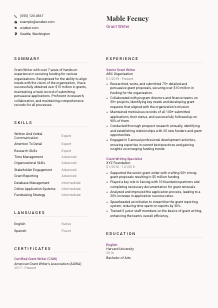
Securing funds, but your resume feels penniless? Check out this Grant Writer resume example, created with Wozber free resume builder. Learn how to clearly present your fundraising flair in ways that match funding criteria, paving your way to opportunities as rich as the grants you chase!
Grant writing is measured by more than polished prose. Hiring teams look for someone who can translate program needs into fundable requests, manage tight submission calendars, coordinate with finance and program staff, and keep reporting and application records accurate across multiple deadlines. A Grant Writer resume should reflect that operating reality, not just a general strength in writing.
A tailored resume changes how quickly your funding track record and workflow become visible. When your wording matches the language of grant proposals, prospect research, online submission systems, and cross-functional collaboration, an ATS-compliant resume is far more likely to surface the right experience early. Wozber's free resume builder helps you align those terms cleanly so hiring teams can immediately see your ability to secure funding and manage the full grant cycle.
This section is simple, but it still carries practical weight. For Grant Writer roles, hiring teams need fast access to your contact details and, when listed in the posting, confirmation that you meet location expectations without having to search for it.
Use your full name in a clear, readable format at the top of the page. Keep it slightly more prominent than the rest of the header so it anchors the document immediately and presents you as a professional candidate, not as a creative layout experiment.
Place "Grant Writer" directly under your name if that is the position you are pursuing. This helps align your resume with the posting from the first line and keeps your professional identity clear, especially when your background includes nearby titles such as Development Associate, Fundraising Coordinator, or Grant Writing Specialist.
List a phone number and professional email address that you check regularly. Accuracy matters here. A missed digit or outdated inbox can cost you an interview, especially in hiring processes that move quickly around submission deadlines and funding cycles.
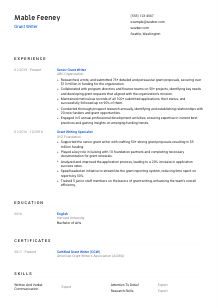
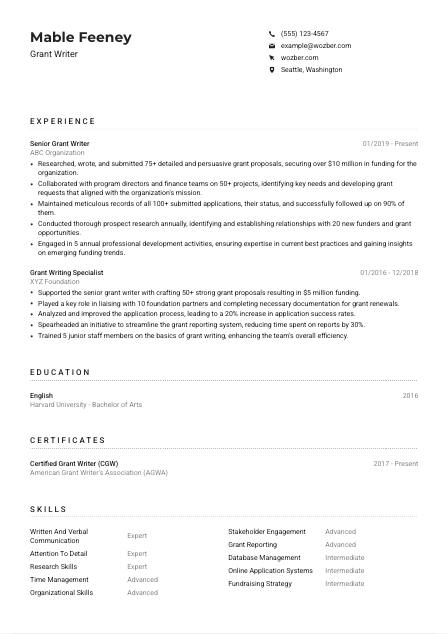
If the employer asks for a local candidate, state your city and state clearly. In this example, "Seattle, Washington" directly addresses a stated requirement and removes uncertainty early. When location is not a requirement, city and state are usually enough without a full street address.
A LinkedIn profile or professional website can support your application if it reflects your nonprofit, fundraising, or grant-related work accurately. Make sure the content is current and consistent with your resume, especially around titles, dates, and major funding results.
Keep this section clean, accurate, and aligned with the posting. It should confirm who you are, how to reach you, and whether you meet practical requirements before the reader moves on to your grant experience.




For a Grant Writer, experience is where hiring teams look for proof of outcomes. They want to see proposal volume, funding secured, collaboration with program and finance partners, prospect research, reporting discipline, and the systems you used to keep applications moving.
Before you edit your bullets, identify the work themes the employer repeats. Here, the priorities are clear: researching prospects, writing and submitting persuasive proposals, coordinating with program directors and finance teams, tracking application status, and staying current on grant practices. Those themes should shape which accomplishments you lead with and how you describe them.
List your most recent position first, then work backward. For grant writing, this makes it easier to see the scale of your current funding work, the complexity of your portfolio, and whether your responsibilities have expanded from support work into ownership of proposals, funder strategy, and grant management.
Each bullet should show what you did and what changed because of it. Focus on actions that matter in this field: wrote proposals, identified funding prospects, coordinated budget narratives, managed submissions, improved reporting processes, or supported renewals. The example resume does this well by showing both proposal execution and cross-functional collaboration instead of relying on vague claims about being a strong writer.
Numbers give real weight to grant writing work. Funding totals, proposal counts, success rates, renewal volume, new funders identified, or reporting time reduced all help a hiring team understand your scope. "Secured over $10 million" and "submitted 75+ proposals" are strong examples because they connect writing activity to money raised and operational output.
Prioritize experience that supports fundraising, stewardship, research, reporting, or stakeholder coordination. If you include adjacent work, make the connection explicit. For example, project management experience belongs here only if it improved submission timelines, strengthened compliance, or supported program data used in proposals.
Your experience section should leave no doubt that you can manage the full grant process, not just write well. Show the scale of your portfolio, the funding results, and the internal coordination required to get proposals submitted accurately and on time.
Education is usually a straightforward section for Grant Writers, but it still helps establish alignment. Degrees in English, Communications, nonprofit-related fields, or similar disciplines support the writing, research, and analytical demands of proposal development.
If the employer names a required or preferred degree, mirror that information clearly when it applies to you. In this case, a bachelor's degree in English, Communications, or a related field is requested, so candidates should make that qualification easy to find.
List your degree, field of study, school, and graduation year in a clean order. Hiring teams do not need extra decoration here. They need to confirm your academic background quickly and move back to the funding and proposal work that carries the most weight.
If your degree directly matches the posting, let that match stand on its own. "Bachelor of Arts in English" works well in the example because it connects naturally to persuasive writing, editing, and communication, all of which are central to grant development.
Early-career candidates can include coursework, capstone projects, or academic writing that relates to nonprofit communication, research, public policy, or persuasive writing. If you already have several years of grant experience, keep this section lean unless an academic detail adds something useful.
Honors, scholarships, or academic distinctions can be worth listing when they reinforce strong writing, research, or subject-matter discipline. Keep them brief and relevant so the section stays supportive rather than distracting.
This section should confirm that your academic background supports the research and writing demands of grant work. If your degree matches the posting directly, make sure that connection is immediate and easy to scan.
Certifications are not required in every Grant Writer search, but they can strengthen your profile when they reflect current practice in fundraising, grant development, compliance, or nonprofit communication. They also support the common employer expectation that grant professionals stay current on funding trends and evolving requirements.
List certifications that connect directly to proposal writing, grant strategy, nonprofit fundraising, or related compliance knowledge. A credential such as "Certified Grant Writer" is relevant because it reinforces specialization in the exact work the employer needs.
A short list of well-chosen credentials is more useful than a long list of unrelated courses. Focus on certifications that strengthen your case for managing proposals, researching funders, handling reporting obligations, or working effectively in nonprofit development settings.
Dates help employers see whether a certification is active or recently completed. In fields shaped by changing funder priorities, submission systems, and reporting expectations, current professional development carries more weight than an old credential with no context.
Ongoing learning matters in grant writing because funding landscapes shift. If you attend workshops, complete continuing education, or hold active certifications, include the most relevant items to show that you keep up with best practices, funder trends, and evolving application requirements.
Use this section to reinforce specialized knowledge and continued growth in grant development. Keep it tightly focused on credentials that support stronger proposals, cleaner grant management, and current nonprofit funding practice.
The skills section should sound like the actual work of a Grant Writer. That means persuasive writing, prospect research, deadline management, collaboration with program and finance teams, recordkeeping, and familiarity with databases or online application platforms, not a generic list of soft skills.
Start with the exact capabilities the employer names. Here, written and verbal communication, attention to detail, grant research databases, online application systems, organization, and time management are all explicit priorities. Mirroring that language helps your resume line up with both human review and ATS screening.
Choose skills that reflect how grants actually get won and managed. Useful examples include prospect research, proposal development, grant reporting, stakeholder engagement, database management, budget collaboration, and deadline tracking. The sample resume handles this well by mixing communication strengths with operational skills such as grant reporting and online application systems.
Do not overload this section with every skill you have used across your career. Prioritize the ones that support proposal quality, submission accuracy, funder research, and collaboration across development, program, and finance teams. A tighter list makes your strengths easier to trust and easier to scan.
Your skills should read like the toolkit of someone who can research, write, coordinate, submit, and track grants effectively. Keep the focus on capabilities that directly support funding outcomes and dependable grant operations.
Language ability is not central in every Grant Writer search, but it can add value when an organization serves multilingual communities, works with diverse stakeholders, or engages funders across regions. If you include languages, make the connection practical rather than decorative.
Review the posting for any language requirement or clue about the population served. Many Grant Writer roles will not mention this directly, but community-based organizations, international nonprofits, and regional service providers may value it more heavily.
If a target employer serves a specific community, list that language prominently. Even when no language is required, an additional language such as Spanish can strengthen your profile if it supports stakeholder communication, community understanding, or work with bilingual materials.
Language skills should complement your core qualifications, not replace them. They can suggest broader communication range and stronger connection to the communities or partners an organization serves, especially in mission-driven environments.
Use honest levels such as Native, Fluent, Conversational, or Basic. Grant writing often involves precise communication, and overstating proficiency can become a problem if the role includes partner communication, community outreach, or document review in that language.
A local foundation, a national nonprofit, and an international NGO may value language skills differently. Use your judgment based on the employer's programs, funder base, and stakeholder network so this section supports the application instead of filling space.
Include languages when they add meaningful context to your work with communities, partners, or funders. If they are relevant, present them clearly and honestly so they strengthen your profile without distracting from your grant record.
Your summary should quickly establish your level of grant-writing experience, the scale of funding you have supported, and the kind of coordination work you handle. For this profession, a useful summary blends writing credibility with funding outcomes and grant-process discipline.
Read the role closely before you draft this paragraph. If the employer emphasizes proposal development, prospect research, collaboration with finance and program teams, and application tracking, those themes should shape the summary instead of a generic statement about being passionate or results-driven.
Start with a clear line that tells the reader who you are and how long you have worked in grant writing or related fundraising roles. The example summary begins effectively with experience level, which immediately gives context for the achievements that follow.
Include a funding total, proposal volume, success rate improvement, or another metric that reflects your scope. "Secured over $15 million in grants" works because it captures business impact quickly and ties the summary to measurable results rather than broad claims.
Aim for a short paragraph that covers experience, outcomes, and core strengths such as proposal writing, prospect research, grant reporting, or cross-functional collaboration. Every sentence should earn its place by clarifying the kind of grant portfolio you can manage.
By the end of this section, the reader should understand your grant-writing level, your funding impact, and the workflow you can handle. Keep it tight, measurable, and closely aligned with the role you want next.
A Grant Writer resume works best when it shows the complete picture: prospect research, proposal writing, collaboration with program and finance teams, submission management, recordkeeping, and measurable funding results. If those elements are easy to find, hiring teams can quickly understand both your writing strength and your operational reliability.
Use Wozber to sharpen that alignment with an ATS-friendly resume format, targeted phrasing, and practical ATS optimization. Done well, your resume should make it easy to judge how effectively you can secure funding, manage deadlines, and support the organization's mission from first draft to final submission.