



Use Wozber and land your dream job
Create Resume
No registration required
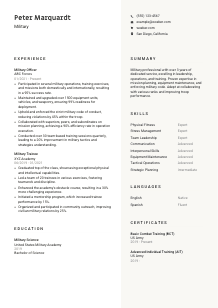
Defending nations but feeling besieged by your resume? Take command with this Military resume example, built with Wozber free resume builder. Learn how to present your defense skills to match civilian job criteria, marching your career forward with precision and honor.
Military hiring turns quickly on proof of discipline, readiness, and dependable performance under pressure. A resume for this field needs to show more than service history. It should make clear how you contribute in training, mission execution, equipment accountability, team coordination, and adherence to standards when conditions are demanding.
When the document is tailored well, the first read becomes much sharper. Wozber's free resume builder helps you shape an ATS-compliant resume around the language used in the posting, so terms tied to operations, physical readiness, training, and communication are easy to find in both ATS screening and human review. That makes it easier to see whether your background matches the pace, structure, and responsibility of the assignment.
This section does a practical job in military hiring. It confirms who you are, how to reach you, and whether you meet any immediate logistical requirements before a reviewer gets into service history, training, or deployment readiness.
Place your full name at the top in a clean, readable format. Keep it slightly more prominent than the rest of the text so it anchors the page without looking decorative or overstyled.
Add the job title directly under your name when it accurately reflects the position you are pursuing. Using "Military" here aligns your resume with the posting language and helps frame the rest of your background around operations, training, and service requirements.
Include a working phone number and a professional email address. In a field where communication accuracy matters, even a small typo in your contact details creates the wrong impression, so review this section with the same care you would give to a report or equipment check.
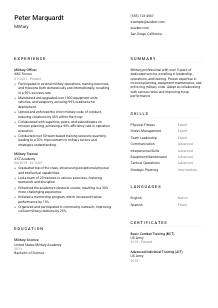
If the posting requires you to be in a certain area or willing to relocate, reflect that clearly in your personal details. Here, San Diego, California is a stated requirement, so listing that location or making relocation intent visible removes an avoidable screening issue at the start.
A LinkedIn profile or personal site can be useful when it adds relevant context, such as leadership history, training, awards, or service-related accomplishments. Include it only if the information is current and consistent with the resume you are submitting.
A well-handled personal details section shows accuracy, professionalism, and attention to stated requirements. That gives the reviewer a clean starting point before they assess your field experience, training record, and readiness for service.




For military resumes, experience needs to do more than list assignments. It should show what you handled, how you performed under structure and pressure, and what outcomes followed from your work in operations, training, maintenance, leadership, or mission support.
Review the responsibilities and requirements before writing bullets. For a military opening, that often means mission participation, equipment readiness, code-of-conduct compliance, team communication, and ongoing tactical training. Build your experience section around those points so the relevance is obvious from the first few lines.
Start with your most recent role and work backward. For each entry, include your title, organization or unit name as appropriate, and dates of service so the progression of responsibility is easy to follow.
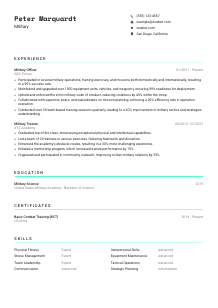
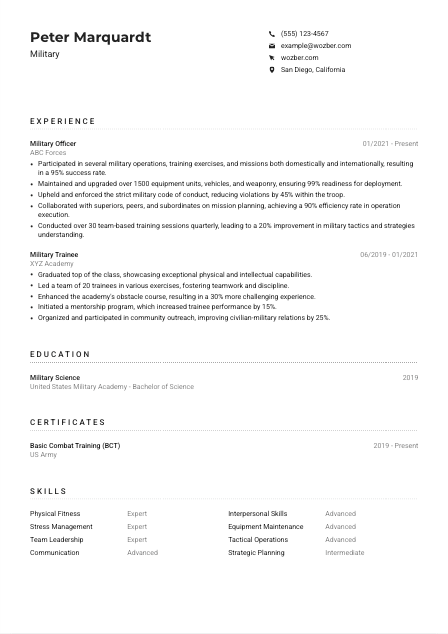
Use accomplishment bullets that show what you actually did in the role. Good military bullets cover mission execution, readiness, leadership, maintenance, training delivery, or procedure enforcement. The example resume does this well by tying responsibilities to outcomes such as equipment readiness, mission execution efficiency, and troop performance improvements.
Metrics strengthen this section when they reflect real performance. Success rates, readiness percentages, number of equipment units maintained, training volume, team size, or reductions in violations all help a reviewer understand scope and reliability. For example, stating that you maintained more than 1,500 units at 99% readiness gives far more operational context than saying you handled maintenance duties.
Prioritize experience that shows field readiness, disciplined execution, and effective coordination across ranks. If you include earlier training or transitional roles, connect them to transferable value such as leadership, physical performance, instruction, or mission preparation rather than listing generic duties.
Your experience section should quickly answer the practical questions behind military hiring: Can you operate effectively, maintain standards, support mission readiness, and work well with others in demanding conditions? If those points are visible in your bullets, this section is doing its job.
Formal education is only one part of military preparation, but it still helps define your background. Degrees, academy training, and related coursework can support your resume by showing technical grounding, leadership development, and long-term commitment to the field.
List your strongest completed academic credential first. This role does not require a specific degree, but a qualification such as a Bachelor of Science in Military Science adds immediate relevance and shows structured preparation for service responsibilities.
Keep each entry simple and easy to scan: degree, field of study, institution, and graduation year. Hiring teams reviewing military candidates are usually moving quickly through service history and training records, so clarity matters more than extra formatting.
If your field of study connects directly to operations, leadership, defense, logistics, engineering, or military science, make that connection clear. Relevant education helps explain the knowledge base behind your tactical judgment, planning ability, or understanding of command structures.
Coursework, academy programs, or MOS-related learning can strengthen this section when it supports the role you are targeting. Use education to complement your experience, especially if the training helps explain readiness for field operations, technical maintenance, or mission planning.
If you graduated with honors, held leadership positions, or completed demanding training programs, include those details when they reinforce your profile. Achievements such as top class standing or cadet leadership are useful because they point to discipline, performance, and peer accountability.
Education should support the rest of the resume, not compete with it. Used well, this section shows the training, study, and leadership development that back up your performance in military settings.
Certifications matter in military hiring when they verify completed training or role-specific qualification. They can quickly confirm that you have cleared the foundational programs or specialty instruction needed for the work.
When a job description calls out specific training, list those items clearly and early. In this case, Basic Combat Training and Advanced Individual Training are direct matches, so they should be visible without making the reviewer search for them.
Lead with certifications tied to field readiness, safety, weapons, vehicles, technical systems, or your Military Occupational Specialty. Remove or de-emphasize credentials that do not strengthen your case for the assignment you are pursuing.
Add the issuing organization and completion date or active date range for each certification. That helps show when your training was completed and whether it remains current enough to support present-day responsibilities.
Military work changes with new systems, tactics, and requirements, so this section should be updated as your qualifications expand. Ongoing certification activity can also reinforce that you stay prepared for changing operational demands.
A focused certificates section confirms required training fast. When the listed credentials match the posting and reflect current readiness, they strengthen your case before the reviewer even reaches the finer details of your experience.
The skills section should read like a concise picture of how you function in military environments. Focus on abilities that matter in training, deployment preparation, team execution, communication, and equipment accountability rather than broad strengths that could belong to any job.
Read the posting for both stated and implied capabilities. Here, physical fitness, communication, teamwork, stress tolerance, equipment maintenance, and tactical training all stand out. Those are the kinds of skills that belong on the resume because they connect directly to daily military work.
Choose skills you can back up elsewhere in the resume through accomplishments, training, or certifications. If you list team leadership, the experience section should show where you led people. If you list equipment maintenance, your bullets should show what systems or volume you handled and with what readiness results.
A shorter list of military-specific skills is usually stronger than a long inventory of generic traits. The example resume keeps the emphasis where it should be, with areas such as physical fitness, stress management, tactical operations, communication, and equipment maintenance. That gives a hiring team a quick operational snapshot.
This section works best when it echoes the responsibilities already proven in your experience and training. A focused skill list helps the reviewer connect your capabilities to mission support, readiness, and disciplined execution.
Military work depends on precise communication. Language ability matters most when it affects command understanding, coordination, training, reporting, or work in multinational and community-facing environments.
If the posting requires fluent English, list English clearly and show your proficiency level. That is a direct screening item here, so it should be easy to find.
Include additional languages when they could support operational communication, community engagement, training environments, or international assignments. Do not add a language unless you can use it at the level you claim.
Use terms such as Native, Fluent, Intermediate, or Basic so your level is immediately understood. Clear labels are more useful than vague descriptions, especially in roles where communication errors can affect execution.
Extra language capability can be an asset in joint operations, overseas work, or civilian-military coordination. For instance, Spanish may be worth listing when it supports communication in relevant communities or operational contexts, but it should remain secondary to required English fluency.
Treat languages like any other operational capability. List only those you can actually use in conversation, instruction, or field communication, and be honest about your level so expectations are accurate from the start.
Language skills strengthen a military resume when they are relevant, clearly rated, and believable. The main point is simple: make required fluency obvious, then add any extra capability that broadens where and how you can contribute.
The summary sits at the top of the resume, so it should immediately tell the reader what kind of military professional you are. Keep it grounded in service length, operational strengths, leadership scope, and the areas where you consistently deliver results.
Before writing, pull out the central requirements and responsibilities from the job description. For this role, that includes prior service or relevant experience, physical readiness, communication, work in high-stress environments, training completion, and mission participation. Those points should shape the language of your summary.
Start with a direct line that states your military background and years of experience. A phrase such as "Military professional with over 3 years of dedicated service" works because it immediately frames your level and field.
Choose the capabilities most relevant to the target role, such as mission planning, equipment readiness, leadership, training delivery, or code-of-conduct enforcement. The sample summary is effective because it groups operations, training, and troop performance into one compact profile rather than trying to mention everything.
Aim for a short paragraph that can be read in seconds. Avoid broad claims like "hardworking" or "team player" unless the resume proves them through military context. The summary should sound like a concise briefing, not a generic introduction.
A strong summary helps the reviewer place your background before they scan the details below. When it clearly states your service history, operational strengths, and readiness for demanding assignments, the rest of the resume lands with more force.
A military resume should leave little guesswork. It needs to show service history, training completion, physical and operational readiness, communication skills, and the kind of disciplined execution that matters in missions, maintenance, and team coordination.
Use Wozber's free resume builder to tighten wording, improve ATS optimization, and present your experience in an ATS-friendly resume format that reflects the language of the posting. When each section is aligned to the assignment, your resume gives a clear view of how you will perform in the field and within the chain of command.