



Use Wozber and land your dream job
Create Resume
No registration required
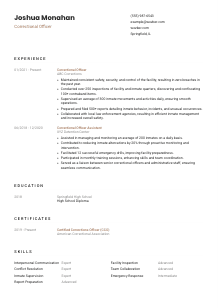
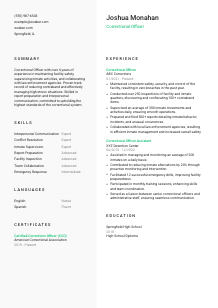
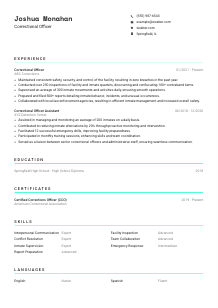
Maintaining order behind bars, but your resume feels confined? Break free with this Correctional Officer resume example, created with Wozber free resume builder. Learn how to present your enforcement expertise in a way that matches job requirements, building a career that's as secure as the facilities you monitor.
Correctional work is measured in control, judgment, and consistency. Hiring teams look for officers who can keep order during routine movement, stay steady in tense situations, document incidents accurately, and work within facility procedures without losing command of the environment. Your resume should make that operational reliability visible from the first few lines.
A targeted resume changes how quickly your background reads as correctional experience rather than general security work. Using Wozber's free resume builder to shape an ATS-compliant resume helps you match the posting's language around inspections, inmate supervision, incident reporting, and conflict handling, so the hiring team can immediately see your readiness for daily facility control.
In corrections, small details carry weight. A clean Personal Details section shows professionalism, reliability, and attention to procedure before the reader reaches your experience. Keep it simple, complete, and aligned with the posting.
Place your full name at the top in the largest text on the resume. In a field built on authority and accountability, your header should feel direct and professional, not stylized or crowded.
List "Correctional Officer" directly under your name when that matches the role you are pursuing. This removes ambiguity right away and helps position your background within detention, inmate supervision, facility security, and incident response rather than broader public safety work.
Include one phone number and one professional email address, then double-check both for accuracy. Hiring can move quickly for facility roles, especially when staffing needs are urgent, so any typo in your contact information can cost you an interview.
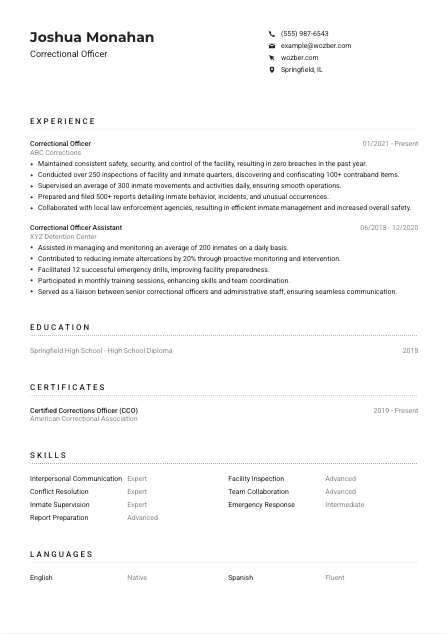
If the posting requires Springfield, IL residency or relocation, reflect that in your city and state line when applicable. The sample resume does this well by listing Springfield, IL upfront, which removes a practical concern before the employer has to ask.
Include a LinkedIn profile or professional site only if it supports your application with consistent job history, certifications, or public service background. For correctional hiring, a link should reinforce credibility, not distract from your experience in security, reporting, or law enforcement environments.
This section does not need personality statements or extra filler. It should confirm who you are, how to reach you, and whether you meet practical requirements such as location without slowing down the rest of the review.




The experience section does the heaviest lifting on a Correctional Officer resume. Hiring teams want to see proof that you can maintain security, monitor inmate activity, respond to incidents, complete reports, and work with other staff under pressure. Duty lists alone are not enough. Show what you handled, how often, and what results followed.
Start by pulling the main responsibilities from the posting and mapping them to your own history. For this kind of role, that usually means facility safety, inspections, inmate movement, behavior monitoring, report writing, emergency response, and coordination with colleagues or outside agencies. When your bullets mirror those functions using truthful language from your work, the fit is easier to recognize.
List your most recent position first, then work backward. Include job title, facility or employer name, and dates. That straightforward structure works well for both human review and ATS parsing, and it helps show progression from support roles into full correctional responsibility if your career has followed that path.
Most correctional officers supervise movement, inspect units, and write reports. What stands out is the scale and result of that work. The sample resume improves ordinary duties by adding outcomes such as zero security breaches, 250+ inspections, and 500+ reports filed. Those details show workload, consistency, and command of procedure.
Quantify the parts of the job that naturally carry volume or operational value. That can include inmate counts, inspections completed, contraband recovered, incidents resolved, emergency drills supported, reports filed, shifts covered, or reductions in altercations. Numbers help the reader understand the pace and responsibility level of your work, not just the title you held.
Prioritize bullets that reflect custody, order, observation, de-escalation, documentation, and teamwork inside a controlled environment. If you have other experience in security or public-facing roles, include it only when it strengthens your case for handling stress, enforcing rules, or communicating effectively in high-accountability settings.
The best experience sections make it easy to picture you on shift. If your bullets show how you maintained order, documented incidents, reduced risk, and supported safe operations, your resume will read like correctional experience rather than generic supervision.
For many Correctional Officer roles, education is straightforward, but it still matters. This section confirms that you meet the baseline requirement and can also support your case if you have training related to criminal justice, public safety, or institutional operations.
If the posting asks for a high school diploma or equivalent, make sure that appears clearly and exactly. In this case, listing your diploma plainly satisfies the requirement without forcing the employer to search for it.
Use a simple entry with school name, degree or diploma, and graduation year or completion date. Correctional hiring often involves fast review of practical qualifications, so clarity matters more than extra description here.
If you completed coursework in criminal justice, sociology, psychology, emergency management, or law enforcement foundations, include it when it supports your candidacy. Those subjects can reinforce your preparation for inmate interaction, report writing, and procedural environments, though they are not required for every opening.
Workshops or formal instruction in crisis intervention, defensive tactics, first aid, CPR, report writing, or emergency preparedness can belong here if they are not listed elsewhere. Use them selectively to strengthen your operational profile.
Academic awards, leadership roles, or attendance achievements can help early-career candidates with limited experience, especially when they suggest discipline, reliability, or responsibility. If you already have several years in corrections, keep the focus on work performance and certifications instead.
Education does not need to be long for this role. It needs to be accurate, visible, and supportive of the practical demands of correctional work.
Certifications carry real weight in corrections because they point to formal preparation, current standards, and role-specific training. When a posting asks for an American Correctional Association credential or a state equivalent, this section becomes a direct qualification check.
If you hold the exact certification requested, list it clearly with the issuer. The sample resume does this effectively with the Certified Corrections Officer credential from the American Correctional Association, which speaks directly to the requirement in the posting.
Prioritize credentials that relate to inmate management, detention procedures, emergency response, use of force policies, crisis intervention, or institutional security. General certificates should come after those most connected to daily correctional operations.
Many credentials need renewal or ongoing standing. Include dates in a clear format so the employer can see that your training is current. A simple date range such as "2019 - Present" works well when the certification remains active.
Correctional facilities value officers who stay current on standards, procedures, and risk management. If you have newer certifications or recurring training, include them to show that your professional development has continued alongside your field experience.
Relevant credentials back up your experience with formal preparation. When they are current and closely tied to correctional duties, they strengthen your case quickly.
A Correctional Officer skills section should read like the toolkit of someone who can manage people, procedures, and pressure inside a secure facility. Keep the list focused on abilities that support safety, order, communication, and documentation.
Start with the competencies the employer names directly. Here, that includes interpersonal communication, handling stressful situations, and diffusing conflicts. Add other skills only if they are clearly supported by your experience in inmate supervision, inspection routines, report writing, or coordinated response.
Put communication, conflict resolution, inmate supervision, facility inspection, report preparation, emergency response, and team collaboration near the top when they reflect your actual work. The sample resume uses this approach well, with skills that connect closely to movement control, incident management, and safe operations.
Avoid long blocks of vague soft skills. A shorter, sharper list helps the reader see the capabilities that matter on shift, in housing units, and during incidents. Choose skills you can back up through accomplishments, training, or certification rather than listing every trait that sounds positive.
The most effective skill list supports the rest of the resume. If your experience shows inspections, reports, de-escalation, and inmate oversight, those same strengths should appear here in concise, job-aligned language.
Communication matters in corrections because instructions, reports, and incident response all depend on clarity. Your language section should confirm that you can handle required communication tasks and, when relevant, show added value in a diverse inmate population or multiagency environment.
If the posting states that English language tasks must be handled efficiently, list English clearly with an honest proficiency level. This is especially important in roles that rely on written reports, verbal directives, and accurate incident documentation.
A second language can be useful when working with varied inmate populations, visitors, or community partners. For example, Spanish in the sample resume adds practical communication value, though it should remain secondary to the required English proficiency unless the posting says otherwise.
List the most important language first, then follow with others in descending order of proficiency or operational usefulness. This helps the reader absorb the information quickly.
Terms like "Native," "Fluent," "Advanced," or "Conversational" give the employer a more accurate picture than vague claims. Choose labels you can defend in an interview or on the job.
Language skills matter here because they support instructions, de-escalation, documentation, and day-to-day interaction. Present them as operational strengths, not as unrelated resume decoration.
This section works best when it confirms communication readiness. Clear English proficiency is essential, and any additional language should strengthen your ability to maintain order and communicate effectively.
Your summary should give a quick, accurate picture of your correctional background. In a few lines, show your experience level, the type of environment you have worked in, and the strengths that matter most for facility safety and inmate management.
Start with your title and years of experience, such as a Correctional Officer with 4+ years in detention or custodial settings. This immediately frames the rest of the summary and helps the employer place your background in the right lane.
Choose achievements that reflect control, safety, or operational consistency. The sample summary mentions reducing contraband and handling high-stress situations effectively, which gives the reader a fast sense of practical impact.
Include a few job-aligned strengths such as incident reporting, inmate supervision, conflict resolution, facility inspections, or collaboration with law enforcement partners. Keep the wording natural and tied to work you have actually done.
Aim for a short paragraph that can be read in seconds. Avoid generic claims about being hardworking or passionate. Use the space to show the type of officer you are, the environment you can handle, and the responsibilities you already know how to manage.
A strong summary makes the rest of the resume easier to trust. When it quickly covers your years in corrections, your security-focused strengths, and a few concrete outcomes, the hiring team knows what kind of officer they are about to read about.
A Correctional Officer resume should show more than basic eligibility. It should present a clear record of facility control, inmate supervision, inspections, incident reporting, and calm decision-making under pressure.
Use Wozber's free resume builder to organize that experience into an ATS-friendly resume template, then strengthen your ATS optimization with the ATS resume scanner so the language of your resume reflects the duties, certifications, and communication standards named in the posting.
When the resume is tailored well, hiring teams can quickly see that you are prepared to protect order, follow procedure, and contribute to safe facility operations from day one.




