



Use Wozber and land your dream job
Create Resume
No registration required
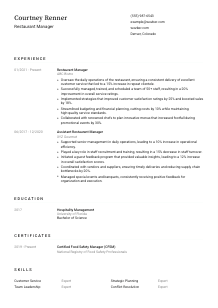
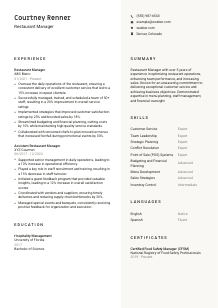
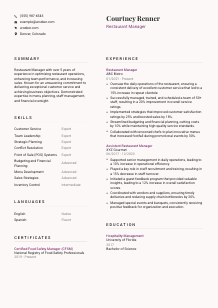
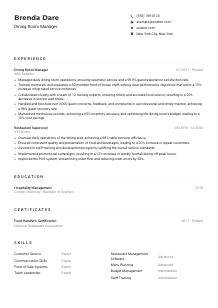
Orchestrating the dining floor, but your resume isn't getting reservations? Plate up success with this Restaurant Manager resume example, created with Wozber free resume builder. Learn how to bring together your management skills and hospitality expertise to match the job's palate, cooking up a career that delivers satisfaction with every service.
Restaurant management is operational work under pressure. You are expected to keep service standards high, staffing on track, food safety procedures followed, guest issues resolved quickly, and margins protected all in the same shift. A resume for this role needs to show that range clearly, from floor leadership and scheduling to inventory control, promotions, and P&L awareness.
When the resume is tailored well, hiring teams can quickly see whether your background matches the pace and scope of the restaurant they run. Wozber's free resume builder helps organize that experience into an ATS-friendly resume format, so key terms like staff training, customer satisfaction, budgeting, and sales growth are easy to surface. That matters when employers are sorting between candidates who have supervised service and those who have actually improved performance.
Restaurant employers move fast when they find a promising manager. Your personal details should make it easy to contact you and immediately confirm basics such as role alignment, professionalism, and in some cases location availability.
Use your full name at the top in a clear, readable format. In hospitality hiring, speed matters, and your header should be easy to scan on a phone, in print, or through an applicant tracking system.
Place "Restaurant Manager" directly under your name if that is the role you are pursuing. It removes ambiguity and helps align your resume with searches for restaurant leadership rather than broader food service or front-of-house positions.
If the employer specifies a city or relocation requirement, include your city and state in your header. Here, Denver, Colorado is relevant because it answers a practical hiring question right away. If you are relocating, make that clear in a concise way.
A LinkedIn profile can reinforce your management background, especially if it supports your resume with the same employers, dates, promotions, and operational achievements. Keep the information consistent across both.
This section should confirm who you are, what role you want, and whether you are reachable and available for the job. For a Restaurant Manager, that kind of clarity helps move you faster into the interview stack.




For Restaurant Manager roles, experience carries the most weight because it shows how you perform in live service, how you lead teams, and whether you can protect both guest experience and profitability. The strongest entries connect daily oversight with measurable business results.
Read the posting closely and map its priorities before rewriting your bullets. For this role, the main themes are daily operations, customer service, staff leadership, scheduling, safety compliance, sales growth, budgeting, inventory control, and collaboration on menus or promotions. Those should shape the language and examples you choose.
Start with your most recent restaurant leadership position and work backward. For each role, include the restaurant name, your title, and dates. If you moved from Assistant Restaurant Manager to Restaurant Manager, that progression is valuable because it shows growing scope and trust.
Do not stop at "managed staff" or "oversaw operations." Show what changed because of your work. Strong bullets describe actions such as training a 50-plus person team, improving service ratings, increasing repeat clientele, or coordinating promotions with chefs that lifted traffic during events. That is the difference between supervision and management impact.
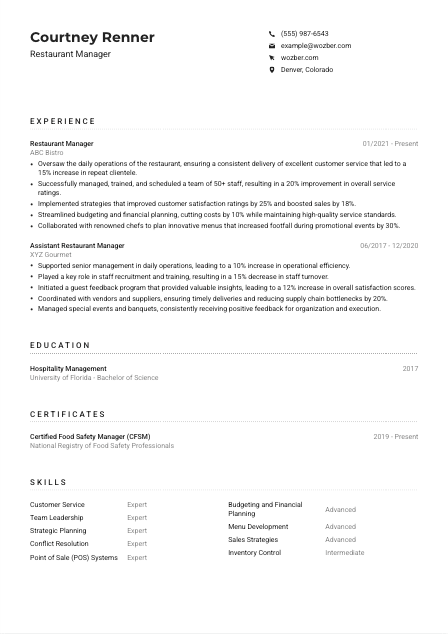
Restaurant hiring teams respond to metrics they live with every day: sales growth, labor efficiency, repeat guest rate, customer satisfaction scores, food cost reduction, turnover reduction, event traffic, or service speed. The sample resume works because it ties operations to outcomes, including an 18% sales increase, a 25% rise in satisfaction ratings, and a 10% cost reduction.
Prioritize experience that shows oversight of service, people, and financial performance. Earlier roles can stay if they support that path, but give more space to positions where you handled scheduling, staffing, vendor coordination, inventory, promotions, or P&L-related decisions. Every bullet should help the reader picture you running a restaurant, not just working in one.
Your experience section should show that you can lead a team, keep operations steady during service, and improve the numbers that matter. If a hiring manager can quickly see stronger sales, better guest experience, and tighter cost control, this section is doing its job.
Education matters most here when it reinforces your operational foundation and progression into management. It will not outweigh restaurant results, but it can strengthen your profile when the employer prefers formal training in hospitality or business-related areas.
If the role prefers a bachelor's degree in Hospitality Management or a related field, list that education clearly. A degree in Hospitality Management, Hotel Administration, Business, or a similar discipline can support your case by showing training in service operations, finance, and customer experience.
Include your degree, school, field of study, and graduation year or date. This section should be easy to scan in seconds. For example, "Bachelor of Science, Hospitality Management" aligns well with the preference in the posting and needs no extra explanation.
Write the full degree and field instead of shortening it too much. If your background closely matches the posting, that wording helps both human readers and ATS parsing connect your education to the employer's stated preference.
Most experienced Restaurant Managers do not need a long list of classes. Include coursework only when it sharpens your fit, such as hospitality operations, food and beverage management, cost control, or event planning. Keep it brief and relevant.
Honors, leadership roles, or restaurant-related projects can be worth including if you are earlier in your management career or if they strengthen your hospitality profile. Once your work history is established, keep the emphasis on operational results and team leadership.
A concise education section adds credibility when it connects directly to hospitality management. Keep it clean, relevant, and proportional to your experience level.
In restaurant management, certifications matter because they speak to risk control, sanitation standards, and operational discipline. They are especially useful when the employer mentions food safety or when the role includes direct responsibility for compliance and staff training.
If you hold a food safety or sanitation certification, make sure it is easy to find. This posting lists food safety and sanitation certification as a plus, which is common in restaurant hiring because managers are often responsible for enforcing procedures, coaching staff, and passing inspections.
Focus on credentials tied to restaurant operations, health standards, alcohol service, or leadership training. A short, relevant list is stronger than a long list of unrelated certificates.
For certifications with renewals or validity windows, show the issuer and the current date range. The sample's "Certified Food Safety Manager" entry works well because it gives both the credential name and issuing organization, which makes it easier to recognize and verify.
Restaurant operations change with regulations, staffing practices, service models, and guest expectations. Updated certifications can reinforce that you stay current on the standards that affect safety, training, and day-to-day execution.
Relevant certifications tell employers you can be trusted with compliance, staff accountability, and safe service standards. In restaurant management, that practical credibility matters.
A Restaurant Manager skills section should mirror the mix of people leadership and business control the job requires. Hiring teams look for a combination of customer-facing judgment, staff management, and operational discipline, not a generic list of soft skills.
Start with the posting and identify the capabilities behind the responsibilities. Here, that includes leadership, communication, staff motivation, customer service, scheduling, budgeting, inventory control, cost management, menu collaboration, and sales improvement. These are the skills that belong near the top.
Lead with the abilities most closely tied to running a shift and improving performance. Team leadership, conflict resolution, POS systems, budgeting, menu development, sales strategy, and inventory control are stronger choices than broad descriptors that could fit almost any manager.
Place the most important skills first so the core of your management profile is visible immediately. In the sample, customer service, team leadership, strategic planning, and budgeting create a clear picture of someone who can handle both guest experience and business performance.
Your skills should show that you can lead staff, manage service quality, and watch the numbers at the same time. If the list reads like the operating needs of a restaurant, it is on the right track.
Language ability matters in restaurants because managers spend their day communicating with guests, coaching staff, handling complaints, and coordinating with the kitchen and front-of-house team. When language is listed well, it adds practical value rather than taking up space.
If the posting requires strong English communication, reflect that directly in your language section or elsewhere on the resume. For a Restaurant Manager, English proficiency supports staff direction, guest recovery, vendor communication, and written reporting.
List other languages you can use professionally, especially if they help with guest relations or team management. In many restaurants, Spanish can be especially useful for day-to-day communication across front- and back-of-house teams.
Use honest levels such as native, fluent, intermediate, or basic. Managers are expected to communicate clearly in real time, so overstating ability can become obvious quickly in interviews or on the job.
Tailor this section when language skills are likely to matter in the specific environment. A bilingual manager may be especially valuable in restaurants with multilingual teams, tourism-heavy service, or a guest base that includes regular non-English speakers.
Language ability can improve staff training, reduce misunderstandings during service, and help resolve guest concerns more smoothly. That makes it more than a nice extra. In the right setting, it directly supports operations and service quality.
Keep this section grounded in communication needs that matter on the floor. For restaurant management, language skills are strongest when they clearly support guest service, staff coordination, and smoother daily operations.
The summary should quickly establish the level of restaurant environment you can manage and the outcomes you have delivered. It works best when it combines years of experience, operational strengths, and a few concrete business or service achievements in a tight opening paragraph.
Start with the main needs from the posting, then reflect the parts of your background that answer them. For this role, that means leadership in daily operations, team management, customer satisfaction, and profitability.
Lead with a direct identifier such as "Restaurant Manager with 5+ years of experience" if that reflects your background. This gives immediate context and helps employers place your seniority before they reach the work history.
Choose strengths tied to restaurant performance, such as optimizing operations, training staff, improving guest satisfaction, managing budgets, or supporting menu and promotion planning. The sample summary works because it stays focused on operations, team performance, sales, and service.
Aim for three to five lines with concrete language. Skip broad statements that could belong to any manager. A better summary names the scale of your experience and the type of outcomes you drive, whether that is stronger repeat business, lower costs, or better service ratings.
Your summary should make it obvious that you can run a restaurant, lead a team, and improve results. When those points come through quickly, the rest of the resume has a much stronger foundation.
A Restaurant Manager resume should show control of daily operations, leadership of staff, commitment to guest experience, and comfort with the financial side of the business. When each section points back to those fundamentals, your application reads like someone ready to take ownership of service, people, and performance.
Use Wozber's free resume builder and ATS resume scanner to align your wording with the job description, strengthen ATS optimization, and present your background in a clean ATS-compliant resume. The finished resume should make one thing easy to judge: you can run a restaurant well and improve how it performs.




