



Use Wozber and land your dream job
Create Resume
No registration required
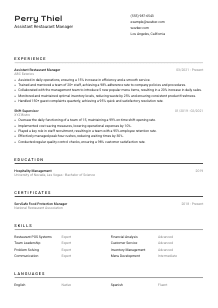
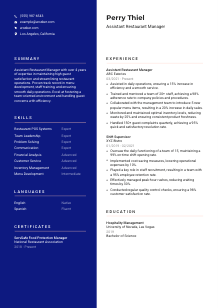
Juggling tables and tasks, but your resume didn't make the cut? Savor this Assistant Restaurant Manager resume example, created with Wozber free resume builder. Learn how to blend your managerial know-how with the job's flavor, making your career as successful as a fully-booked eatery!
Assistant Restaurant Managers work in a constant flow of service, staffing, guest issues, and cost control. Hiring teams want to see that you can keep the floor moving, coach staff in real time, protect the guest experience when things go wrong, and stay on top of inventory and sales performance without losing pace during a busy shift.
A tailored resume changes the first read from "restaurant experience" to clear management value. When your bullets use the same operational language the employer uses, from POS systems to guest satisfaction and financial analysis, Wozber's free resume builder helps you shape an ATS-compliant resume that surfaces the right terms and makes your management scope easier to recognize fast.
Restaurant hiring moves quickly, especially for floor leadership roles. Your contact section should make it easy to place you, contact you, and confirm that you meet practical requirements such as title alignment and, when requested, location.
Use your full name as the clearest visual element in the header. Keep it simple, professional, and slightly larger than the rest of the text so the hiring manager can identify you immediately when scanning a stack of restaurant management resumes.
Place "Assistant Restaurant Manager" directly under your name when that is the role you are pursuing. This removes guesswork and helps connect your background to the opening before the reader even reaches your experience section.
Your phone number and email should be current, direct, and business-appropriate. For shift-based operations roles, fast follow-up matters, so make sure the contact information you list is the one you actually monitor.
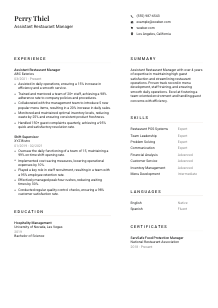
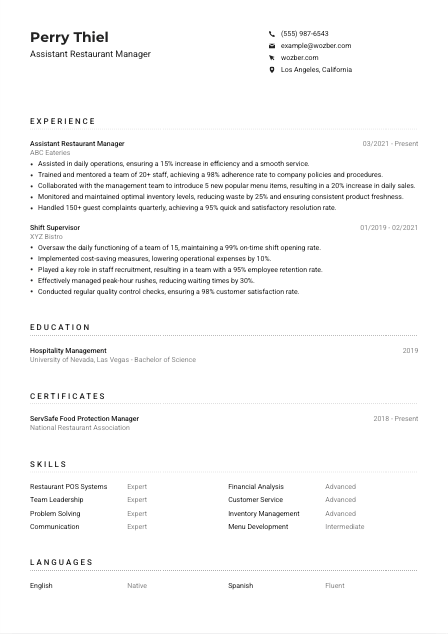
If the job requires local availability, list your city and state clearly. In the example, "Los Angeles, California" directly supports the employer's stated requirement and avoids uncertainty around relocation or commute logistics.
Include LinkedIn or a professional website if it supports your restaurant management background with consistent job titles, promotions, certifications, or hospitality experience. Leave it off if it is outdated or thin.
This section should confirm the basics quickly and cleanly. When your title, contact details, and location line up with the posting, the hiring team can move straight to your service leadership and operations experience.




For an Assistant Restaurant Manager, experience is where the decision usually gets made. Hiring teams look for proof that you have handled busy service periods, led hourly staff, resolved guest problems, and supported the business side of the restaurant through sales, inventory, and labor-aware execution.
Read the posting for the specific work the restaurant needs covered day to day. In this role, the clear priorities are smooth daily operations, staff training, POS proficiency, guest satisfaction, inventory control, and comfort with restaurant financials. Those themes should show up across your recent positions, not sit only in a skills list.
List your jobs in reverse chronological order and make sure the most relevant leadership work appears first. Assistant manager, shift supervisor, or lead server roles can all work if the bullets show scheduling support, team oversight, service standards, and operational accountability.
Replace generic task statements with results tied to restaurant performance. The example does this well by showing training 20+ staff to a 98% policy adherence rate, introducing new menu items that lifted daily sales by 20%, and resolving 150+ guest complaints quarterly with a 95% satisfaction rate. Those bullets show management judgment under real service conditions.
Metrics make your impact concrete when they reflect how restaurant performance is actually measured. Good examples include sales growth, waste reduction, guest satisfaction scores, shift opening accuracy, wait time reduction, retention, or policy compliance. Even one or two well-chosen numbers per role can make your scope easier to trust.
Prioritize experience that strengthens your case for supervising staff, maintaining service quality, and supporting profitability. If an older role does not connect to restaurant operations, guest service, or team leadership, shorten it or remove it so your strongest management evidence stays in focus.
Your experience section should show that you have already handled the pace, people, and performance pressure of restaurant operations. By the end of this section, a hiring manager should be able to picture you running a shift, coaching the team, and protecting both guest experience and margins.
Education usually plays a supporting role in Assistant Restaurant Manager hiring, but it still helps frame your foundation in hospitality, business, or service operations. Present it cleanly so it strengthens your profile without taking attention away from your shift leadership and restaurant results.
List your highest or most relevant degree first, especially if it connects to hospitality, business, food service, or operations. A degree in Hospitality Management, like the one in the example, reinforces that your restaurant knowledge is backed by formal training as well as floor experience.
Use a simple structure with degree, field of study, school, and graduation year. That is enough for most restaurant management applications and keeps the section readable for both hiring teams and ATS parsing.
If your coursework or degree ties closely to restaurant operations, mention the field clearly. Hospitality Management, food and beverage operations, or business administration can all strengthen your positioning for roles that involve staffing, service quality, and financial oversight.
Honors, coursework, or campus leadership can help if you are earlier in your career or if they connect directly to service operations, team supervision, or hospitality standards. If you already have several years of restaurant leadership, keep this section tighter.
Restaurant management values practical, current knowledge. If you have completed additional training in food safety, operations, or hospitality leadership, make sure it appears in the appropriate section so your resume reflects continued development beyond your degree.
This section should confirm that you have a solid foundation without competing with your operations experience. Clean, relevant education helps round out a profile built on service leadership and day-to-day restaurant execution.
Certifications carry real weight in restaurant management when they connect to compliance, food safety, and day-to-day operating standards. They can be the extra proof that you are prepared to supervise responsibly, especially in roles that touch training, sanitation, and guest protection.
Lead with certifications that matter in food service settings. For this opening, ServSafe Food Protection Manager is especially relevant because the employer names it as a preference, but similar food safety or responsible management credentials can also add value when they apply to your market or concept.
List the certification name, issuing organization, and date or validity period so the reader can immediately understand its status. The example handles this well by naming the National Restaurant Association and showing the certification remains current.
An expired food safety certification weakens a management resume because it raises avoidable questions about compliance readiness. If renewal is due soon, update it before applying or note the current validity accurately.
As you move deeper into restaurant leadership, additional training in management, alcohol service compliance, inventory control, or labor practices can strengthen your resume. Choose credentials that reflect the type of operation you want to manage, not just anything available.
Relevant, current certifications show that you can manage service with the standards restaurants are expected to meet. They are especially useful when they support food safety, staff training, and operational discipline.
An Assistant Restaurant Manager skills section should read like the toolkit behind a smooth shift. The best mix usually combines operational systems, people management, guest-facing judgment, and a working grasp of the numbers that keep a restaurant profitable.
Start with the terms the employer already uses when they describe the role. Here, that includes restaurant POS systems, customer service, financial analysis, inventory management, staff training, and written and spoken English. Mirroring this language helps your resume align naturally with ATS screening and hiring expectations.
Do not list only soft skills or only technical ones. Assistant Restaurant Managers are expected to move between floor leadership and operational control, so combine skills like POS systems and financial analysis with team leadership, complaint resolution, communication, and problem solving. The example does this by pairing operational tools with guest and staff management strengths.
Choose skills you can support with bullets elsewhere in the resume. If you claim inventory management, your experience should show waste reduction, ordering support, or freshness control. If you list menu development, show a promotion or launch that affected sales, traffic, or guest response.
Your skills section should confirm that you can run service, coach staff, and support the business side of the restaurant. Every item should connect back to real results or responsibilities already shown in your experience.
Language ability matters in restaurant management because service issues, coaching moments, and guest expectations all happen in real time. If a posting specifies English proficiency, treat that as a required operating skill, not a minor detail.
If the role asks for spoken and written English, include English with an accurate proficiency level. This is especially important for positions that involve guest recovery, staff direction, policy communication, and written reporting.
Additional languages can strengthen your profile when they support guest communication or team leadership. In many restaurant markets, Spanish can be especially useful for coordinating with staff and improving day-to-day communication across the floor and back of house.
Use clear labels such as Native, Fluent, Advanced, or Intermediate. Accurate levels matter because restaurant managers often need to resolve complaints, explain procedures, and coach performance without confusion.
Language skills matter most when they help you deliver smoother service, clearer staff communication, or a better guest experience. If multilingual communication has been part of your management success, support it elsewhere in your resume through team or guest-facing achievements.
For hospitality roles, language ability supports more than conversation. It can reduce misunderstandings during peak service, help with training consistency, and improve the experience for a broader guest base.
This section should make clear whether you can communicate at the level the restaurant needs. For an Assistant Restaurant Manager, that means supporting staff clearly and handling guest interactions with confidence.
Your summary should quickly position you as someone who can support daily operations, lead people, and maintain the guest experience under pressure. Keep it focused on restaurant management value, not broad personality traits or generic hospitality language.
Before writing, pull the two or three requirements that matter most for the role. For this position, that means restaurant supervisory experience, strong guest service, POS familiarity, and comfort with financial and inventory-related responsibilities. Your summary should reflect that mix in a few tight lines.
Start with your title or closest equivalent plus your years of experience. A line like "Assistant Restaurant Manager with 4+ years in high-volume restaurant operations" immediately gives context and places you in the right hiring lane.
Follow with strengths that connect directly to the role, such as staff training, guest complaint resolution, waste reduction, menu support, or sales growth. The example summary works because it mentions guest satisfaction, daily operations, and team-oriented leadership rather than vague ambition.
Aim for 3 to 5 lines with direct wording and role-specific terms. This section should read quickly while still making your management scope, service mindset, and operational value immediately clear.
A focused summary helps the reader place you before they review the details. For Assistant Restaurant Manager roles, it should point straight to service leadership, operational control, and the kind of results that matter in a restaurant environment.
At this point, your resume should show far more than general restaurant experience. It should connect your shift leadership, guest recovery, staff training, inventory control, POS fluency, and business awareness to the work an Assistant Restaurant Manager is hired to handle.
Use Wozber's free resume builder to organize that experience into an ATS-friendly resume format, refine role-specific wording with its AI resume builder features, and check alignment with an ATS resume scanner. The finished resume should make it easy to see that you can step into service, support the team, and help the restaurant run well from day one.