




Use Wozber and land your dream job
Create Resume
No registration required
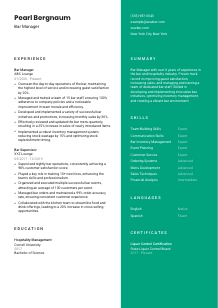
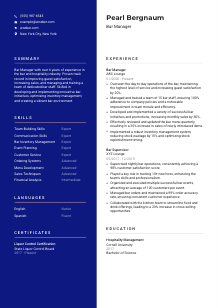
Running the bar, but your resume feels more like a last call? Shake up your presentation with this Bar Manager resume example, created with Wozber free resume builder. Learn how to mix your beverage leadership with the job recipe, making your career as refreshing as a perfectly crafted cocktail!
Bar managers are trusted with more than service. They set the pace of the room, protect margins, keep stock under control, train bartenders to standard, and adjust the menu when guest demand shifts. Your resume needs to show that you can run a profitable bar floor while keeping quality, compliance, and guest experience steady on busy nights.
When bar management resumes are tailored well, hiring teams can quickly separate candidates who mainly supervised shifts from those who owned inventory, promotions, staff development, and menu decisions. Wozber's free resume builder helps you turn that experience into an ATS-compliant resume by aligning your wording with the posting and keeping the structure clean enough for both recruiters and ATS screening to pick up the right bar operations strengths.
This section should make it easy to contact you and confirm a few practical basics right away. For a Bar Manager role, that includes showing the right title and, when the posting asks for it, making your location status clear without crowding the top of the page.
Use your full name as the most prominent text on the resume. Keep the styling simple and polished. In hospitality leadership, presentation matters, and that starts with a header that looks clean and organized rather than decorative or overdesigned.
Add "Bar Manager" under your name so the role focus is immediate. This helps both recruiters and ATS tools connect your resume to the opening, especially if your recent title was slightly different, such as Bar Supervisor or Beverage Lead, but your responsibilities already match bar management work.
Include a reliable phone number and a professional email address. Check every character before sending. A hiring manager who wants to ask about your shift leadership, inventory systems, or promotions plan should never hit a dead end because of a typo.
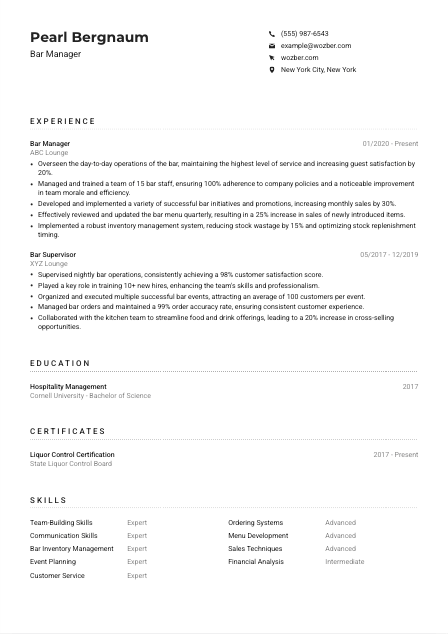
If the employer specifies a city, reflect that in your header when it applies. In the example, listing "New York City, New York" immediately answers a stated requirement. If you are relocating, you can note that clearly instead of leaving the employer to guess about availability.
Include LinkedIn or a professional site only if it supports your application. For a Bar Manager, that might show hospitality leadership experience, venue history, event work, or promotions you helped run. Make sure the content matches the tone and facts of your resume.
At the top of the page, the employer should see who you are, what role you do, how to reach you, and whether a practical requirement like location is already covered. That keeps the focus on your bar operations experience instead of avoidable questions.




Bar Manager hiring decisions are heavily shaped by day-to-day operating results. Your experience section should show that you can lead service, train staff, manage ordering and stock, run promotions that move sales, and protect profit margins without letting standards slip.
Read the posting for the parts of the job that carry the most weight. Here, the employer emphasizes bar operations, staff training, promotions and events, menu updates, inventory control, ordering, and cost-effective margin management. Those themes should shape which bullets you lead with and the language you use.
Start with your most recent hospitality management role and include your job title, venue name, and dates. Clear progression matters in this field. Moving from a supervisory position into full bar leadership, as shown in the example, tells a stronger story than a list of unrelated service jobs.
Each bullet should show what you owned and what improved because of your work. Good Bar Manager bullets mention guest satisfaction, sales lift from promotions, reduced waste, stronger policy compliance, better order accuracy, or improved team performance. The example does this well by pairing responsibilities with results like a 20% guest satisfaction increase and 15% lower stock wastage.
Hospitality resumes gain credibility when the metrics match the work. Include figures such as monthly sales growth, average event attendance, waste reduction, customer satisfaction scores, staff headcount, menu item sales, or ordering accuracy. Numbers like a 30% sales increase from promotions or managing a team of 15 bartenders make your operating scope easy to understand.
If an older role does not help prove bar leadership, inventory control, training, or guest-facing service standards, shorten it or leave it off. Use the space for the work that best supports this role. Employers hiring a Bar Manager want to see how you run a bar, not every task you handled across your whole hospitality history.
After reading this section, a venue should be able to picture you running service, coaching staff, controlling stock, and improving sales in a real bar environment. Keep the emphasis on operational ownership and measurable results.
Education usually plays a supporting role in Bar Manager hiring, but it can still strengthen your profile when it connects to hospitality operations, food and beverage management, business fundamentals, or compliance knowledge.
Some Bar Manager roles require only experience, while others value hospitality management or business training. If the posting does not specify a degree, list your highest relevant education clearly and let your experience carry the most weight. In the example, a Hospitality Management degree supports the candidate's progression into bar leadership.
List degree, field of study, school, and graduation year. Keep it compact and easy to scan. This section should confirm your educational background without distracting from the operating achievements that matter most in hospitality management hiring.
If you studied subjects such as beverage management, inventory control, hospitality law, food and beverage costing, or guest service operations, include them only when they strengthen your case for the role. This is most useful for earlier-career candidates or for jobs with a strong business and compliance focus.
Honors, leadership roles, or industry-related projects can be worth including if they connect to hospitality or venue operations. If you have several years of bar management experience already, keep these details brief so the page stays centered on live service results, team leadership, and financial control.
Training beyond your degree can fit here if it is educational rather than certification-based. Workshops in menu development, beverage costing, leadership, or hospitality analytics can show that you keep building the skills needed to run a bar profitably and consistently.
Use this section to reinforce your background, not to compete with your experience. For most Bar Manager applications, education works best when it supports your understanding of hospitality operations and business discipline.
Certifications matter in bar management when they confirm legal compliance, responsible service knowledge, or specialized hospitality training. This section is especially important when the posting names a required liquor control certification or license.
If the job asks for a state liquor control certification or similar license, place that credential first and word it clearly. In the example, the Liquor Control Certification directly answers a stated requirement. That kind of match should never be buried below less relevant certificates.
Choose credentials that support the actual work of the role, such as alcohol service compliance, food safety, inventory systems, beverage training, or hospitality leadership. A short, relevant list is stronger than a longer list of general courses that do not affect bar performance or compliance.
Show who issued the certificate and whether it is current. For regulated environments, employers need to know that your credential is valid. Dates also show whether your compliance knowledge is recent enough for present-day policy and service standards.
Requirements vary by state and employer, so stay current on the certifications that matter where you work. Beyond compliance, targeted training in beverage programs, cost control, or staff development can add depth when you are moving into larger venues or higher-volume operations.
A Bar Manager resume benefits when this section quickly confirms that you can meet legal requirements and operate responsibly. Lead with the credentials that support service compliance and bar leadership first.
A Bar Manager skills section works best when it reflects the way bars are actually run. That means balancing leadership and guest-facing strengths with operational skills like ordering, inventory control, costing, promotions, and menu planning.
Use the employer's wording where it honestly matches your background. For this role, that includes leadership, team-building, bar inventory management, costing, ordering systems, promotions, events, menu updates, and fluent English communication. Matching those terms helps both ATS screening and human review.
Do not list only soft skills or only technical ones. Bar Managers are expected to coach bartenders, maintain service standards, manage stock, and protect margins at the same time. The example handles this balance well with skills such as Team-Building, Bar Inventory Management, Event Planning, Menu Development, and Financial Analysis.
Trim generic skills that do not add much depth. A shorter list of role-specific abilities is more useful than a long inventory of vague strengths. Choose the skills you can back up in your experience section, especially those tied to sales growth, waste reduction, staff development, and daily bar operations.
Anyone scanning this list should immediately understand that you can lead a team, run a bar's systems, and support revenue. Relevance matters more than volume here.
Language skills can matter in bar management because service depends on fast, clear communication with guests, bartenders, servers, vendors, and sometimes a diverse local clientele. This section should stay factual and useful.
When the job posting explicitly asks for English fluency, list English prominently and state your level accurately. For this opening, fluent and articulate English is a core requirement, so it should be easy to find on the page.
Add other languages only with honest ratings such as Native, Fluent, Intermediate, or Basic. In a busy bar, language ability affects guest interaction, upselling, team communication, and issue handling, so accuracy matters more than sounding impressive.
Additional languages can strengthen your application when the venue serves an international, tourist-heavy, or multilingual customer base. For example, Spanish alongside English may be useful in many hospitality settings, but it should be presented as an added advantage, not a substitute for the required communication standard.
Do not overstate your ability. If you can greet guests and take simple orders but cannot manage complaints or staff training in that language, rate it accordingly. Bar Managers need trust, and that starts with accurate self-reporting.
If you mention more than one language, let it support a practical point elsewhere in your resume, such as guest service, event hosting, or team coordination. The value is not in the language itself, but in smoother service and stronger communication on the floor.
For Bar Manager applications, languages should support service quality and communication. Lead with the required English proficiency, then add any other languages that genuinely help you operate more effectively.
The summary should give a quick, credible picture of the kind of bar leader you are. In a few lines, show your level of experience, the operating areas you handle well, and the results you tend to deliver.
Before writing, identify the themes that define the opening. Here, that means bar operations, staff training, promotions, inventory management, menu development, cost control, and guest service. Your summary should reflect the parts of that mix you can genuinely claim from experience.
Start with a direct line such as "Bar Manager with 6+ years in hospitality operations" or a version that fits your background. This immediately tells the reader whether you have the management tenure the role requires. The example summary does this well by establishing both title and experience range up front.
Mention the areas where you consistently perform, such as improving guest satisfaction, training bar teams, running profitable promotions, or reducing inventory waste. Keep it tied to outcomes. Phrases like increased monthly sales, lowered stock loss, or improved team efficiency carry more weight than broad claims about being passionate or hardworking.
Aim for 3 to 5 lines with tight wording. A Bar Manager summary should read quickly but still tell the employer what scale of operation you can handle and where you add value. Save the finer detail for the experience section, where your numbers and examples can do the heavier lifting.
By the time someone finishes these lines, they should know your experience level, your operational strengths, and the kinds of results you deliver in a bar setting. That is enough to earn closer attention to the rest of the resume.
A well-tailored Bar Manager resume should show clear control of service standards, team performance, inventory, promotions, and profitability. Each section needs to support that picture with specifics that match the role you are targeting.
Use Wozber's free resume builder to organize your experience into an ATS-friendly resume format, then refine it with the ATS resume scanner and AI-powered tailoring features so the language lines up with the job description naturally. The final result should make it easy for a hiring team to see that you can step in and run a bar with confidence from day one.




