



Use Wozber and land your dream job
Create Resume
No registration required
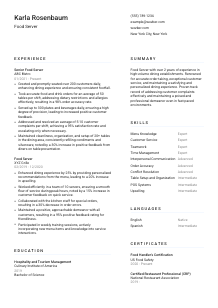
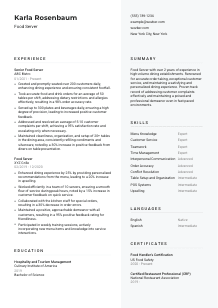
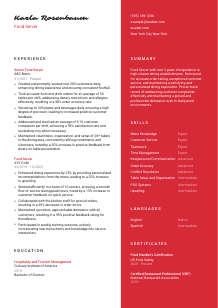
Balancing plates, but your resume seems half-empty? Dish up inspiration with this Food Server resume example, made with Wozber free resume builder. Learn how to present your service skills in line with job demands, and fill up your career plate as wholesomely as the meals you serve!
Food service hiring moves quickly, but the standard is high. Managers are looking for servers who can keep tables moving, remember menu details, handle special requests without mistakes, and stay composed when the dining room gets busy. Your resume needs to show that kind of floor readiness right away through real service volume, order accuracy, guest interaction, and the pace of the environments you've handled.
A tailored resume also helps separate restaurant service experience from general customer-facing work. When you use Wozber's free resume builder to match your wording to the posting and keep an ATS-friendly resume format, details like menu knowledge, allergy handling, complaint resolution, and English proficiency are easier to surface in both ATS screening and the hiring manager's first review. That makes it easier to see whether you can step onto the floor and contribute from day one.
In restaurant hiring, the top of the resume should answer the practical questions fast: who you are, how to reach you, and whether you match any basic logistics in the posting. Keep this section clean, professional, and easy to scan.
Use your full name as the most visible line on the page. Hiring managers often review many hourly-service resumes in one sitting, so your name should be clear and readable without decorative styling or extra wording.
Place "Food Server" directly under your name if that is the role you are targeting. This keeps your resume aligned with the posting and avoids confusion with adjacent titles such as host, bartender, or cashier.
Add a phone number you answer and a professional email address you check regularly. Restaurant interviews are often scheduled quickly, sometimes within a day or two, so accurate contact information matters more than people think.
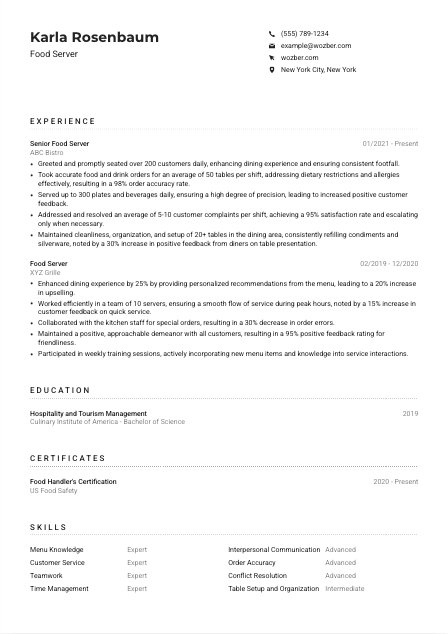
If the employer specifies a city, add it plainly in your personal details. Here, listing "New York City, New York" directly addresses a stated requirement and removes an easy reason for a resume to be passed over early.
A LinkedIn profile or personal website is optional for most Food Server roles, but include one if it reinforces your hospitality background or customer-service experience. If you link it, make sure the job titles and dates match your resume.
This section should confirm that you are reachable, professionally presented, and aligned with any basic location requirement. Keep it simple so the hiring manager can move straight to your service experience.




For a Food Server, experience does the heaviest lifting on the resume. Managers want to see what kind of dining room you handled, how accurately you worked, how you dealt with guests, and whether you could keep service quality steady during busy shifts.
Start by marking the responsibilities that appear most often in the job description. In this case, that includes greeting and seating guests, taking accurate food and drink orders, handling dietary restrictions, serving professionally, resolving complaints, and maintaining a clean station. Those priorities should shape the language of your bullet points.
List your jobs in reverse chronological order with employer name, title, and dates. In restaurant hiring, a straightforward timeline helps employers quickly confirm that you have at least 1 year of food service experience and understand how your responsibilities have grown over time.
Food Server resumes are stronger when bullets show scale and results, not only duties. The sample resume does this well by pairing core tasks with numbers, such as serving 200+ customers daily, managing 50 tables per shift, or reaching a 98% order accuracy rate. Use your own version of that approach to show pace, consistency, and guest-facing performance.
Numbers matter most when they reflect restaurant operations. Useful metrics include covers served, tables handled per shift, order accuracy, guest satisfaction, upselling results, complaint resolution, turnaround speed, or reductions in order errors from strong kitchen communication. These details make your experience feel real and credible.
If you have work outside food service, include only the parts that strengthen your case for front-of-house performance, such as customer service, cash handling, teamwork, or working under pressure. Most of the space should stay focused on restaurant service, menu knowledge, and guest care.
After reading your experience section, a hiring manager should understand the kind of floor you worked on, the pace you handled, and the quality of service you delivered. Make those points visible through specific actions and restaurant-relevant results.
Education is usually secondary for Food Server hiring, but it can still add useful context. Keep it concise and use it to support your hospitality background rather than distract from your service record.
Many Food Server jobs focus more on hands-on service experience than on degrees. Still, review the posting first so you know whether to keep education brief or give a little more space to hospitality-related training.
For each entry, include your school, degree, field of study, and graduation year or date. A simple format is best because restaurant hiring managers typically spend more time on your experience and certifications than on academic detail.
If your degree or coursework connects to hospitality, tourism, restaurant operations, or customer service, that is worth showing. In the example, a degree in Hospitality and Tourism Management supports the candidate's front-of-house career direction, even though the role itself does not require a bachelor's degree.
Short courses in wine service, guest relations, food safety, or hospitality operations can strengthen this section if they are not listed elsewhere. Use them when they add practical value, especially for restaurants that expect menu fluency or stronger table-side recommendations.
Honors, leadership roles, or relevant student activities can stay if they reinforce professionalism, hospitality interest, or communication ability. If they do not support your service profile, leave them out and keep the section lean.
Education does not need to carry the resume for a Food Server role. Its job is to add useful context, especially when your studies or training connect directly to guest service or restaurant operations.
Certifications can matter more than formal education in restaurant hiring, especially when health regulations or alcohol service rules are involved. Put the credentials that affect day-one eligibility or service quality where they are easy to find.
If the job asks for a Food Handler's certification, make that credential visible and current. This posting does exactly that, so it should appear before less relevant certificates and include dates that show it is valid or recently completed.
Choose certificates that support front-of-house work, food safety, guest service, wine knowledge, alcohol awareness, or hospitality operations. A shorter, relevant list is more useful than a long list of unrelated training.
Many food-service credentials need renewal. Include the issue date and, when relevant, the active period so the employer can see whether you are ready to work without extra follow-up.
If you are aiming for higher-service venues, certifications in wine, responsible alcohol service, or guest experience can help. The example resume includes both a Food Handler's certification and a restaurant professional credential, which broadens the candidate's profile beyond basic compliance.
Certificates should answer two questions quickly: are you cleared for the work, and have you invested in restaurant-specific training that improves service quality. Lead with the credentials that matter operationally.
The skills section should reflect what service looks like in practice. For a Food Server, that means a mix of guest-facing communication, menu fluency, order precision, and the ability to stay organized through a busy shift.
Use the posting to identify the skills that deserve priority. Here, that includes food and beverage knowledge, wine and cocktail familiarity, interpersonal communication, professionalism, attention to detail, and performance in a fast-paced environment.
Restaurant hiring often depends on both. Include hard skills such as POS systems, order accuracy, table setup, menu knowledge, allergy awareness, and upselling alongside soft skills like guest service, teamwork, communication, and conflict resolution.
Do not overload this section with generic traits. A tighter list that matches restaurant service reads better and supports ATS optimization more effectively. The sample resume is a useful model here because it stays focused on capabilities that matter on the floor, such as menu knowledge, time management, and complaint handling.
Your skills section should reinforce that you can manage guest interaction, order flow, and service standards at the same time. Prioritize the abilities that directly affect table service and shift performance.
Language ability can be a real advantage in hospitality, but it should be presented with the same clarity as the rest of the resume. Lead with the language needed for service, then add any others that could help you connect with guests.
If the posting specifies English proficiency, list English at the top of this section with your actual level. This role requires strong English, so that detail should be immediate rather than buried after secondary languages.
List the languages you speak from strongest to weakest. That makes it easier for a manager to understand how comfortably you can handle guest questions, menu explanations, and service recovery conversations.
Extra languages can be useful in busy dining rooms, tourist areas, and multicultural neighborhoods. They are especially worth listing when they help with rapport, menu explanations, or smoother communication across a diverse guest base.
Use clear labels such as "Native," "Fluent," "Advanced," "Intermediate," or "Basic." In customer-facing work, overstating language ability can create problems during service, so accuracy matters.
Some venues benefit more from certain languages than others. A restaurant with international traffic, a neighborhood regular base, or a cuisine-specific concept may value an additional language more than a general dining room would. Include what genuinely helps your candidacy, not every language you have studied briefly.
For Food Server roles, languages are most useful when they strengthen guest communication. Lead with the required language, present your level honestly, and keep any extra language skills tied to real service value.
Your summary should quickly place you in the right kind of restaurant work. In a few lines, show your experience level, service strengths, and the parts of your background that match the pace and expectations of the job.
Start with a direct statement that names you as a Food Server and gives your years of experience. If relevant, add the kind of environment you know best, such as high-volume dining, casual service, upscale hospitality, or fast-paced front-of-house operations.
Choose two or three points that match the job description closely. For this posting, that could include order accuracy, menu and beverage knowledge, handling dietary restrictions, complaint resolution, or staying polished during peak hours. The example summary works because it stays anchored in service performance rather than broad personality claims.
Aim for 3 to 5 sentences or a compact paragraph. Restaurant managers usually want a quick read before moving into your recent experience, so every line should add something concrete about guest service or floor performance.
Your summary should sound like someone who has actually worked service, not like generic resume language. Replace vague phrases with concrete ones such as "98% order accuracy," "high-volume dining," or "resolving guest concerns during peak service" when those claims reflect your real record.
A Food Server summary should establish your service level fast and make the rest of the resume easier to read in context. Wozber's free resume builder can help you shape that opening into an ATS-compliant resume that reflects the wording, pace, and guest-service priorities of the job you are targeting.
A Food Server resume works best when it reads like strong restaurant performance, not generic customer service. Show the pace you handled, the guest care you delivered, the menu knowledge you used, and the accuracy you maintained when service got busy.
Use Wozber to build an ATS-friendly resume that aligns your experience with the posting, highlights missing requirements through its ATS resume scanner, and presents your background in a clean format hiring teams can review quickly. The finished resume should make one thing clear: you are ready to step into service and handle the dining room well.




