



Use Wozber and land your dream job
Create Resume
No registration required
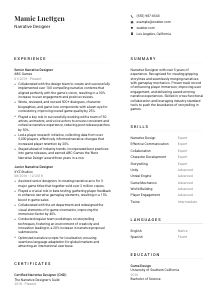
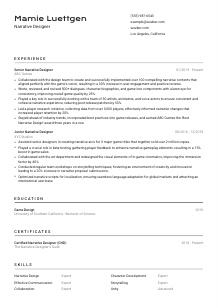
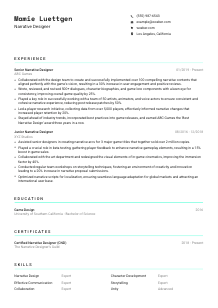
Crafting captivating tales, but your resume lacks storyline flow? Check out this Narrative Designer resume example, created with Wozber free resume builder. Learn how to seamlessly thread your storytelling finesse into job criteria, penning a career narrative that keeps prospects on the edge of their seats!
Narrative design sits at the point where story decisions shape how a game feels to play. Hiring teams want to see more than polished dialogue. They look for proof that you can build character arcs, lore, and branching content in ways that support mechanics, production constraints, and the player experience across the whole development pipeline.
When that connection is clear, your resume reads less like a writing portfolio and more like a game development hire. Wozber's free resume builder helps you shape that story into an ATS-compliant resume that uses the right narrative design language, so teams can quickly recognize your tool fluency, cross-functional collaboration, and ability to turn story work into stronger player engagement.
For a Narrative Designer, the header should do one simple job well: present your identity and availability without distracting from the work. This section is brief, but it still helps establish whether you match practical requirements such as title alignment, professional contact details, and, when relevant, location.
Use your full name in a clean, readable format at the top of the page. Keep it slightly larger than the body text so it anchors the document right away. In game hiring, resumes often move between recruiters, producers, and creative leads, so clear identification matters.
Place "Narrative Designer" under your name if that is the role you are pursuing. Matching the target title helps position you correctly in ATS screening and in human review, especially when your past titles vary between junior, senior, quest, cinematic, or content-focused narrative roles.
List a reliable phone number and a professional email address. A simple format such as firstname.lastname@email.com works best. If you include a portfolio, personal site, or LinkedIn profile, make sure the writing samples, shipped titles, and credits there match the experience described on your resume.
If the job requires a specific location, reflect that accurately in your header. Here, Los Angeles, California is part of the employer's stated requirement, so the sample resume handles that directly. For other Narrative Designer openings, only include location details that help clarify your availability for onsite, hybrid, or remote production work.
A website link can strengthen your application if it leads to relevant material such as writing samples, branching narrative examples, released game credits, or portfolio breakdowns of dialogue systems and lore design. Skip anything unfinished or unrelated. Every link should support your case as someone who can build story content inside a game team, not just write well in isolation.
Your personal details should remove basic questions immediately: who you are, what role you are targeting, how to reach you, and whether any stated location requirement is covered. Then the reader can move straight to your narrative and production experience.




This is the section where Narrative Designers separate themselves from general writers. Hiring teams look for shipped work, implementation awareness, collaboration across design and art, and signs that your narrative decisions improved the game itself, whether through engagement, retention, consistency, or reduced rework.
Before rewriting your bullets, mark the requirements that define the role. For this opening, the important themes are narrative implementation, dialogue and lore writing, collaboration with artists and voice talent, player research, and familiarity with tools such as Twine, Unity, or Unreal Engine. Those themes should appear in your experience through real work, not copied phrases.
Start with your most recent position and include job title, company, and dates. Narrative design careers often show progression from junior content support to ownership of story systems, cinematic writing, or worldbuilding direction, so chronology helps the reader see how your scope has grown across productions.
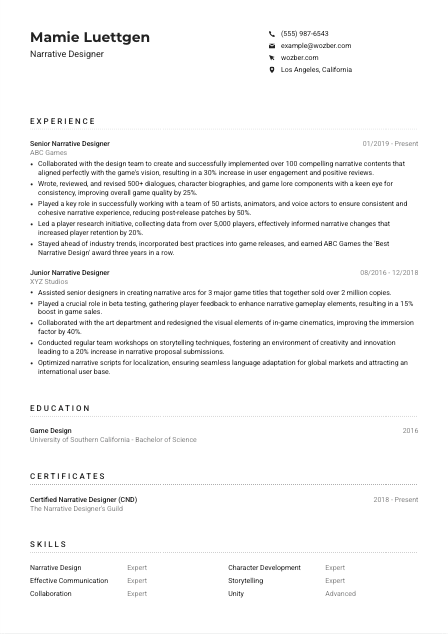
For each role, describe the narrative work you actually owned. Useful bullets mention things like dialogue writing, branching structures, lore bibles, quest content, narrative reviews, script revisions, implementation support, collaboration with level design, or coordination with audio and animation. The sample resume does this well by naming dialogue, character biographies, game lore, and collaboration with a 50-person creative team instead of relying on vague statements about storytelling.
Numbers are especially useful when they show how story work changed the player experience or development process. Engagement lift, retention gains, reduced post-release patches, content volume, player research sample size, review scores, or shipped title scale all help. In the example, metrics such as 30% higher user engagement, 500+ revised dialogue and lore assets, and feedback gathered from 5,000 players make the narrative contribution much easier to understand.
Choose bullets that support your candidacy for narrative design. Writing that belongs more to general marketing, unrelated editing, or non-game content should stay out unless it directly supports branching writing, character development, worldbuilding, or collaborative game production. Even when you have broad creative experience, the resume should center on story craft inside playable systems.
A hiring team should be able to scan this section and understand the scale of your content, the teams you worked with, the tools or engines around the work, and the player or production outcomes that followed. That is what turns experience into a credible Narrative Designer profile.
Education matters here because it often shows the first formal bridge between storytelling and interactive design. For Narrative Designers, the most relevant entries usually connect writing, game design, interactive media, or adjacent fields that support systems thinking and collaborative production.
If the employer asks for a bachelor's degree in Game Design, Creative Writing, or a related field, make that information easy to spot. In the sample, "Bachelor of Science in Game Design" from USC aligns directly with the posting. If your degree is in a related area, use the field title clearly rather than leaving the connection implied.
List your degree, field of study, school, and graduation year or date range. That is usually enough for an experienced Narrative Designer. Clear formatting matters more than extra description unless you are early in your career and need your academic work to carry more of the application.
Coursework, capstones, or thesis projects can help if they show interactive writing, quest design, level narrative integration, worldbuilding systems, or game production collaboration. Skip generic class lists. Add detail only when it strengthens the connection between your studies and the narrative design responsibilities in the target role.
Academic honors, game lab leadership, or writing club roles can support your profile when they point to story craft, team collaboration, or shipped student projects. If you already have more than 3 years of industry experience, these details should stay secondary to your professional work.
If you built an interactive fiction prototype, led narrative design on a student game, or created branching dialogue in Unity, Twine, or Unreal during school, that can be worth a line. These examples are most useful when they reflect the same blend of writing and implementation awareness that studios expect on the job.
For most Narrative Designers, education confirms the foundation while experience carries the heavier weight. Keep this section concise, relevant, and clearly connected to interactive storytelling rather than general academics.
Certifications are rarely the deciding factor for Narrative Designer hiring, but they can strengthen your profile when they reflect relevant craft development, engine fluency, or specialized training in interactive storytelling. Include them when they add substance, not just extra lines.
The posting does not require a certification, so this section should stay selective. Focus on credentials tied to narrative design, game writing, interactive fiction, engine workflows, or related production methods. In the example, a Certified Narrative Designer credential reinforces specialization in the field.
Use the certificate name, issuing organization, and date. One relevant credential is stronger than a long list of loosely related online courses. If you have training in Unity narrative tools, branching design, or game writing workshops with recognized industry backing, those can be useful additions.
Dates show whether the training is recent, active, or part of ongoing professional development. That matters more when the certificate relates to evolving tools, pipelines, or production practices. If a credential expires or requires renewal, show that clearly.
Studios notice candidates who keep pace with narrative systems, player-centered design, and new storytelling methods in games. If you add new training, choose programs that sharpen practical skills such as branching structure design, scripting workflows, localization-aware writing, or engine-based implementation.
This section works best when every entry adds something concrete to your Narrative Designer profile. Keep it focused on training that strengthens your story craft, tool fluency, or contribution to game production.
Narrative Designer skill lists work best when they show range across storytelling, implementation, and collaboration. Studios want to know whether you can write compelling content, work inside the production environment, and shape narrative in ways that support mechanics, pacing, and player response.
Start with the language used in the posting. Here, the clearest signals include narrative design, storytelling, collaboration, communication, understanding of game mechanics, and proficiency with Twine, Unity, or Unreal Engine. These belong in your skills section only if they reflect your actual working ability.
A useful Narrative Designer skills section mixes story craft with production capability. Include strengths such as dialogue writing, character development, worldbuilding, branching narrative design, game mechanics, player engagement, narrative systems, and engine familiarity. The sample resume handles this balance well by combining storytelling and character development with Unity, Unreal Engine, and Twine.
Do not turn this section into a full software inventory. Focus on the abilities most likely to matter for the target role and support them through your experience bullets. If a tool or skill is central to the job, keep it. If it is peripheral and unused in your recent work, leave it out so the core profile stays clear.
The best skill lists show how you operate inside a game team. When the mix is right, a reader can quickly picture you writing narrative content, collaborating across disciplines, and using the right tools to bring story into the playable experience.
Language matters more in Narrative Design than it does in many adjacent game roles because the work often depends on tone, dialogue quality, lore consistency, revision accuracy, and collaboration with cross-functional teams. If a posting calls out language proficiency, your resume should address it directly.
This job specifically states that strong English proficiency is fundamental, so English should appear first with an honest proficiency level. For a writing-centered role, that line is not a formality. It helps confirm that you can handle dialogue, narrative documentation, revisions, and cross-team communication at a professional level.
Use straightforward labels such as Native, Fluent, Advanced, or Intermediate. Avoid vague descriptions. Hiring teams need a quick read on whether you can write final-quality content, support localization conversations, or participate confidently in narrative reviews and table reads.
Additional languages can be relevant in studios with global audiences, localization-heavy pipelines, or multicultural narrative settings. In the sample, Spanish adds useful range without distracting from the required English proficiency. Include extra languages when they are real assets, not decorative additions.
Narrative and dialogue work demand precision, so overstating language ability can create problems quickly. If you can review translated scripts, support localization notes, or write directly in another language, say so through the proficiency label you choose. If not, keep the rating modest and accurate.
Even when a second language is not listed in the job description, it can support work on localization, culturally informed character writing, player community research, or international releases. Mention it when it fits the kind of games or audiences you have worked with.
For Narrative Designers, language skills are tied to the quality of the work itself. Use this section to make your communication range clear, especially when the role depends on polished English and collaboration across creative teams.
Your summary should quickly establish where you sit in the game pipeline and what kind of narrative value you bring. A generic creative profile will not do enough here. This section needs to connect your storytelling strengths to collaboration, implementation awareness, and measurable player or production results.
Read the posting for its recurring themes before you draft anything. For this role, those themes include narrative content creation, dialogue and lore quality, collaboration with artists and voice actors, player feedback analysis, and tool familiarity. Your summary should reflect the priorities most central to the opening you want.
Open with your title and years of relevant experience, such as "Narrative Designer with 5+ years of experience in game development." That immediately places you in the right hiring lane and helps separate you from applicants whose background is strong in writing but not in games.
Choose strengths that matter in production, such as integrating narrative with gameplay, building dialogue and world lore, guiding cross-disciplinary story execution, or using player feedback to refine content. The sample summary works because it connects storylines and gameplay mechanics to player immersion, engagement, and award-winning results instead of staying abstract.
Aim for a short paragraph that a recruiter or creative lead can absorb in seconds. Skip broad claims about passion or creativity unless they are backed by concrete role language. A strong summary should sound like someone who has shipped narrative work, collaborated across departments, and understands how story choices affect the final player experience.
A sharp summary helps the reader place your experience before they reach the first bullet point. For Narrative Designer roles, that means making your story craft, game collaboration, and player-facing impact clear from the first lines of the resume.
A Narrative Designer resume works when it shows how your writing performs inside development, not only on the page. If your sections clearly connect story craft to mechanics, collaboration, tools, and player response, hiring teams can picture you contributing to production from day one.
Use Wozber to shape that into an ATS-friendly resume format with cleaner role targeting, stronger terminology, and more precise alignment to each job description. The finished resume should make one thing easy to judge: you can build narrative content that strengthens the game players actually experience.