



Use Wozber and land your dream job
Create Resume
No registration required
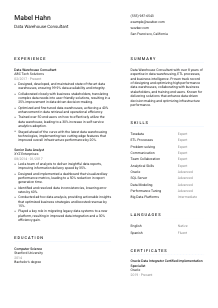
Building data foundations, but your resume feels in the dark? Illuminate your path with this Data Warehouse Consultant resume example, created with Wozber free resume builder. Learn how to blend your data architect skills with job specifics, ensuring your career journey is as streamlined as the solutions you design!
Data warehouse consulting sits at the point where data architecture meets business use. Hiring teams want to see more than general BI exposure. They look for someone who can design reliable warehouse structures, keep data accurate at scale, and turn stakeholder requests into models, pipelines, and reporting layers that people can actually use.
A tailored resume helps separate hands-on warehouse consultants from broader data professionals whose work stayed closer to reporting or analysis. Using Wozber's free resume builder to shape an ATS-compliant resume around the posting makes it easier to surface the right signals early, from ETL and data modeling to platform experience and business-facing delivery.
For a Data Warehouse Consultant, the header should establish professional alignment fast. This section is brief, but it still needs to confirm who you are, how to reach you, and, when relevant to the posting, whether you already meet location expectations.
Place your full name at the top in a clean, readable format. Keep the styling professional and simple. In technical consulting roles, clarity wins over design flourishes, and your header should feel as organized as the systems you build.
If you are applying for a Data Warehouse Consultant position, use that title directly under your name when it accurately reflects your background. This helps align your resume with the posting and avoids confusion with adjacent profiles such as BI Developer, Data Engineer, or Senior Data Analyst.
Include a current phone number and a professional email address. Add your city and state when location matters. In the example, listing San Francisco, California immediately supports a posting that requires local presence and removes a common screening question before it comes up.
Include LinkedIn, a personal site, or a portfolio only if it adds useful depth. For this profession, that could mean project summaries, platform expertise, architecture work, dashboard ecosystems, or consulting outcomes tied to warehousing, migration, or performance tuning.
Do not include age, marital status, gender, or other personal identifiers that have no bearing on warehouse design, ETL delivery, or stakeholder consulting. Keep the section focused on job-relevant facts and easy recruiter access.
Your header should tell a hiring team, in seconds, that you are reachable, professionally aligned, and, where required, already in the right market for the role.




This is the section most likely to decide whether you move forward. Data Warehouse Consultant resumes are strongest when they show architecture work, ETL and modeling depth, platform familiarity, performance gains, and the ability to translate business needs into working data solutions.
Start by identifying the repeated technical and consulting themes in the job description, then bring those into your experience bullets. Here, that means data warehousing, ETL processes, data modeling, platform knowledge, performance optimization, and stakeholder collaboration. If you have done the work, use the same language naturally in your role descriptions so both reviewers and ATS tools can connect your experience to the opening.
List positions in reverse chronological order with title, employer, and dates. That straightforward structure works well in an ATS-friendly resume format and lets hiring teams quickly map your career progression from analysis or BI work into warehouse consulting, architecture, or platform ownership.
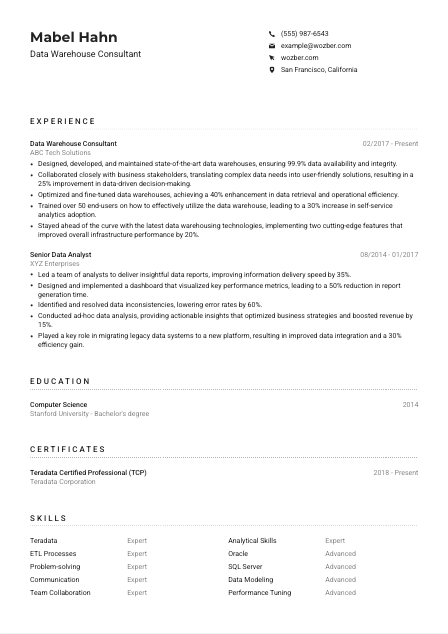
Focus your bullets on what you designed, built, improved, or supported. Good warehouse bullets mention things like schema design, ETL orchestration, data integrity, warehouse maintenance, stakeholder requirements, user training, or query optimization. The example does this well by showing warehouse design, stakeholder translation, end-user enablement, and infrastructure improvement instead of vague ownership language.
Quantify results with measures that matter in this field, such as data availability, retrieval speed, error reduction, adoption of self-service reporting, migration efficiency, or improvement in decision support. Metrics like 99.9% data availability, 40% faster retrieval, or 30% higher analytics adoption read as credible because they connect directly to warehouse performance and business use.
A resume for warehouse consulting should prioritize relevant technical and consultative work over unrelated accomplishments. Keep older or less aligned roles only if they show transferable strengths such as reporting automation, data quality improvements, legacy migration, or stakeholder-facing analytics. Everything on the page should help explain why you can own warehouse design, tuning, and business-facing delivery.
By the end of the experience section, your resume should make your warehouse scope clear: the platforms you worked with, the data problems you solved, and the operational or business results your work improved.
Most Data Warehouse Consultant roles still expect a formal technical foundation, especially when the work involves modeling decisions, database architecture, ETL logic, and cross-functional consulting. Education does not need much space, but it should answer the requirement cleanly.
If the posting asks for a bachelor's degree in Computer Science, Information Systems, or a related field, present that information clearly. Do not bury the degree name or field. In the example, "Bachelor's degree" and "Computer Science" line up directly with the job requirement, which helps the reviewer confirm eligibility quickly.
List degree, field of study, school name, and graduation year in a clean order. This supports ATS parsing and keeps the section easy to read. For experienced consultants, that is usually enough unless your academic work directly strengthens your case for the job.
If your degree is closely tied to databases, information systems, analytics, or software engineering, make that connection visible. A technical field of study reinforces your grounding in data structures, SQL, systems thinking, and analytical methods that matter in warehouse environments.
Include courses only when they support your target role in a meaningful way. Useful examples might include database systems, data modeling, distributed systems, business intelligence, or data mining. This is especially helpful for earlier-career candidates who need more evidence of technical depth.
Honors, capstone projects, or relevant research can help if they relate to warehousing, analytics, or enterprise data systems. For senior candidates, keep these additions brief and only include them when they reinforce the technical direction of your career.
Your education section should quickly confirm that you meet the role's academic baseline and have the technical grounding expected for warehouse architecture and BI-focused consulting work.
Certifications are especially useful in data warehouse consulting because they add credibility around specific platforms, integration tools, and BI ecosystems. They are rarely the main reason someone gets hired, but they can strengthen a profile when the role mentions named technologies.
Look at the technologies in the posting and prioritize certifications that support them. For a role mentioning Teradata, Oracle, Microsoft BI, ETL tools, or Big Data platforms, credentials in those areas show focused investment in the same environment the team uses.
Choose certifications that relate to warehousing, data integration, modeling, or BI delivery rather than broad generic tech badges. In the example, Teradata and Oracle Data Integrator certifications work because they support the role's platform and ETL expectations directly.
If the certification is current, active, or recently earned, include the date or validity period. That is particularly useful in data roles where tool versions, cloud platforms, and integration practices shift over time.
Ongoing certification can support your resume when you are moving toward more senior consulting work, platform specialization, or broader architecture responsibility. Prioritize credentials that sharpen your command of warehouse performance, data integration, governance, or modern analytics infrastructure.
Relevant certifications should strengthen your technical credibility around the warehouse stack, not distract from experience. Keep the list focused on tools and methods that support the role you are targeting.
The skills section should read like a clean snapshot of your warehouse toolkit. For this profession, that means balancing core database and ETL capabilities with modeling, optimization, and communication skills that matter in consulting-heavy environments.
Read the job description for explicit tools and the less obvious capabilities behind them. Here, the clear technical needs include Teradata, Oracle, SQL Server, Big Data platforms, ETL processes, and data modeling. The consulting side includes analytical thinking, problem-solving, and the ability to explain data concepts in business terms.
Mirror the employer's language where it accurately reflects your background. If you have hands-on experience with Teradata or SQL Server, name those platforms directly instead of hiding them under broad labels like "databases." The example's use of rated skills such as "Teradata," "ETL Processes," and "Performance Tuning" creates a much clearer technical picture.
Do not overload this section with every tool you have touched. Prioritize the skills most likely to influence screening for warehouse consulting roles: database platforms, ETL or ELT, data modeling, performance tuning, BI support, stakeholder communication, and analytical problem-solving. A concise list is easier to scan and stronger in ATS optimization when the terms match your real experience.
Your skills section should make the warehouse environment you can step into immediately obvious, from core platforms and modeling work to the consulting skills needed to work with business users.
Language skills matter most in this profession when the role involves stakeholder workshops, training, documentation, and explaining technical tradeoffs to non-technical teams. List them clearly, with English covered first when the posting makes it a requirement.
If English proficiency is listed as vital, show it at the top of the section with an honest level such as Native or Fluent. That matters in a consulting role where requirements gathering, user training, and business translation are part of the job, not side tasks.
Other languages are worth listing when they reflect real working ability. They can be helpful in multinational organizations, distributed analytics teams, or client-facing environments where data discussions cross regions and business units.
Stick to standard terms such as Native, Fluent, Intermediate, or Basic. Avoid vague descriptions. Hiring teams should be able to understand your communication level as quickly as they understand your SQL or ETL background.
Extra languages are most useful when they support cross-functional delivery, stakeholder alignment, training sessions, or documentation across teams. In a warehouse consulting context, communication often affects user adoption as much as technical build quality does.
Only list languages you can use with confidence in a professional setting. For example, native English and fluent Spanish can be meaningful if your work includes end-user training, international reporting groups, or cross-border consulting support.
For Data Warehouse Consultants, language ability supports more than conversation. It can improve requirement gathering, user training, and the day-to-day work of turning complex data structures into something business teams can use.
The summary needs to establish your level quickly: how long you have worked in warehousing or BI, what technical ground you cover, and what kind of business outcomes your work supports. Keep it short, but make it specific enough that the rest of the resume has a clear frame.
Before writing, identify the few themes that matter most for the position. For this kind of opening, that usually means years in data warehousing or BI, ETL and data modeling strength, platform experience, performance tuning, and business-facing consulting.
Lead with a direct line that states who you are and how much experience you bring. A phrase like "Data Warehouse Consultant with over 8 years of experience" works because it immediately places you at the right seniority level for a posting asking for 5+ years.
Use the next sentence to name your most relevant technical and consulting strengths. Good examples include designing and maintaining data warehouses, optimizing ETL and retrieval performance, or translating stakeholder needs into scalable data solutions. The sample summary works because it combines technical delivery with business collaboration rather than treating them separately.
End with a result-oriented line that shows the value of your work, such as improved data availability, faster reporting, stronger self-service analytics adoption, or better decision support. Keep the whole summary to 3 to 5 lines so it reads quickly in both human review and ATS-friendly resume templates.
A strong summary should position you as someone who can build and improve warehouse environments, work credibly with business stakeholders, and contribute from day one in a data-heavy consulting role.
A Data Warehouse Consultant resume works best when every section points to the same story: you understand warehouse architecture, ETL and modeling, platform performance, and the business context behind the data. When that story is consistent, hiring teams can quickly see whether you belong in a consulting, BI, or warehouse modernization conversation.
Use Wozber's free resume builder to organize that story in an ATS-friendly resume format, then refine the wording with Wozber's AI resume builder and ATS resume scanner so the language matches the posting naturally and the most relevant requirements appear in the right sections.
At that point, your resume should make one thing easy to judge: whether you can step into the warehouse environment, improve it, and help the business use it well.




