



Use Wozber and land your dream job
Create Resume
No registration required
Navigating networks, but your resume goes offline? Plug into this Data Center Engineer resume example, created with Wozber free resume builder. Learn how matching your infrastructure insights to the job requirements can keep your career connection strong and always online!
Data center engineering is judged in live environments where uptime, hardware reliability, and clean execution matter every day. A resume for this field needs to show that you can work comfortably around servers, storage, network infrastructure, and operational change without creating risk. Hiring teams want to see more than general systems experience. They look for signs that you can deploy, maintain, troubleshoot, and scale infrastructure in environments where downtime has real business cost.
When the resume is tailored well, your operational scope becomes easier to read quickly, especially in ATS screening and early technical review. Wozber's free resume builder helps you align your wording with the posting, keep an ATS-friendly resume format, and surface details such as hardware support, capacity planning, and performance improvements so the employer can quickly see whether your background matches the demands of running a data center well.
For a Data Center Engineer, the personal details section does one practical job first. It confirms that you are reachable, professionally presented, and logistically viable for the opening. Keep it lean, accurate, and aligned with the role's stated requirements.
Place your name at the top in a clean, readable format. In infrastructure hiring, clarity matters. A straightforward header helps the reviewer move quickly into the technical content of your resume without distraction.
Add "Data Center Engineer" directly beneath your name when that is the role you are targeting. This removes ambiguity, especially if your past titles include related labels such as Infrastructure Engineer or Systems Engineer, and keeps your resume aligned with the posting from the first line.
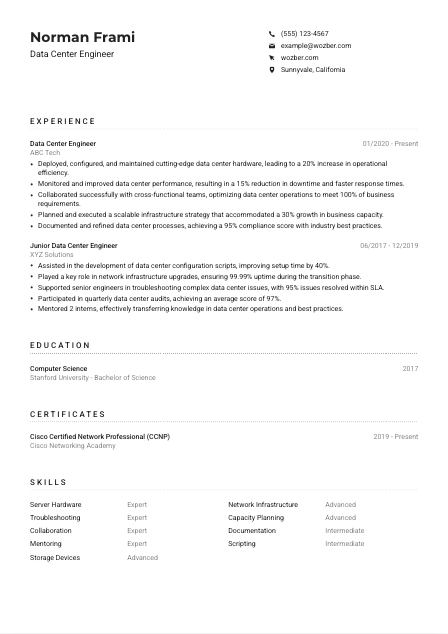
If the posting specifies a location requirement, reflect it clearly. Here, listing Sunnyvale, California supports the employer's need for someone already local or ready to relocate. That kind of detail can remove an avoidable objection early, especially for roles tied to on-site infrastructure work.
Include LinkedIn or a professional site if it reinforces your infrastructure background. Make sure it matches your resume on dates, titles, and certifications. For data center roles, a profile that shows progression across operations, hardware, networking, or facility-scale support can strengthen credibility.
This section should confirm the basics fast: who you are, what role you are targeting, and whether you meet the logistics of the job. Once that is clear, the hiring team can focus on your technical track record.




This is the section most likely to decide whether your resume moves forward. Data center hiring teams look for proof that you have handled real infrastructure, kept systems stable, worked through incidents, and supported growth without losing control of reliability or process.
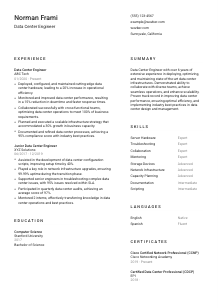
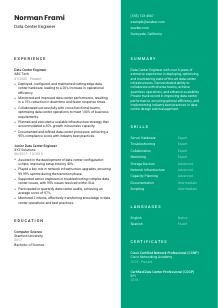
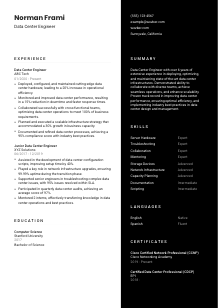
Start by marking the operational themes in the posting: deployment, configuration, maintenance, monitoring, capacity planning, troubleshooting, and documentation. Then make sure your bullets speak to those same areas using work you have actually done. The sample resume does this well by tying deployment and maintenance work to a 20% gain in operational efficiency instead of leaving the scope vague.
List roles in reverse chronological order with title, employer, and dates. That timeline matters in infrastructure hiring because it shows how your responsibility has grown, whether from junior support into hands-on engineering, or from maintenance into planning and optimization. Keep the structure simple so the reviewer can track your progression quickly.
Generic lines such as "responsible for data center operations" do not say much. Strong bullets connect the work to outcomes, scale, or reliability. Use verbs like deployed, configured, monitored, optimized, troubleshot, documented, or planned. A bullet about reducing downtime by 15% or supporting 99.99% uptime says far more than a broad claim about supporting infrastructure.
Numbers carry weight here when they reflect how infrastructure performance is actually measured. Good examples include uptime, incident resolution against SLA, efficiency gains, reduced downtime, faster setup time, audit scores, growth capacity, or compliance rates. The example resume uses these well with metrics like 30% capacity growth and 95% compliance with best practices, which makes the work easier to picture.
Prioritize experience tied to hardware, storage, networking, monitoring, reliability, documentation, and cross-functional execution. If you include adjacent systems work, frame it in a way that supports the target role. A scripting bullet is useful, for example, when it improved setup time or standardized configuration, not when it drifts into unrelated software work.
Your experience section should leave no doubt that you can support live infrastructure, improve performance, and handle operational pressure. Focus on the work that shows you can keep a data center dependable while it scales.
Education is usually not the longest section for an experienced Data Center Engineer, but it still matters because many employers use it as an early qualification check. Present it clearly and make the technical foundation easy to see.
If the posting asks for a bachelor's degree in Computer Science, Information Technology, or a related field, list your degree in a way that makes that match obvious. A Bachelor of Science in Computer Science, as shown in the example, immediately satisfies the requirement without extra explanation.
Include degree, field of study, school, and graduation year. That is usually enough. In technical hiring, this section works best when it is fast to scan and does not compete with your infrastructure experience for space.
Write the official degree title rather than abbreviating loosely or using internal program labels. Precision helps both ATS parsing and human review, especially when the employer has set a formal education requirement.
Most mid-level candidates can skip coursework. If you are early in your career, though, relevant subjects such as computer networks, operating systems, storage systems, or systems administration can help connect your education to data center work.
Projects, honors, or lab work are worth adding only when they support the role directly. For example, a capstone involving infrastructure design, network topology, or systems reliability is more useful than unrelated academic activities.
This section should confirm that you meet the baseline technical requirement and let the reader move on quickly to your hands-on infrastructure work. For most Data Center Engineers, experience will carry more weight, but education still needs to be easy to verify.
Certifications matter in data center hiring because they can reinforce technical depth in networking, facility operations, and best-practice execution. They are especially useful when the employer mentions them directly, as this posting does with CCNP and CDCP.
When a job description calls out certifications, put matching ones front and center. For this role, CCNP and CDCP are both directly relevant because they support networking knowledge and data center operations. If you hold one of them, make it easy to find.
List certifications that strengthen your case for infrastructure deployment, operations, networking, resilience, or standards. A shorter list of well-matched credentials usually works better than a long list of marginal ones.
Technical credentials can expire or require renewal, so include dates or current status where relevant. That helps the reviewer understand whether your certification is current and still meaningful in a fast-moving infrastructure environment.
Data center work changes with new hardware platforms, automation practices, network architectures, and operational standards. Ongoing certification or training shows that your knowledge is current and that you stay engaged with the field beyond day-to-day maintenance work.
Certifications will not replace solid experience, but they do strengthen your profile when they align with the role's infrastructure demands. List the ones that add real credibility to your hands-on background.
The skills section should read like the toolkit behind your experience. For Data Center Engineer roles, that usually means a mix of hardware knowledge, network understanding, operational troubleshooting, documentation discipline, and collaboration with adjacent teams.
Start with the language used in the job description. Here, that includes server hardware, storage devices, network infrastructure, troubleshooting, communication, and capacity planning. Mirroring those terms helps ATS matching and also keeps your resume anchored in the employer's actual environment.
Lead with the technical capabilities most central to the role, then add supporting strengths. Infrastructure hiring teams usually care more about whether you can handle servers, storage, networking, monitoring, and incident response than whether you have a long list of broad soft skills. Include collaboration and communication, but do not let them crowd out core engineering abilities.
Use skills you can defend in an interview or back up in your experience bullets. The example resume works because skills such as troubleshooting, capacity planning, documentation, and scripting all connect to visible accomplishments. That consistency matters more than trying to sound comprehensive.
A well-built skills list should echo the infrastructure problems you solve and the systems you work on. If the section matches your experience and the posting's language, it will support both ATS optimization and technical review.
Language ability is rarely the main differentiator for a Data Center Engineer, but it can still matter when the role requires clear incident communication, documentation, or coordination across teams and vendors. Present this section in a simple, factual way.
If the posting states a language requirement, list it explicitly. In this case, strong English communication is part of the role, so English should appear on the resume with an honest proficiency level.
Order languages by role relevance. For a U.S.-based data center role, English should come first because it affects documentation, troubleshooting updates, handoffs, and communication with operations or network teams.
Additional languages can still add value, especially in global organizations or vendor-facing environments. They are supportive details, though, not a substitute for the technical and operational content elsewhere in the resume.
Use standard labels such as Native, Fluent, Advanced, or Intermediate. Clear proficiency labels prevent overstatement and help the employer understand how you can communicate in practical work settings.
Some data center environments involve cross-regional support, global incident coordination, or documentation shared across teams. In those cases, extra language ability can be a useful secondary advantage, especially when paired with strong technical communication.
This section should confirm that you can communicate at the level the role requires and, if applicable, add a little extra range for multi-team or international environments. Keep it concise and credible.
The summary is your opening read on the page, and for a Data Center Engineer it should quickly establish technical depth, operational scope, and the kind of outcomes you deliver. Skip broad claims and use the space to define the work you do well.
Before writing, identify the few priorities that show up most strongly in the job description. For this posting, those include infrastructure deployment, performance monitoring, operational reliability, capacity planning, and documentation. Use those themes to shape the summary rather than writing a generic systems-engineering profile.
Begin with your role identity and years of experience. A line such as "Data Center Engineer with 6+ years of experience in data center design, operations, and infrastructure maintenance" gives immediate context and helps the reader place your seniority.
Use one or two concrete strengths tied to business results. The example summary works because it connects infrastructure work with efficiency, scalability, and smooth operations. You can do the same with outcomes like uptime improvement, faster deployments, audit compliance, or capacity growth, depending on your own background.
Aim for a short paragraph that is dense with relevant information. Every phrase should connect to data center work, whether that means hardware deployment, troubleshooting under pressure, network and storage support, or process discipline. If a sentence could fit almost any IT role, revise it.
A strong summary should quickly tell the employer what kind of data center environment you have supported and what results followed from your work. Get that right, and the rest of the resume becomes much easier to read in your favor.
A Data Center Engineer resume should make three things easy to see: the infrastructure you have supported, the reliability or efficiency you improved, and the scope you can handle under operational pressure. If those points are clear across your experience, skills, and summary, you give hiring teams a practical reason to move you forward.
Use Wozber's free resume builder to tighten the language, keep an ATS-compliant resume structure, and check alignment with the posting through its ATS resume scanner. The final resume should make it easy to judge your readiness to deploy, maintain, troubleshoot, and scale data center operations with confidence.




