



Use Wozber and land your dream job
Create Resume
No registration required
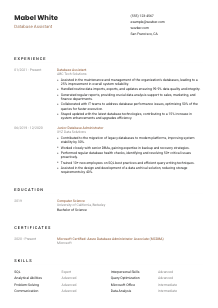
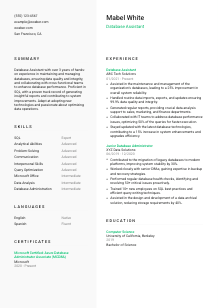
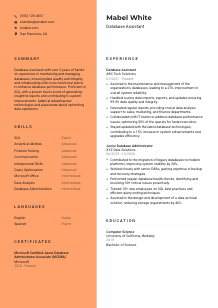
Tuning queries, but your resume gets ambiguous responses? Browse this Database Assistant resume example, created with Wozber free resume builder. Learn how to index your database dexterity to meet job criteria, keeping your career flow in sync and never stuck in deadlock!
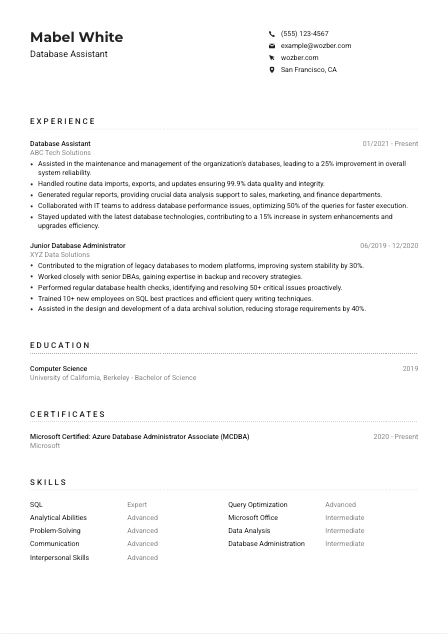
Database Assistant work is judged in the details. Teams rely on you to keep records accurate, move data cleanly between systems, troubleshoot query issues, and turn raw tables into reports other departments can actually use. Your resume should make that operational reliability visible, not just say you have worked with databases.
When a database resume is tailored well, reviewers can quickly see whether you have handled the kinds of tasks that matter here, such as SQL-based updates, data integrity checks, recurring reporting, and coordination with IT or business teams. Wozber's free resume builder helps organize that experience into an ATS-compliant resume, so the right database terms and responsibilities surface clearly before a hiring team decides who moves forward.
For a Database Assistant, the contact section should be clean, precise, and easy to scan. This role centers on accuracy, so basic details need to look dependable from the first line.
Place your name at the top in a clear, readable format. Skip decorative styling. In technical support roles like database operations, a clean header suggests the same attention to structure you would bring to data records and reports.
Add "Database Assistant" under your name when that is the role you are pursuing. Matching the posted title helps position you correctly, especially when employers are sorting applicants across related profiles such as data analyst, junior DBA, or systems support.
Use a professional email address and a phone number you actively monitor. One typo in this section can derail an otherwise solid application, and for a role tied to data quality, careless contact details send the wrong message.
If the posting asks for a specific location, reflect it clearly. In this example, listing San Francisco, CA addresses an explicit requirement without taking up more space than needed.
Include LinkedIn or a personal site only if it supports your application. For a Database Assistant, that might mean a profile with consistent job dates, SQL coursework, database projects, or technical certifications. If the link adds no useful context, leave it out.
Keep this section brief, accurate, and aligned with the posting. It should confirm that you are reachable, professionally presented, and already matched to basic requirements such as title and location.




This is the section hiring teams read most closely for database support roles. They want to see what systems you maintained, what data work you handled, how you improved reliability or performance, and whether you can support both technical and business users.
Read the responsibilities and translate them into experience themes you can prove. For this role, that includes database maintenance, imports and exports, data integrity, reporting, query optimization, and collaboration with IT teams. Those should appear naturally in your bullet points if you have done comparable work.
List positions in reverse chronological order with job title, employer, and dates. Database hiring often involves quick comparisons between candidates with similar technical backgrounds, so your structure should make progression and relevant tenure obvious at a glance.
Focus each bullet on work that changed system performance, data quality, reporting quality, or team efficiency. The sample resume does this well by tying daily database support to outcomes such as improved reliability, cleaner data updates, and faster queries. That is much stronger than generic lines like "responsible for managing databases."
Use numbers where they reflect real operational impact. Useful examples include query execution improvements, uptime or reliability gains, issue counts resolved, report volume, record accuracy, migration scope, or storage reduction. Metrics like 99.9% data quality or 50% query optimization gains work because they sound native to database operations.
If an older role included mixed responsibilities, prioritize the parts tied to SQL, relational databases, backups, health checks, reporting, system upgrades, or troubleshooting. Hiring managers do not need every task you handled. They need the experience that shows you can support production data work with care and consistency.
Your experience should show that you can keep databases dependable, support routine data operations without introducing errors, and contribute to performance improvements that other teams notice.
Database Assistant roles often ask for a technical degree because employers want a baseline understanding of data structures, SQL logic, and information systems. Present your education in a way that confirms that foundation quickly.
If you have a Bachelor's degree in Computer Science, Information Systems, or a related field, make that easy to spot. In the example, a Bachelor of Science in Computer Science directly satisfies the educational requirement listed in the posting.
List degree, field of study, school, and graduation year. This section does not need extra styling. It should be fast to verify, especially when the employer is checking whether you meet a stated academic baseline.
Use the formal degree name rather than shortening it too much. If your background is adjacent, such as software engineering or information technology, keep the field accurate and let the rest of your resume show the database relevance.
Early-career candidates can strengthen this section with relevant classes such as database systems, SQL, data modeling, information management, or systems analysis. For someone with a few years of experience, coursework matters less unless it fills an obvious gap.
Projects, honors, or research can help if they connect to databases, reporting, or data architecture. A capstone involving relational schema design or query performance tuning is relevant. General campus activities usually are not worth the space unless you are very early in your career.
This section should confirm that you have the technical foundation to work comfortably with structured data, database concepts, and the day-to-day demands of SQL-based support work.
Certifications matter most when they reinforce the platform knowledge or database administration skills the employer values. For a Database Assistant, they can strengthen your profile when your experience is still growing or when the posting names a preferred credential.
Put the most relevant credential first. Here, the posting lists Microsoft Certified: Azure Database Administrator Associate as a plus, so an Azure database certification deserves prominent placement if you hold it.
A short list of database, cloud data, SQL, or platform administration credentials is stronger than unrelated certifications. Employers scanning for database support capability will care far more about Azure, SQL Server, or data management training than broad office software courses.
Add the year earned or the active date range when appropriate. In database work, current knowledge matters because tooling, cloud services, backup practices, and security standards change quickly.
If you are targeting roles that touch Azure, SQL Server, or cloud-hosted relational databases, ongoing certification work can make your resume more competitive. It shows you are keeping up with the systems and administration practices behind modern database environments.
Relevant certifications back up your technical claims and can tip the balance when the employer wants database support experience plus proof of current platform knowledge.
For a Database Assistant, the skills section should read like a practical toolkit for maintaining data quality, supporting reporting, and working inside relational database environments. Generic filler weakens it fast.
Start with the skills the employer names directly, then add closely related capabilities you can support elsewhere in the resume. In this case, SQL, relational databases, analytical ability, problem-solving, and communication all belong near the top.
This role sits between systems and people. Include hard skills such as SQL, query optimization, database administration, data imports and exports, reporting, or backup support alongside soft skills like stakeholder communication and cross-team coordination. The mix matters because the job includes both technical maintenance and department-facing data support.
Put the most role-specific items first. SQL should appear before broader tools like Microsoft Office. If you use ratings, keep them believable and consistent. The sample resume gets this mostly right by leading with SQL and analytical skills before secondary tools.
Your skills list should quickly tell a reviewer that you can work hands-on with databases, solve routine data issues, and communicate clearly when reports, updates, or system problems affect other teams.
Language skills are usually a secondary section for database roles, but they still matter when the posting calls one out directly or when the job involves support across multiple teams. Keep this section factual and brief.
If the employer specifies English proficiency, list English clearly with an honest level. In this posting, English is required, so it should appear before any additional language entries.
Order languages by practical value for the job. For most Database Assistant roles in the U.S., English leads because it affects documentation, ticket handling, reporting notes, and day-to-day communication with IT and business teams.
Additional languages can help in organizations with multilingual teams or customer data operations, but they are usually a supporting detail rather than a deciding factor. Include them when they are genuine and professionally usable.
Use plain labels such as "Native," "Fluent," or "Intermediate." Avoid vague descriptions. Clear proficiency levels are especially important in roles where report explanations, issue escalation, and cross-functional communication need to be handled accurately.
Do not let languages take up more space than technical qualifications unless the role is explicitly multilingual. For most database support applications, this section should confirm communication capability, not compete with SQL, reporting, or systems experience.
List languages clearly, lead with the one the employer requires, and keep the focus on communication that supports accurate reporting, stakeholder coordination, and everyday database operations.
The summary should frame you as someone who can support database operations reliably from day one. Focus on the kind of work you have handled, the tools you use confidently, and the operational results you have delivered.
Before writing, identify the two or three themes that matter most in the posting. Here, that means database maintenance, SQL proficiency, data quality, reporting support, and collaboration around performance issues. Your summary should touch the strongest of these based on your background.
Start with your title or closest equivalent, followed by your years of experience and area of focus. "Database Assistant with 3+ years of experience supporting relational databases and SQL-based data operations" is more useful than a broad statement about being motivated or detail-oriented.
Use the next sentence or two to mention real strengths such as maintaining database reliability, improving query performance, supporting business reporting, or preserving data accuracy across imports and updates. The sample summary works because it ties hands-on database work to concrete operational value rather than listing buzzwords.
Aim for a short paragraph, usually 3 to 5 lines. Every phrase should help a reviewer understand your database background quickly. Save longer tool lists and detailed metrics for the experience section, where they can be expanded properly.
A well-written summary gives immediate context for your database experience and makes it easy to see why your background matches the technical support, reporting, and data quality demands of the role.
Shape your resume around the work Database Assistants are actually trusted to do: maintain database reliability, protect data integrity, support reporting, and help improve system performance. Use role-specific wording, measurable outcomes, and clean formatting so both hiring teams and ATS tools can follow your experience without guesswork.
Wozber's free resume builder, ATS resume scanner, and ATS-friendly resume format make that tailoring process faster and more precise by helping you align your language with the posting and surface missing requirements. The final result should make one thing clear right away: you can be trusted with live data operations.




