



Use Wozber and land your dream job
Create Resume
No registration required
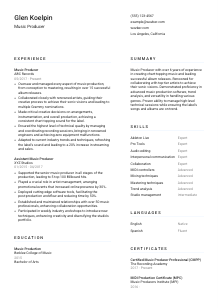
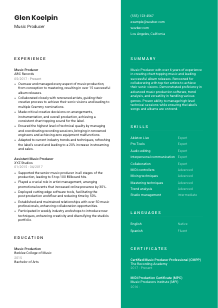
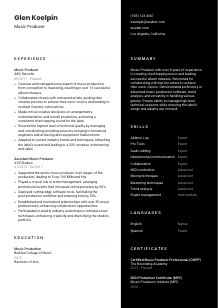
Cooking up tracks, but your resume isn't hitting the right notes? Sync up with this Music Producer resume example, created with Wozber free resume builder. It shows how to tune your production prowess to match job specifications, so your career always hits the highest charts!
Music production resumes are strongest when they show how you shape sound from early concept through final master. Hiring teams want to see creative judgment, technical control in the studio, and the ability to bring artists, engineers, and session players toward one finished record without losing momentum or quality.
A tailored resume helps separate producers who have touched a few tracks from those who can actually run sessions, guide arrangements, and deliver release-ready work. Using Wozber's free resume builder to align your wording with the job description and keep an ATS-compliant resume structure makes it easier for reviewers to spot the production scope, tools, and results that matter first.
In music production, the top of the resume should feel as organized as a well-run session file. Keep this section clean, professional, and immediately relevant so the reader can move straight to your production credits, tools, and studio experience.
Your name should be the clearest line on the page, set in a readable font and slightly larger than the rest. Producers often work through referrals, credits, and repeat collaborators, so make it easy for someone to remember and search you after scanning your resume.
Place "Music Producer" directly below your name when that matches the role you are targeting. This removes guesswork right away, especially when employers are sorting applicants across adjacent profiles like audio engineers, beat makers, composers, and studio managers.
List one phone number and a professional email address you actually monitor. If you include a website, make sure it leads to current work such as production credits, selected releases, discography highlights, or a portfolio that reflects your sound and client range.
If a posting requires local presence for studio sessions, label meetings, or in-person collaboration, include your city and state. Here, Los Angeles, California matters because the employer asked for it specifically. If location is less critical in another posting, you can keep it simpler.
A website, portfolio, or LinkedIn profile should extend the resume, not repeat it. Link to finished tracks, artist collaborations, production credits, or project summaries that show genre range, mixing quality, and the level of artists or labels you have worked with.
This section should confirm who you are, what role you do, and how to reach you without clutter. When the details are clean, the hiring team can focus on the sessions, releases, and production decisions that define your work.




Experience is where a Music Producer resume earns attention. Credits matter, but employers also look for what you controlled in the process, how you worked with artists, and whether your productions led to release quality, audience growth, or commercial traction.
Read the posting for the parts of the workflow they care about most. For this role, that includes overseeing projects from pre-production to mastering, collaborating with artists and songwriters, managing recording sessions, and keeping the sound current. Build your bullets around those responsibilities instead of listing generic studio tasks.
Start with your latest production role and work backward. For each entry, include your job title, company, studio, label, or freelance entity, plus dates. That timeline should quickly show whether you meet the requested 5+ years of professional production experience.
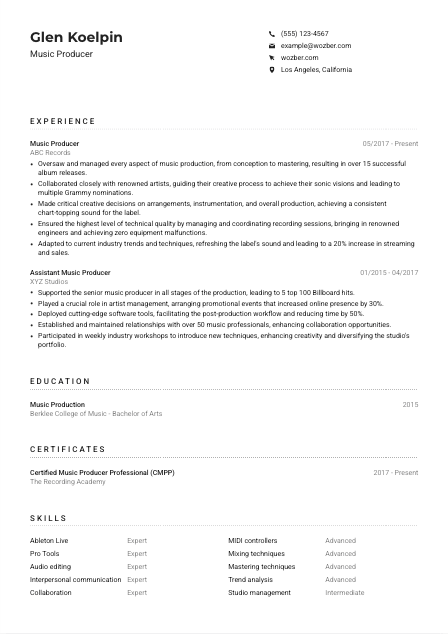
Each position should make clear where you led creative and technical decisions. Mention arrangement choices, instrumentation, vocal direction, session coordination, editing oversight, mixing input, or final mastering involvement. The example does this well by stating ownership of the full production process and tying it to more than 15 album releases.
Quantify with release counts, chart performance, nomination history, streaming lift, turnaround improvements, or reduction in studio issues when those metrics are real. "Multiple Grammy nominations," "5 top 100 Billboard hits," or a "20% increase in streaming and sales" gives much better context than saying you produced successful music.
If you have worked across pop, hip-hop, R&B, electronic, film, indie, or other genres, say so through your credits and bullets. The posting asks for production experience across various genres, so your resume should show range through actual projects, artist types, or sonic approaches rather than a vague claim of versatility.
A useful experience section shows far more than job titles. It should tell the reader what kind of producer you are, how you run sessions, and what your work delivered once it left the studio.
Education carries weight in music production when it supports technical grounding, studio fluency, and formal training in audio workflows. Keep it straightforward, especially when the posting asks for a bachelor's degree in Music Production, Audio Engineering, or a related field.
If you have the requested bachelor's degree, list it in a way that is easy to scan. Include the degree name, school, field of study, and graduation year. In the example, a Bachelor of Arts in Music Production from Berklee College of Music aligns directly with the employer's requirement.
This section does not need extra narrative. A simple line for school, degree, field, and date is usually enough unless you are early in your career or your training is a major differentiator.
For music roles, the field matters as much as the degree. "Music Production," "Audio Engineering," or a related discipline should not be buried, because it tells the employer you were formally trained in recording, editing, signal flow, DAWs, and production fundamentals.
Include coursework or academic projects only if they strengthen your case, such as advanced mixing, mastering, sound design, recording technology, MIDI sequencing, or live session production. This is especially helpful for less experienced producers who need to show deeper studio exposure.
Honors, scholarships, or notable performance-based achievements can stay if they add relevant context. Keep them brief and only include them when they support the story of strong technical training, creative discipline, or recognized musical development.
For experienced producers, education is usually a supporting section, not the headline. Its job is to confirm formal training quickly and reinforce your command of the production environment.
Certificates are optional in many Music Producer applications, but the right ones can strengthen your profile when they point to current tools, production methods, or specialized training. Use them to reinforce relevant expertise, not to fill space.
Only include credentials tied to music production, recording technology, MIDI programming, mixing, mastering, or related studio practice. This posting does not require certifications, but examples like CMPP or a MIDI-focused credential can still support your professional development.
The value of a certificate depends heavily on who issued it. Prioritize respected institutions, established training providers, or recognized industry organizations that carry weight with artists, studios, and labels.
If the certification is current, recently earned, or shows continued relevance in evolving production workflows, include the date. In software-heavy fields like music production, recency helps show that your methods are not outdated.
Production tools, genre conventions, and release standards change fast. If you keep learning new DAWs, controller workflows, immersive audio methods, or updated mastering practices, relevant certifications can show that you stay engaged with the craft between projects.
Certificates should strengthen the production story already present in your experience and skills. A short, focused list works better than a long catalog of loosely related training.
The skills section should reflect how you actually work in production. That means pairing your core software and audio capabilities with the collaboration skills needed to guide artists, run sessions, and deliver polished tracks under deadline.
Pull the required technical skills directly from the job description where they match your background. Here, that includes Ableton Live, Pro Tools, MIDI controllers, audio editing, mixing, and mastering. Those terms matter both to the hiring team and to ATS matching, so use the exact phrasing when it is accurate.
Music producers are hired for both sonic judgment and collaboration. Alongside DAWs and post-production techniques, include skills like artist communication, session direction, cross-functional collaboration, and studio coordination. The example handles this well by mixing technical strengths with interpersonal communication and collaboration.
Choose skills you can back up through credits or achievements. A shorter list of relevant production tools and core capabilities usually lands better than a long spread of generic abilities. Grouping skills by technical, creative, and collaborative strengths can also make the section easier to scan.
When this section is done well, the reader should quickly understand your DAW fluency, audio craft, and ability to work with artists and engineers from demo stage to finished master.
Language skills are secondary for many Music Producer roles, but they still matter when the posting mentions them or when your work involves artists, writers, or teams from different markets. Keep this section factual and useful.
If the job calls for English proficiency, list English first and note your level clearly. That confirms you can handle artist communication, session direction, production notes, and professional collaboration in the language expected for the role.
Use plain labels such as Native, Fluent, Advanced, or Conversational. Overstating language ability can create problems fast in real studio settings where directions, revisions, and creative feedback need to be precise.
Additional languages can be valuable when you work with international artists, multilingual markets, or cross-border production teams. In the example, Spanish adds range without distracting from the core production qualifications.
Use the same rating style for every language so the section is easy to scan. A clean, consistent format looks more credible than mixing descriptors that are hard to compare.
If another language has helped you communicate with artists, direct sessions, or expand your collaboration network, it is worth including. In music, smoother communication can directly affect creative flow and session efficiency.
This part does not need to be long. It should simply confirm that you can communicate at the level the role requires and note any extra language range that could help in artist-facing work.
A Music Producer summary should quickly tell the reader what kind of projects you lead, how much experience you bring, and what production strengths show up across your work. Keep it concise, but make sure it sounds grounded in actual releases, sessions, and results.
Before writing, identify the few points that define the target role. In this case, that includes full-cycle production oversight, collaboration with artists, technical command of editing and mastering, and experience across genres. Your summary should bring those threads together in a few lines.
Lead with your title and years of experience, such as "Music Producer with 6+ years of experience." That immediately gives the employer a frame for your level and helps establish whether you meet the experience threshold.
Use one or two concrete achievements or distinguishing strengths, such as album releases, chart performance, artist collaborations, genre versatility, or strong command of DAWs and post-production. The example summary works because it combines years of experience, chart-oriented outcomes, and production versatility without becoming a long paragraph.
Aim for a short paragraph that sounds like you, not a collection of keywords. Focus on the production scope, technical strengths, and business or audience outcomes you can genuinely claim. If every sentence could apply to any creative role, it needs another revision.
Your summary should make it clear, within seconds, whether you are a producer who can guide artists, manage sessions, and deliver polished, market-ready music. Wozber's free resume builder helps shape that message into an ATS-compliant format that keeps your strongest production credentials easy to find.
A Music Producer resume should leave no doubt about the kind of work you can lead, the tools you know, and the results your productions have achieved. When the details are tailored to the posting, reviewers can quickly connect your credits, session leadership, and technical range to the role in front of them.
Use Wozber to build an ATS-friendly resume template, refine wording with role-specific terminology, and check alignment with an ATS resume scanner before you apply. The final read should make one thing easy to judge: you can take a project from concept to master with both creative and technical control.




