



Use Wozber and land your dream job
Create Resume
No registration required
Spinning grooves, but your resume misses the beat? Sync up with this DJ resume example, made with Wozber free resume builder. Learn how to show off your musical mastery in line with job criteria, keeping your career as fresh and pumping as the mixes you drop!
A DJ resume has to do more than say you love music. Hiring teams want to see whether you can read a room, hold energy across a full event, protect sound quality, and work within venue rules without killing the atmosphere. If your resume only lists gigs and gear, it misses the part that matters most in live performance work: how you turn track selection, transitions, and client communication into a packed floor and a smooth event.
The first pass often comes down to whether your resume clearly surfaces live-event experience, genre range, equipment fluency, and audience-facing work in language an ATS can parse. Wozber's free resume builder helps you shape that into an ATS-compliant resume that mirrors the posting naturally, so the hiring team can quickly see whether you can deliver the kind of set, professionalism, and event reliability they need.
This section is short, but for DJs it still sets a practical tone. Event work moves fast, and the basics need to confirm that you are reachable, professionally presented, and available for the market the role serves.
Use the name you actually book under, whether that is your full legal name or a professional performance name. Keep it easy to read and slightly larger than the rest of the header so promoters, venue managers, and recruiters can find it quickly when they revisit applications.
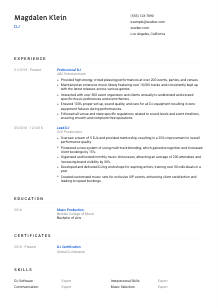
Place "DJ" near your name so the target role is immediately clear. If your background is more specialized, you can use a variation that still matches the posting, such as "Professional DJ" or "Lead DJ," as long as it reflects your real work and stays close to the employer's wording.
List a current phone number and a professional email address. DJs often get contacted on short timelines for venue calls, event confirmations, or follow-up questions about availability, so make sure nothing in this section creates friction.
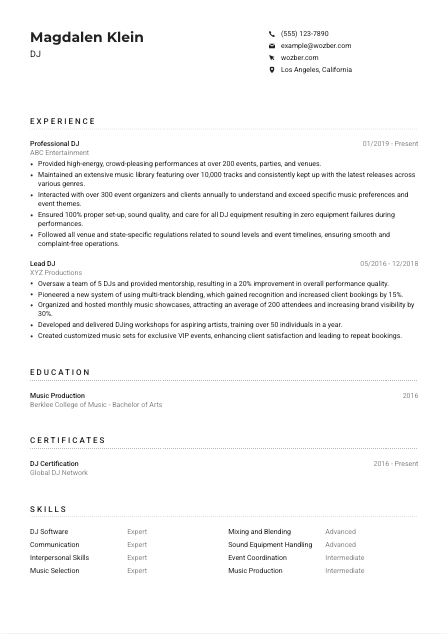
If a posting requires local availability, include your city and state exactly. In this example, Los Angeles, California matters because the employer wants someone already based there or ready to relocate. If you are relocating, make that clear rather than leaving the employer to guess.
A website, portfolio, or professional profile can strengthen your application if it shows mixes, event footage, client feedback, or your booking history. For a DJ, that kind of link works best when it supports the resume with real performance context, not just social activity.
Your header should answer the practical questions fast: who you are, how to reach you, and whether you can be considered for the booking without location or contact issues slowing things down.




For DJs, experience is where hiring decisions usually take shape. A list of past venues means little on its own unless it shows audience size, event volume, genre flexibility, client collaboration, equipment control, and the kind of results that lead to repeat bookings.
Before editing your experience bullets, isolate the work patterns in the job description. Here, the priorities are clear: high-energy performances, broad genre knowledge, seamless mixing, DJ software and equipment proficiency, client interaction, and compliance with venue rules. Use those themes to decide which bullets stay, which get rewritten, and which should be cut.
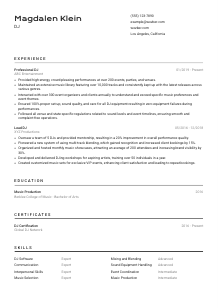
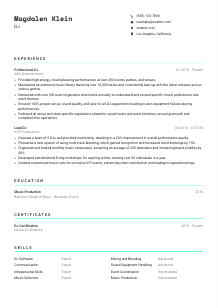
Start with your most recent role and include employer or company name, title, and dates. For DJ work, this structure matters because it shows consistency in live-event performance. The example does this well by moving from "Lead DJ" to "Professional DJ," giving the reader a quick sense of progression and time on the circuit.
Each bullet should show what you handled and what happened because of it. Instead of saying you "performed at events," specify the scope, the setting, or the client result. The sample bullet about delivering crowd-pleasing performances at more than 200 events works because it shows both volume and the kind of atmosphere the employer is hiring for.
Metrics make DJ experience easier to trust when they reflect real event work. Strong examples include number of events played, size of music library, repeat booking rates, client volume, attendee counts, equipment failure rate, or booking growth. In the sample, "over 10,000 tracks," "over 300 event organizers and clients annually," and "zero equipment failures" all communicate range, demand, and reliability in concrete terms.
Choose accomplishments that reinforce your value as a working DJ. Crowd management through music selection, custom sets for event themes, clean setup and teardown, or compliance with sound and timing restrictions belong here. If a point does not help show that you can deliver the kind of event this employer runs, leave it out, even if it was personally meaningful.
By the end of this section, the employer should be able to picture you handling the booth, the client brief, the crowd, and the equipment without extra hand-holding. That is what turns experience into booking confidence.
Formal education is rarely the deciding factor for a DJ role, but it can still strengthen your profile when it connects to music, production, audio, or live event work. It adds context for how you developed technical judgment beyond the booth itself.
If you studied music production, sound engineering, performance, or a related field, put that front and center. The example's Bachelor of Arts in Music Production works well because it supports both musical range and technical fluency, which matter when employers want seamless blends and dependable sound quality.
List the school, degree, field of study, and graduation year or date range. Keep this section easy to scan. In most DJ applications, education is supporting information, so clarity matters more than detail-heavy formatting.
When your studies relate directly to performance or audio, make that relevance obvious through the field name itself. A degree in Music Production, Audio Engineering, or Music Business helps frame your understanding of track structure, transitions, sound systems, and event execution.
You can include workshops, short programs, or focused study if they sharpen your case for the role. Audio mixing, live sound, music technology, or event production are useful additions when your formal degree is broader or when you are earlier in your career.
If you are newer to professional DJ work, educational achievements can carry more weight, especially if they include performance-based projects or music-tech training. Once you have several years of live event experience, keep education concise and let your bookings, client work, and measurable results lead.
This section should reinforce your technical and musical foundation, not compete with your event record. When it is relevant and concise, it adds useful depth without pulling focus from your live performance experience.
Certifications matter most when they support venue requirements, technical credibility, or the kind of events you want to book. For DJs, they can also show that you take the operational side of live entertainment seriously, not just the creative side.
Start with credentials that relate directly to DJing, live events, sound, or operations. In the example, a DJ certification is the strongest fit because the job description explicitly mentions certification or licensing where required by venue or state rules.
Order certificates by job relevance, not by prestige alone. A DJ or audio-related credential should usually appear before a broader event certificate, unless the job is heavily client-facing or production-heavy and that second credential clearly supports the role.
Include the issue date and, if relevant, the active period. This helps employers see whether your training is current, especially when venues have compliance standards or expect familiarity with current equipment and event practices.
As your career grows, add certifications that make sense for the events you want to work. That might include advanced DJ training, live sound, event safety, or production-related credentials. Choose courses that improve your actual performance range or operational reliability, not just the look of the resume.
Used well, certifications show preparedness for the technical, regulatory, and client-facing realities of live events. They are especially useful when a venue requires proof of training or when you want to show discipline beyond performance alone.
A DJ skills section works best when it reflects the full job, not just the gear. Employers want a mix of technical control, music judgment, live-event awareness, and audience engagement that fits the venues or events they run.
Start with the language the employer already uses. For this role, that includes DJ software, controllers, turntables, music genre knowledge, seamless blending and mixing, communication, and interpersonal skills. Those terms help your resume stay aligned with both ATS filtering and human review.
Do not make this section a hardware inventory. Include the tools and techniques you actually use, but also the skills that shape the event experience, such as music selection, crowd reading, client communication, and sound equipment handling. The example does this well by combining software, mixing, communication, and event coordination.
Only include skills you can support elsewhere in the resume. If you list "Mixing and Blending" at an advanced level, your experience bullets should back that up through genre range, smooth transitions, or custom sets. A shorter list of real strengths is more convincing than a long list with no proof behind it.
Your skills list should make it obvious that you can manage both the technical side of the setup and the human side of the event. That combination is what makes a DJ valuable in live bookings.
Language ability can matter more in DJ work than people expect. It affects how you handle MC moments, client discussions, event changes, and audience interaction, especially in multicultural venues, private events, and international-facing entertainment markets.
If the posting names a mandatory language, list it clearly with your proficiency level. Here, English is required, so it should appear first and be described accurately. Do not make employers hunt for a basic qualification that is essential to the role.
Extra languages can strengthen your appeal when you perform for diverse audiences or work closely with clients from different backgrounds. They are especially useful if they help with announcements, requests, event coordination, or building rapport before and during a set.
Choose clear terms such as "Native," "Fluent," "Advanced," or "Conversational." For DJs, overstating language ability can become obvious quickly in client calls or live event situations, so accuracy matters.
If you work weddings, private parties, tourist-heavy venues, or cross-cultural events, language skills can become a real booking advantage. They help you handle requests smoothly and adapt your audience engagement with less friction.
Languages are most valuable when they improve communication, comfort, and energy in the room. In the sample resume, Spanish adds useful breadth because it suggests the ability to connect with a wider client and guest base in addition to meeting the English requirement.
This section should show that you can communicate clearly where it counts: with clients, event staff, and the crowd. In live entertainment, that can directly affect how smoothly the night runs.
Your summary should quickly explain what kind of DJ you are, what level you operate at, and what you consistently deliver in live settings. It is strongest when it blends experience, musical range, technical control, and client-facing performance into a few well-chosen lines.
Read the posting for the recurring ideas, then reflect them in your own language. In this case, the employer is looking for high-energy performance, broad genre knowledge, seamless mixing, equipment proficiency, and strong communication with organizers and audiences.
Start with your title and years of experience, such as "DJ with 5+ years of professional experience." That immediately gives the reader a sense of your stage in the field and whether you meet baseline experience expectations like the 3-year requirement in this example.
Choose strengths that affect bookings and audience experience, not generic personality traits. Good options include maintaining a deep and current music library, blending across genres, customizing sets to event themes, or delivering reliable live performance under venue constraints.
Aim for a short paragraph that can be read in seconds. The sample summary works because it covers experience, music range, track blending, client satisfaction, and equipment handling without drifting into filler. Every sentence should help the employer imagine you in front of their audience.
After reading these opening lines, an employer should already understand your level, your style of work, and the type of event value you bring. That makes the rest of the resume easier to trust.
A DJ resume should leave no doubt about three things: you can perform, you can manage the event environment, and you can work professionally with clients, venues, and audiences. When your experience, skills, and summary all point in that same direction, the document starts to read like a booking decision rather than a general profile.
Use Wozber's free resume builder to tighten structure, match job language, and present your background in an ATS-friendly resume format. Wozber's ATS resume scanner can also help you spot missing requirements and align your wording with the posting, so your application is easier to shortlist for the gigs and venue roles you actually want.
The finished resume should make one thing easy to judge: whether you can step into the booth and deliver the night the client expects.




