



Use Wozber and land your dream job
Create Resume
No registration required
Conducting melodies, but your resume feels off-key? March through this Band Director resume example, created with Wozber free resume builder. Learn how to match your baton-waving talents to job criteria, orchestrating a career that hits all the high notes!
A Band Director resume has to show more than musicianship. Schools need someone who can run productive rehearsals, choose literature that matches student ability, prepare performances that reflect well on the program, and keep a classroom culture steady through busy concert seasons. Your resume should make that operational side of music education easy to see.
When the resume is tailored to the posting, hiring teams can quickly separate general music instruction from actual band program leadership. Wozber's free resume builder helps you align your language with the job description and create an ATS-compliant resume, so your experience with rehearsals, student assessment, performances, and program management is easier to recognize at a glance.
School hiring starts with practical basics. If your header is unclear, missing key contact details, or ignores a stated location requirement, your application can lose momentum before anyone reaches your teaching record or ensemble results.
Use your full name in a larger, clean font so the top of the resume feels professional and easy to scan. In education hiring, clarity matters. Principals, arts coordinators, and HR teams often review many applications at once, and a simple, polished header helps them move straight to your qualifications.
Place "Band Director" below your name if that is the role you are targeting. This keeps your positioning clear, especially if your past titles include Band Instructor, Music Teacher, or Senior Band Director. A direct title match helps the school immediately understand your focus.
Include a current phone number and a professional email address you check regularly. Hiring for school programs often moves around performance schedules, semester planning, and interview availability, so your contact details need to support quick follow-up without friction.
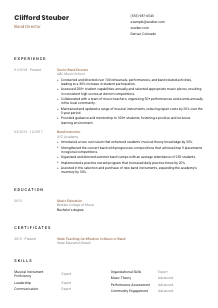
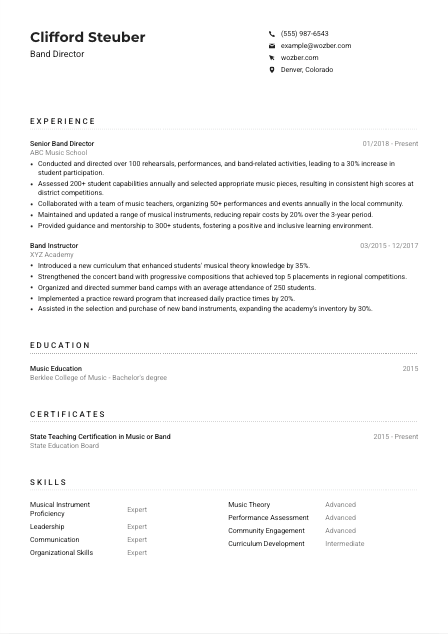
If a school specifies a city or relocation expectation, list your location clearly. In the example, Denver, Colorado appears in the header because the posting asks for candidates who are local or willing to relocate. That kind of detail answers an administrative question early and keeps attention on your teaching background.
A LinkedIn profile or personal site can help if it shows relevant work such as concert programs, awards, festival participation, curriculum highlights, or community performances. Only include it if the content is current and consistent with the resume.
This section should remove administrative doubt fast. When your name, role, contact details, and any stated location requirement are easy to confirm, the school can move straight to your rehearsal leadership and student outcomes.




This is the section school leaders read to understand how you actually manage an ensemble. They are looking for evidence of rehearsal leadership, repertoire decisions, student growth, event coordination, and day-to-day ownership of the program, not just a list of teaching duties.
Read the job description and identify the work that defines success in the program. For a Band Director, that often includes directing rehearsals and performances, assessing student ability, selecting music, coordinating events, maintaining instruments, and mentoring students. Use those priorities to decide which bullets deserve space and which older details can be cut.
List positions in reverse chronological order and include the school or organization, your title, and dates. Keep the structure consistent so the reader can follow your progression from instruction into broader program leadership. Titles such as Band Instructor and Senior Band Director already suggest scope, so support them with responsibilities that match the title level.
Bullets should show what changed because of your work. Instead of only saying that you directed rehearsals, show scale and result. The sample does this well by noting more than 100 rehearsals and performances and a 30% increase in student participation. That gives hiring teams a concrete picture of leadership, consistency, and program growth.
Metrics make your work easier to understand when they reflect the realities of the job. Useful numbers for Band Directors include student enrollment, rehearsal volume, festival or competition results, event count, instrument inventory improvements, repair cost reduction, camp attendance, or gains in practice participation. The example's 200+ student assessments, 50+ annual performances, and 20% repair cost reduction are strong models because they tie directly to program operations.
Choose experience that supports the role you want now. General music teaching, private instruction, or unrelated arts work can stay if it strengthens your case, but the emphasis should remain on ensemble direction, conducting, curriculum, student development, and program coordination. Every bullet should help a school picture you running rehearsals, preparing concerts, and guiding students across a full academic year.
Your experience section should leave no doubt that you can lead an ensemble, manage the logistics around it, and improve student performance over time. If a hiring team can picture your rehearsal room and concert calendar from these bullets, this section is doing its job.
For school-based music roles, education is a qualification checkpoint, not a formality. The degree tells the employer whether you have the academic foundation expected for classroom instruction, ensemble leadership, and student development in a structured school setting.
If the posting calls for a Bachelor's degree in Music Education or a related field, make sure that appears clearly and early in the section. A direct match matters because it confirms you meet a basic hiring standard before the school reviews your instructional style or performance record.
List degree, field of study, school name, and graduation year in a consistent order. Clean structure helps both human reviewers and ATS systems read the information correctly. In the example, "Bachelor's degree" in "Music Education" from Berklee College of Music is presented in a way that is easy to scan and easy to match to the requirement.
If your program included conducting, orchestration, brass or woodwind methods, percussion techniques, music theory, or secondary music pedagogy, those details can strengthen your fit when early-career experience is lighter. Keep them brief and only include coursework that adds value to band instruction.
Honors, ensemble participation, student teaching placements, and leadership in collegiate bands can help when they connect to classroom or performance preparation. For newer candidates, these details can show rehearsal discipline, ensemble experience, and commitment to music education standards.
Once you have several years of school band leadership, the degree should stay concise. You want the section to confirm qualification without overshadowing the more persuasive proof in your experience section, where rehearsals led, students mentored, and performances delivered carry more weight.
The education section should quickly confirm that you meet the academic expectation for the role. After that, your resume can move the focus where it belongs, onto student instruction, ensemble results, and program leadership.
For a Band Director in a school setting, certification is often a hiring requirement that can determine whether the application moves forward. It tells the district you are eligible to teach the subject within state rules, not simply experienced in music performance or private instruction.
When the posting asks for a valid state teaching certification in Music or Band, list it clearly with the full name. Do not bury it behind less relevant credentials. This is one of the first qualification checks many districts make.
Additional certificates can help, but lead with the ones that matter for the role. Teaching licensure, music education endorsements, or state-specific band credentials belong here before workshop completions or general arts training.
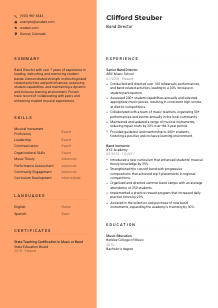
If a certificate is current, renewable, or tied to a validity period, include the date information. The sample's "2015 - Present" format works because it shows continuing eligibility at a glance, which is especially useful for school HR review.
Licensure and renewal expectations can shift by state and district. Update this section whenever you renew, add an endorsement, or move jurisdictions. For educators, outdated certification details raise avoidable questions about classroom readiness.
For school music positions, certification is part of the hiring threshold. Make it easy to find, easy to understand, and clearly current so the conversation can move on to your teaching and ensemble leadership.
A Band Director's skills section should reflect how the work is actually done. Schools are looking for a mix of musical command, classroom leadership, student assessment, and program organization, not a generic list of strengths that could belong to any educator.
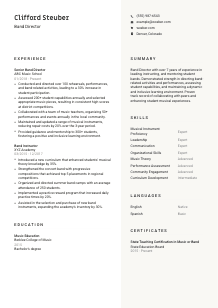
Read the requirements closely and note both explicit and implied skills. Here, the school calls for proficiency with a variety of band instruments, plus leadership, communication, and organizational skill. It also implies student assessment, repertoire selection, rehearsal management, and collaboration with faculty and administration.
Your list should show that you can teach and run the program. Include technical capabilities such as instrument proficiency, conducting, music theory, performance assessment, and curriculum development alongside leadership, communication, and organization. The sample handles this balance well by pairing musical and educational skills in one concise section.
Keep the list focused. If a skill does not help explain how you direct ensembles, guide students, maintain program quality, or coordinate performances, it probably does not belong here. A shorter list with role-specific value will read much better than a broad inventory of unrelated abilities.
This section should sound like the toolkit of someone who can lead a band program day to day. When the skills connect directly to instruction, performance prep, and school coordination, the match feels credible immediately.
Language ability matters in education because communication extends beyond the podium. You may be working with students, families, administrators, and community members, so this section should support the communication demands of the role without overstating its importance when it is not central to the posting.
If the job calls for advanced English, make that visible first. Schools need confidence that you can lead rehearsals, give clear musical and behavioral instruction, communicate with parents, and handle written school communication effectively.
Extra languages can support family communication and community engagement, particularly in diverse school populations. In the example, Spanish is listed as a basic secondary language, which is useful because it adds context without exaggerating fluency.
Use clear levels such as Native, Fluent, Advanced, Intermediate, or Basic. Avoid vague labels. Hiring teams may infer classroom communication range from this section, so accuracy matters.
If another language has helped you communicate with families, support student inclusion, or participate in community events, that can be worth mentioning elsewhere in the resume as well. Keep the language section itself concise and factual.
Language learning is ongoing, and even modest progress can become more useful over time in school settings. Refresh the ratings when they no longer reflect your current communication level.
For a Band Director, this section works best when it confirms strong English and accurately reflects any added language ability that supports students, families, or the wider school community.
The summary should give a school a quick, specific picture of the kind of Band Director you are. In a few lines, it should connect your years of experience to the parts of the job that matter most, such as ensemble direction, student growth, performance preparation, and a positive band culture.
Start with a clear line such as "Band Director with 7+ years of experience" so the reader immediately understands your professional identity and tenure. This is especially helpful when your background includes a mix of teaching and performance work.
Follow with two or three role-specific strengths that match the posting. Good examples for this profession include directing rehearsals and performances, assessing student ability, selecting repertoire, mentoring students, and maintaining an inclusive learning environment. The sample summary covers these well and stays close to the school's priorities.
A short mention of program growth, competition outcomes, curriculum improvement, or large-scale student mentorship can separate you from other applicants. Keep it concise. The goal is to hint at measurable impact, then let the experience section provide the proof.
Close by pointing toward the value you bring to the next school, whether that is stronger ensemble performance, thoughtful student development, or a well-run band program. Keep the tone grounded and avoid generic aspiration language.
A strong summary tells a school, early on, that you can teach, conduct, organize, and build a positive program. Once that frame is in place, the rest of the resume can back it up with detail.
A Band Director resume works when it shows that you can teach musicianship, run rehearsals, prepare performances, and manage the practical demands of a school ensemble with consistency. That combination of instructional and program leadership is what schools need to see quickly.
Wozber's free resume builder gives you a practical way to shape that story with ATS-friendly resume templates, an ATS resume scanner, and role-focused wording support that helps align your resume with the posting. The final result should make one thing easy to judge: you are ready to lead students and the band program with confidence from day one.




