



Use Wozber and land your dream job
Create Resume
No registration required
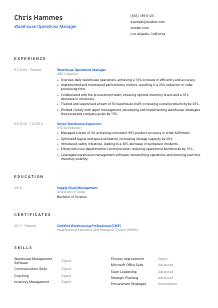
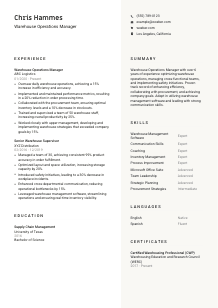
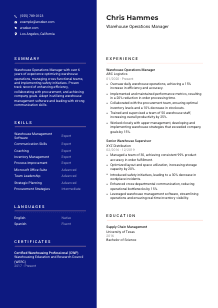
Mastering warehouse maneuvers, but your resume seems stacked up? Check out this Warehouse Operations Manager resume example, created with Wozber free resume builder. Learn how to showcase your logistics leadership to match job prerequisites, making your career lift as efficient as your inventory flow!
Warehouse operations management is judged in the real world by how smoothly inventory moves, how safely teams work, and how reliably orders leave the building. A resume for this role needs to make that operational control visible fast. Hiring teams look for someone who can run daily flow, tighten process discipline, coach frontline staff, and keep performance on track when volume, accuracy, and service levels are all under pressure.
Resume tailoring changes how quickly that operational picture comes through, especially when an ATS screens for terms tied to warehouse leadership, inventory control, fulfillment, and safety. Wozber's free resume builder helps you shape that language into an ATS-compliant resume that reflects the posting without sounding copied, so a hiring manager can quickly see whether you've led the kind of warehouse performance this job depends on.
This section is simple, but it still carries practical weight. In warehouse leadership hiring, clear contact details and a matching job title remove friction immediately, and location can matter when the employer needs someone on site quickly. Keep it direct, professional, and aligned with the role you're targeting.
Place your full name at the top in a clean, easy-to-read format. You want instant recognition, especially for a role where the rest of the resume will focus on execution, staffing, safety, and warehouse performance.
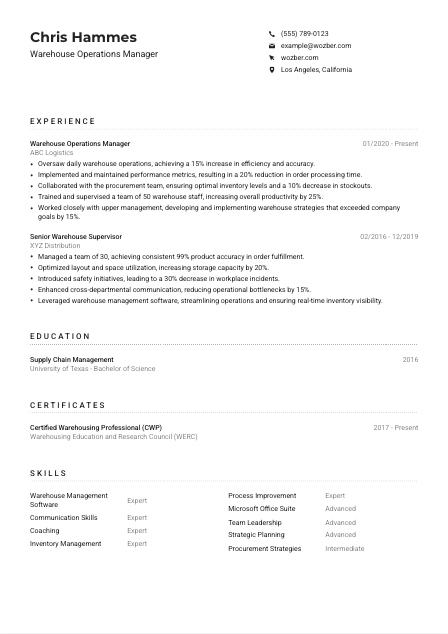
Add "Warehouse Operations Manager" beneath your name when that is the role you are applying for. This creates immediate alignment with the posting and helps frame the rest of your experience around warehouse leadership rather than a broader operations label.
Make it easy for employers to reach you for interviews or follow-up questions about your background in inventory management, team supervision, or shipping and receiving operations.
If the job calls for someone local or willing to relocate, include your city and state. In the example, listing Los Angeles, California answers that requirement immediately and removes uncertainty about on-site availability.
Include LinkedIn or a professional site if it supports your candidacy with consistent job titles, promotions, certifications, or operational achievements. If your online profile mentions warehouse KPIs, leadership scope, or safety initiatives, it can reinforce the story your resume tells.
Keep this section clean and businesslike. For a Warehouse Operations Manager, the best result is simple: hiring teams can see who you are, what role you are targeting, and whether any practical requirement such as location is already covered.




For warehouse operations management, experience is where employers look for proof of control. They want to see how you handled throughput, inventory accuracy, staff supervision, safety practices, and coordination with functions like procurement or upper management. Write this section so each role shows operating scope and measurable results, not just duties.
Start by identifying the work the employer cares about most. In this posting, that includes daily warehouse operations, inventory management, order fulfillment, shipping and receiving, performance metrics, staff development, procurement coordination, and strategy execution. Mirror those themes in your experience when they are part of your actual background so both ATS screening and human review connect your history to the job quickly.
List positions in reverse chronological order, with titles, employers, and dates clearly shown. Give the most space to roles where you managed warehouse flow, led teams, improved process efficiency, or owned performance outcomes. A title like "Senior Warehouse Supervisor" can still support a management application when the bullets show leadership scale and operational responsibility.
Warehouse leadership resumes work best when each bullet shows what you owned and what changed because of your work. Instead of saying you managed inventory or supervised staff, show outcomes such as faster order processing, fewer stockouts, stronger accuracy, safer operations, or improved productivity. The example does this well by tying daily oversight to a 15% gain in efficiency and performance metrics to a 20% reduction in order processing time.
Use numbers that reflect how warehouse teams are actually measured: processing time, fulfillment accuracy, stockout reduction, storage capacity, incident rates, productivity, or team size. These details give hiring managers a clearer picture of your operating range. A bullet about training 50 warehouse staff or sustaining 99% product accuracy says far more than a general claim about leadership.
Prioritize experience that supports warehouse management decision-making. Keep the emphasis on supervising teams, improving processes, using warehouse management systems, enforcing safety protocols, and aligning operations with business goals. If older roles are less relevant, reduce them so the resume stays focused on the kind of operation this employer needs someone to lead.
Your best experience bullets should sound like warehouse results, not job-description paraphrases. When a hiring manager can quickly see your scope, metrics, and leadership impact, your resume starts to resemble the role itself.
Education will not outweigh hands-on warehouse leadership, but it still matters, especially when the posting names a degree in supply chain, business, or a related field. Present it clearly and let it support your operational background rather than compete with it.
Place your strongest relevant degree first, especially if it matches the field named in the posting. A bachelor's degree in Supply Chain Management, Business, or a closely related discipline shows formal grounding in inventory flow, logistics, and operational planning.
List the degree, school, and graduation year in a straightforward order. Hiring teams should be able to confirm your academic background quickly without digging through extra wording. Clear formatting matters just as much here as it does in a warehouse report or KPI dashboard.
If your degree directly supports the work, do not bury the field. In the example, "Bachelor of Science" is strengthened by clearly stating "Supply Chain Management," which directly connects to warehouse planning, inventory control, and broader logistics understanding.
If you are earlier in your career or shifting into warehouse operations management, relevant coursework in logistics, operations management, procurement, or supply chain analytics can help. For experienced managers, this is usually optional unless the coursework directly supports a specialized warehouse environment.
Honors, leadership roles, or meaningful projects can stay if they reinforce operations, leadership, or analytical capability. For a candidate with 5+ years in warehouse management, these details should stay brief and should never crowd out the experience section.
Keep this section concise and relevant. For this role, education should confirm that your practical warehouse leadership rests on a solid understanding of supply chain or business operations.
Certifications are not always mandatory for warehouse operations leadership, but they can sharpen your profile when they reflect safety, warehousing standards, logistics knowledge, or continuous improvement. Use this section to show specialized development that supports the work you already do.
Choose credentials that support warehouse operations, safety management, logistics, or team leadership. Even when a posting does not require certification, a relevant credential can reinforce your seriousness about operational standards and professional growth.
One strong certification is better than a scattered list. Focus on credentials that speak to warehouse execution and oversight, such as a warehousing or supply chain certification. The example's Certified Warehousing Professional works because it supports the role directly instead of adding unrelated training.
Add the year earned and, if relevant, the active period. This helps employers see whether your training is current, which matters when warehouse practices evolve around safety, systems, and process control.
Warehouse managers are often expected to improve operations continuously, so recent or active certifications can reinforce that pattern. If you have training tied to safety protocols, lean operations, inventory systems, or supervisory development, this is where it belongs.
Treat certifications as supporting proof of your operational discipline. They work best when they extend the same story your experience already tells about warehouse leadership, safety, and process improvement.
A Warehouse Operations Manager skills section should read like the toolset behind the results in your experience section. Focus on capabilities that support inventory accuracy, team leadership, warehouse systems, process improvement, safety, and cross-functional coordination. Keep the list targeted enough that each skill clearly connects to the job.
Review the job description for both direct requirements and implied expectations. Here, that includes warehouse management software, Microsoft Office, communication, warehouse safety, inventory management, staff supervision, and collaboration with procurement and upper management. Those are the skills worth prioritizing if they reflect your real background.
Every listed skill should support a real part of warehouse operations. "Warehouse Management Software" points to inventory visibility and process control. "Coaching" and "Team Leadership" connect to training and evaluating staff. "Process Improvement" speaks to cycle time, accuracy, and space utilization. Skills land better when they map to actual operating tasks and outcomes.
Do not try to capture everything you can do. Lead with the skills most likely to matter in a warehouse leadership search, then add supporting capabilities such as strategic planning or procurement coordination. The example keeps a useful balance by giving priority to warehouse systems, inventory management, coaching, and communication before secondary strengths.
A focused skills section helps employers connect your technical and leadership strengths to the daily realities of warehouse performance. When the list reflects the posting and your actual track record, it supports both ATS optimization and a stronger human read.
Language skills matter in warehouse operations when they affect day-to-day coordination, safety communication, and workforce supervision. If the posting specifies English, list it clearly. Additional languages can be valuable when they support communication across a diverse team or facility environment.
If the posting requires clear English communication, place English first and state your proficiency honestly. For a management role, this matters because instructions, reporting, coaching conversations, and cross-functional coordination all depend on precision.
When an employer names a required language, make sure it appears exactly and clearly in this section. That removes guesswork during screening and shows you meet a practical communication requirement from the start.
Additional languages can strengthen your profile when they help with team leadership or stakeholder communication. In some warehouse environments, Spanish can be especially useful for training, floor communication, and day-to-day supervision, which makes the example's bilingual profile a relevant advantage rather than filler.
Label each language with an accurate level such as Native, Fluent, Intermediate, or Basic. Clear ratings are more useful than vague claims because they help employers judge how you may communicate in training, reporting, and operational discussions.
Only include extra languages when they add practical value. For some roles, English alone fully meets the requirement. For others, another language may support smoother staff communication or coordination across teams. Keep the section aligned with the operating environment, not padded for effect.
For warehouse management, language proficiency is mainly about effective communication on the floor and across departments. List what is required first, then add anything else that strengthens your ability to lead the operation clearly.
Your summary should quickly establish the scale and kind of warehouse leadership you bring. This is where you connect years of experience, operational strengths, and a few core outcomes into a short introduction that tells employers what sort of facility manager they are about to read about.
Read the posting closely and pull out the themes that define the role. For this one, those include warehouse operations oversight, inventory control, fulfillment, shipping and receiving, safety, metrics, staff leadership, and collaboration with procurement and management. Your summary should reflect the priorities most central to the role you are targeting.
Start with your job title and years of relevant experience. A line such as "Warehouse Operations Manager with over 6 years of experience" works because it immediately frames you as someone who has already operated in this space rather than someone adjacent to it.
Choose strengths that matter for warehouse leadership and that you can prove elsewhere on the resume. Good examples include improving efficiency, managing inventory levels, enforcing safety practices, leading warehouse teams, or using warehouse management software to improve visibility and control. The example summary handles this well by combining operations optimization, cross-functional collaboration, and safety initiatives in a compact form.
Aim for a brief paragraph of about 3 to 5 lines. Avoid broad claims like "results-driven professional" unless you immediately replace them with warehouse-specific detail. The summary should be short enough to scan quickly, but detailed enough to show whether your background matches the operation they need to run.
When this section is written well, it gives the reader a quick read on your warehouse scope, leadership level, and performance focus. That is exactly what a hiring team needs before they move into the details of your experience.
A Warehouse Operations Manager resume should make one thing easy to understand: you can run a warehouse safely, efficiently, and at scale. If your experience shows control over inventory, fulfillment, staff performance, and process improvement, hiring teams can picture you in the role much faster.
Use Wozber to turn that experience into a polished, ATS-friendly resume with stronger keyword alignment, clearer structure, and role-specific wording. With an ATS resume scanner and an ATS-friendly resume format, you can tighten the match to each posting while keeping the focus where it belongs, on the warehouse results you know how to deliver.




