



Use Wozber and land your dream job
Create Resume
No registration required
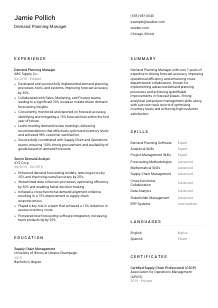
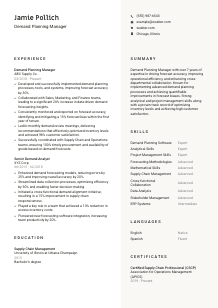
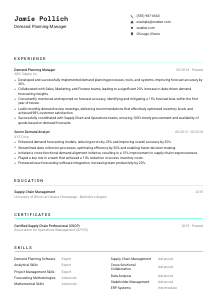
Forecasting stock, but your resume seems back-ordered? Streamline it with this Demand Planning Manager resume example, created with Wozber free resume builder. Learn how to align your inventory insights with job expectations, keeping your career trajectory always in high demand!
Demand planning work gets judged in real business terms. If your forecasts miss, inventory swells, service levels slip, and Sales, Finance, and Operations start making decisions on shaky assumptions. A Demand Planning Manager resume needs to show more than analytical ability. It should make clear that you can improve forecast accuracy, manage bias, and turn planning data into actions that protect supply continuity and customer satisfaction.
Hiring teams often sort demand planning candidates by how clearly the resume connects forecasting work to operational outcomes. Wozber's free resume builder helps shape that connection into an ATS-compliant resume by aligning your language with demand planning processes, forecasting terminology, and review cadence, so your background reads like someone who can lead the demand plan rather than simply report on it.
The top of the resume should confirm basic fit in seconds. For a Demand Planning Manager, that means showing professional identity, reliable contact details, and any location detail that matters for the target opening without cluttering the page.
Use your full name as the clearest identifier on the page. Keep the formatting simple and professional so the hiring team can move quickly from your name to your title and contact details without distraction.
Place "Demand Planning Manager" directly beneath your name when that is the role you are applying for. This immediate alignment helps both recruiters and ATS systems connect your resume to the opening and frames the rest of your experience in the right context.
List a current phone number and a professional email address. In supply chain hiring, interview scheduling often moves quickly across HR, operations leaders, and planning stakeholders, so accuracy here matters more than people think.
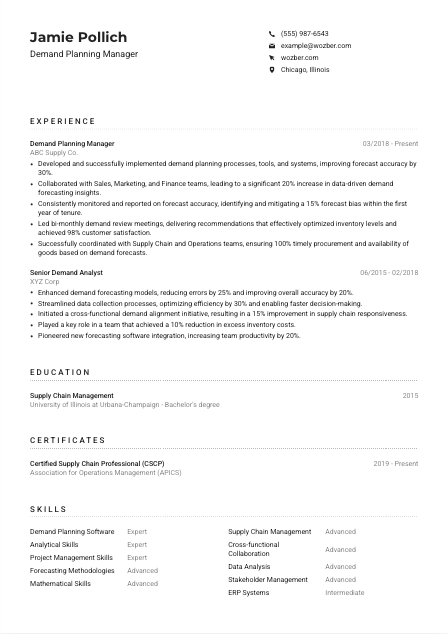
If the employer asks for a local candidate or someone willing to relocate, state your city and state clearly. In the example, listing "Chicago, Illinois" removes a likely screening question early. For other openings, only include location when it helps confirm logistics or market familiarity.
Include LinkedIn or a professional website only if it supports your candidacy with consistent titles, career history, or supply chain credentials. If your online profile highlights forecasting systems, inventory planning projects, or APICS certification, it strengthens the first read.
Your header should answer the practical basics fast: who you are, what role you do, how to contact you, and whether you meet any immediate location requirement. That frees the reader to focus on your forecasting and planning track record.




This is where Demand Planning Manager candidates separate themselves. Employers want to see how you handled forecast accuracy, demand review, inventory decisions, and cross-functional planning in actual business settings, not just that you held a planning title.
Start with positions that show direct ownership of demand forecasting, S&OP inputs, inventory recommendations, or planning analytics. The sample progression from Senior Demand Analyst to Demand Planning Manager works well because it shows increasing scope, stronger business influence, and readiness to lead demand planning discussions.
Focus each bullet on a result tied to planning performance. Improvements in forecast accuracy, reductions in forecast bias, better inventory positioning, faster data collection, or stronger customer service levels all speak directly to how this function is measured. A bullet such as improving forecast accuracy by 30% immediately carries weight because it reflects a core outcome of the role.
Use numbers wherever they reflect real planning performance. Forecast error reduction, inventory cost reduction, service level improvement, procurement timeliness, meeting cadence, and productivity gains all help the reader understand your scope. The example's 98% customer satisfaction and 100% timely procurement work because they connect the forecast to downstream execution.
Remove achievements that do not support your case for forecasting leadership, planning process design, supply coordination, or analytical decision-making. Even impressive wins should stay off the page if they do not help explain how you improved demand visibility, supported supply alignment, or influenced inventory outcomes.
Use phrasing that reflects the employer's terminology when it matches your real experience. Terms such as "forecast accuracy," "demand planning processes," "demand review meetings," and collaboration with Sales, Marketing, Finance, Supply Chain, or Operations help your resume surface in ATS screening and make your relevance obvious on a human read.
Your experience section should show a planner who can translate data into better forecasts and better supply decisions. If the bullets make your effect on accuracy, inventory, collaboration, and service levels easy to follow, this section is doing its job.
Education is usually a supporting section for an experienced Demand Planning Manager, but it still matters because many openings filter for a bachelor's degree in supply chain, business, or a related field. Keep it clear and directly relevant.
List your bachelor's degree clearly, especially if it is in Supply Chain Management, Business, Operations, or another closely related field. In the example, a Bachelor's degree in Supply Chain Management matches the posting directly and removes any doubt about academic fit.
Show the degree, field of study, school, and graduation year in a consistent order. This section should be quick to scan because most hiring managers are checking for qualification alignment rather than reading for narrative detail.
If your degree title does not directly say supply chain or business, use the field line to clarify the connection. Demand planning sits at the intersection of forecasting, operations, and commercial decision-making, so academic relevance can still strengthen your profile.
Relevant coursework, workshops, or executive education can help when they deepen your planning profile, such as forecasting methods, inventory management, statistics, ERP systems, or supply chain analytics. Keep these additions selective so the section stays focused.
Include honors or notable academic achievements if they add something meaningful, especially earlier in your career. For more experienced candidates, they matter most when they reinforce analytical strength, leadership, or supply chain specialization.
For this role, education confirms that you meet the baseline and understand the business context of planning work. A clean, relevant entry is usually all you need.
Certifications carry real weight in demand planning and supply chain roles because they show structured expertise in forecasting, inventory, and operations. They are especially useful when an employer lists APICS or IBF as preferred.
Put the most relevant credentials first, especially APICS or IBF certifications when they appear in the posting. The example's CSCP from APICS is a strong fit because it supports supply chain credibility and aligns with the stated preference without overstating its relevance.
A shorter list of directly relevant certifications works better than a long list of loosely related learning. For a Demand Planning Manager, forecasting, supply chain planning, inventory management, and operations certifications usually add the most value.
Show the award date or active period when the credential is current or time-sensitive. That gives hiring teams a clearer sense of whether your training reflects current planning frameworks and professional development.
Demand planning tools, forecasting models, and supply chain processes keep evolving. Recent certifications, recertification activity, or coursework in analytics and planning systems can show that your methods are current and that you keep investing in the discipline.
Well-chosen certifications strengthen your case as someone who understands planning beyond day-to-day execution. They add another layer of credibility around forecasting discipline, supply chain knowledge, and professional commitment.
A Demand Planning Manager skills section should read like the toolkit behind better forecasts and smoother supply decisions. Keep it anchored in forecasting systems, analysis, planning judgment, and the collaboration required to make demand signals usable across the business.
Review the job description for explicit and implied requirements. Here, demand planning software, forecasting methodologies, analytical strength, mathematics, and project management are all clear priorities, and the collaboration with Sales, Marketing, Finance, Supply Chain, and Operations points to stakeholder management as well.
Choose skills that support the actual workflow of the job. Good examples include demand planning software, forecasting methodologies, data analysis, ERP systems, inventory planning, cross-functional collaboration, and project management. The sample resume does this well by combining technical planning skills with business-facing coordination skills.
Order the list by relevance, not by how long you have had the skill. Lead with the capabilities most likely to influence hiring decisions for this role, such as forecasting systems, analytical ability, demand planning process knowledge, and stakeholder-facing planning communication.
This section should reinforce the planning capabilities already proven in your experience bullets. If the top skills map clearly to forecasting accuracy, inventory decisions, and cross-functional demand alignment, the section is working.
Language skills are usually a secondary section for demand planning, but they can matter when the posting names a language requirement or when the business works across regions, suppliers, or multinational teams. Keep the section factual and relevant.
If the role requires the ability to read complex English materials, state your English proficiency plainly. "Native" or "Fluent" can immediately address that requirement, which is useful for roles involving forecast reports, planning documentation, and cross-functional business communication.
Include additional languages when they could help in supplier coordination, regional planning, or communication across international business units. A language like Spanish may be useful in some supply chain environments, but it should remain a supporting detail unless the job makes it central.
Stick to recognizable levels such as Native, Fluent, Intermediate, or Basic. Clear labels help hiring teams understand how you can actually operate in meetings, written communication, and documentation review.
Some demand planning roles support domestic product lines, while others touch global markets, imported goods, or distributed operations. Emphasize multilingual ability more when the employer's planning network or supplier base makes it relevant.
Treat languages as a practical capability, not a personality feature. For this profession, the value lies in reading planning reports accurately, communicating demand assumptions clearly, and supporting coordination across teams or regions when needed.
When listed well, language skills quietly confirm that you can handle documentation and communication demands that come with planning work. Keep the emphasis on business usefulness.
The summary should quickly establish your level, your planning focus, and the outcomes you are known for. For a Demand Planning Manager, that usually means experience depth, forecasting results, process improvement, and cross-functional influence.
Start with a direct line that states your title and years of experience. "Demand Planning Manager with over 7 years of experience" works because it immediately places you at the right level for a posting asking for 5+ years in demand planning or a related analytical role.
Include two or three outcomes that define your value in the function, such as improving forecast accuracy, reducing bias, optimizing inventory, or raising service levels. The sample summary works because it ties expertise to measurable planning impact rather than broad management claims.
Avoid generic adjectives and use the limited space for forecasting methods, operational improvements, or cross-functional planning strengths. A concise summary with real planning language will do more for you than a paragraph full of broad leadership phrases.
Finish with the business contribution you are prepared to make, such as strengthening demand planning processes, improving decision quality, or supporting inventory and customer satisfaction goals. This gives the reader a clear picture of how your experience translates into the role you want next.
A strong summary makes it easy to place you in the demand planning function before the reader reaches the first job entry. It should sound like someone who improves the forecast, leads the conversation, and understands the operational consequences of planning decisions.
You now have a clear framework for building a Demand Planning Manager resume around forecasting outcomes, planning systems, inventory impact, and cross-functional decision-making. Each section should help a hiring team understand how you improve demand visibility, support supply readiness, and contribute to service and efficiency goals.
Use Wozber's free resume builder, ATS-friendly resume templates, and ATS resume scanner to tailor your content to each opening with cleaner terminology, stronger ATS optimization, and a structure that keeps planning results easy to read. The finished resume should make one thing clear fast: you can turn demand signals into reliable business action.




