



Use Wozber and land your dream job
Create Resume
No registration required
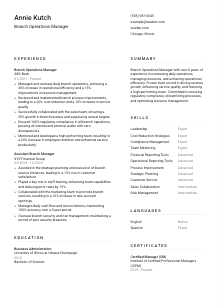
Steering branches, but your resume hits a roadblock? Navigate this Branch Operations Manager resume example, created with Wozber free resume builder. Learn how to align your operational expertise with job-specific directives, paving the way for your career to gain full operational advantage!
Branch operations managers are trusted with the part of the business customers feel immediately and executives measure closely. Daily execution has to hold up under service demands, staffing issues, audit standards, and cost pressure at the same time. Your resume should make that operating control visible, especially through process improvement, branch performance, and team leadership.
A tailored resume changes how quickly your branch experience is understood, especially when hiring teams need to separate hands-on operations leaders from broader office managers or sales-heavy candidates. Wozber's free resume builder helps you align your language with the posting, keep an ATS-compliant resume structure, and surface the operational results, compliance record, and reporting strength that matter first for this role.
For branch operations roles, the top of the resume should feel orderly and dependable. Hiring teams expect accuracy here because the job itself depends on precision, follow-through, and clear communication. Use this section to remove basic friction and confirm essential details right away.
Set your name at the top in a clean, readable format so it anchors the document immediately. Skip decorative styling and use the same professional tone you would bring to an operations report or branch review. The presentation should feel organized and controlled from the first line.
Use the job title "Branch Operations Manager" directly beneath your name when that is the role you are pursuing. This helps frame the rest of the resume around branch oversight, process control, service delivery, and staff leadership instead of leaving the reader to guess whether your background is more sales, admin, or general management.
Your contact block should be current, simple, and easy to verify. Any error here undercuts the operational credibility you need elsewhere on the page.
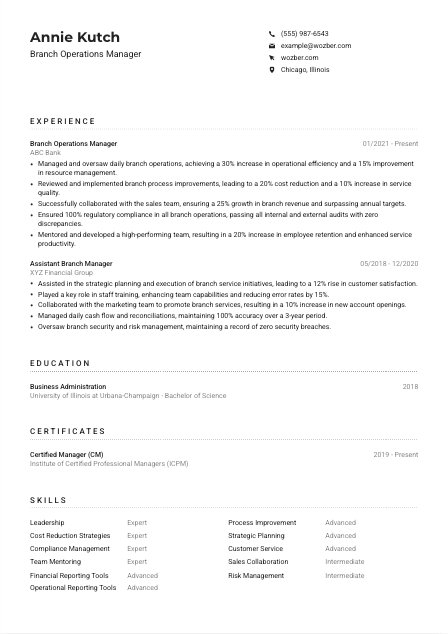
If the employer asks for a candidate in a specific market, add that city and state in your personal details. Here, listing Chicago, Illinois immediately answers a stated requirement and prevents location from becoming an avoidable screening issue. Keep this practical rather than overexplained.
Include LinkedIn or another professional profile only if it supports your resume with matching titles, dates, and achievements. For branch operations candidates, that profile should reinforce leadership scope, compliance exposure, operational metrics, and progression into larger responsibilities. Consistency matters more than volume.
This section should confirm that you are reachable, local if required, and already aligned with the role. When the basics are accurate and polished, the reader can move straight into your branch results and management record.




Experience carries the most weight for a Branch Operations Manager because this job is learned through execution. Hiring teams want to see how you improved branch performance, managed resources, supported revenue goals, and kept operations compliant under real conditions. Keep this section focused on outcomes, not duty lists.
Read the description closely and underline the phrases tied to branch performance. In this case, the emphasis falls on operational efficiency, cost reduction, service quality, compliance, and collaboration with sales. Those priorities should shape which achievements you elevate and which older details you trim.
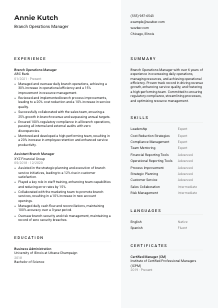
Start with your most recent position and show a progression that makes sense for branch leadership. For each role, include title, employer, and dates, then follow with accomplishment bullets that reflect branch oversight, staff development, reporting discipline, or customer service improvement. The sample resume does this well by moving from Assistant Branch Manager into Branch Operations Manager.
Branch operations resumes get stronger when each bullet shows a problem addressed, an action taken, and a business result. Instead of writing that you "managed daily operations," show what changed because of your management, such as faster workflows, lower operating costs, better service scores, cleaner audits, or stronger retention. The example bullet about a 20% cost reduction and 10% service quality increase is the right kind of proof.
Quantify your work with numbers that hiring managers in branch operations recognize. Efficiency gains, audit results, revenue contribution, error reduction, retention, cash accuracy, account growth, and customer satisfaction all carry weight when they reflect your actual work. Metrics like 30% higher operational efficiency or zero audit discrepancies help the reader understand scale and consistency quickly.
Choose achievements that support branch leadership rather than general office activity. Prioritize examples involving process review, resource allocation, regulatory compliance, team coaching, reporting, and cross-functional coordination with sales or service teams. If a bullet does not help prove you can run branch operations effectively, cut it and use the space for stronger operational evidence.
Your experience section should show that you have already managed the kind of operating demands this role brings. When the bullets connect daily branch oversight to measurable efficiency, service, compliance, and team results, the case for an interview becomes much clearer.
Education is usually a supporting section for this role, but it still matters because many branch operations postings specify a business, finance, or related degree. Present it clearly, match the wording to the requirement when appropriate, and keep the focus on qualifications that support financial operations and management responsibility.
Check the posting for the exact education requirement and mirror it honestly. Here, a Bachelor's degree in Business Administration, Finance, or a related field is requested, so a Bachelor of Science in Business Administration should be written clearly enough to register on a quick scan.
List degree, field of study, school, and graduation year in a simple order. That format makes it easy for a recruiter or hiring manager to confirm that you meet the baseline requirement without searching through extra detail. Clean structure is especially important on resumes that already carry substantial experience content.
If your degree directly connects to branch management, business operations, finance, accounting, or a related discipline, do not bury that detail. In the sample resume, "Business Administration" aligns neatly with the posting and helps support the management and reporting side of the role.
Most branch operations managers do not need to list classes once they have several years of experience, but there are exceptions. If you completed training in financial analysis, banking operations, compliance, risk management, or service operations that genuinely strengthens your candidacy, include it only when it adds clear value.
Academic honors, leadership positions, or relevant extracurricular work can stay if they reinforce traits that matter in branch operations, such as accountability, leadership, or analytical discipline. Keep them brief. By this career stage, your operating results should remain the main focus.
This section does not need flourish. It needs to confirm that you meet the educational requirement and support the business and operational foundation behind your experience. Make it easy to read and easy to validate.
Certifications can strengthen a Branch Operations Manager resume when they support leadership, compliance, process improvement, or operational oversight. They are rarely the deciding factor on their own, but they can add professional weight, especially when the rest of the resume already shows solid branch results.
Include certificates that connect naturally to branch leadership, operations management, customer service standards, compliance, or financial processes. The Certified Manager credential in the example works because it reinforces leadership and management discipline, even though the posting does not require a specific certification.
Put the certifications most useful to branch operations near the top so they are seen quickly. Hiring teams scanning for management maturity will care more about credentials tied to supervision, operations, or regulated environments than unrelated training from other fields.
List the full certification name, issuing organization, and date earned. If the credential is current or ongoing, say so in a straightforward way. Clear dating helps the reader understand whether the training is recent and whether it reflects active professional development.
Use this section to show that you continue building capability in areas that affect branch performance, such as people leadership, reporting, process control, or compliance awareness. A short, relevant list looks stronger than a long catalog of certificates with little connection to daily branch operations.
Certifications should support the operational leadership story already established in your experience. When they reinforce management credibility and current professional development, they add useful depth without distracting from your core branch record.
The skills section should reflect how branch operations are actually managed. That means a mix of operational, financial, compliance, and leadership skills, not a generic list of business buzzwords. Keep it aligned with the posting and with the work your experience section has already demonstrated.
Scan the posting for explicit skill language and convert it into resume-ready terms. Here, the employer points to financial and operational reporting tools, interpersonal leadership, service quality improvement, cost control, and collaborative team management. Those are the capabilities worth foregrounding.
Include skills you have used in branch settings and that you can back up with examples. Strong options for this role often include compliance management, process improvement, financial reporting, operational reporting, team mentoring, customer service, risk control, and sales collaboration. The sample resume handles this well by pairing leadership-oriented skills with reporting and cost reduction capabilities.
Do not crowd this section with every tool or trait you have ever picked up. A shorter list built around branch operations carries more value than a broad inventory. Group your strongest skills around branch performance, regulatory discipline, service execution, and team leadership so the section reads with purpose.
When this section mirrors the demands of the role, it helps hiring teams connect your experience to the branch environment quickly. Every skill listed should point back to a real part of running operations, leading staff, or improving branch performance.
Language skills matter in branch operations because the job depends on accurate communication with staff, customers, auditors, and internal partners. Keep this section grounded in actual proficiency and job relevance. Do not overstate it, and do not ignore a required language when the posting names one directly.
If the posting specifies English, list it at the top with an accurate proficiency level such as Native or Fluent. Since the role requires speaking, reading, and writing in English, this should be immediately visible rather than implied elsewhere on the resume.
Additional languages can strengthen a branch resume when they support customer interactions, team communication, or service delivery in diverse markets. Spanish, for example, may be useful in many branch settings, but it should be presented as added capability rather than a universal requirement.
Use clear labels such as Native, Fluent, Advanced, Intermediate, or Basic. That gives hiring teams a realistic sense of how you can communicate in customer-facing or internal settings. Honest language ratings are especially important in roles where communication mistakes can affect service quality or compliance.
Think about whether the branch serves a multilingual community or whether the internal team benefits from broader language coverage. In some markets, extra language ability can improve customer experience and reduce friction at the branch level, even when it is not listed as a formal requirement.
List languages only when they are real and usable in a professional context. For a Branch Operations Manager, the value comes from clearer service interactions, smoother staff communication, and stronger support in community-facing operations, not from padding the resume.
This section should show that you can communicate reliably in the language the role requires and, where relevant, serve a broader customer base. Kept honest and practical, it adds another layer of credibility to your branch leadership profile.
The summary is where you frame your value before the hiring team reaches the detailed sections. For a Branch Operations Manager, that means leading with years of relevant experience, branch performance outcomes, and management strengths that match the posting. Keep it tight, specific, and grounded in actual results.
Read beyond the title and capture the few themes the employer clearly cares about most. In this posting, those themes are operational efficiency, cost-effective resource management, service quality, compliance, and team leadership. Your summary should reflect that operating mix in a few direct lines.
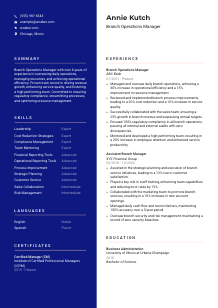
Open with your title or professional identity, then mention your years of relevant branch or operations management experience. This gives immediate context and helps distinguish you from candidates coming from unrelated management roles. The sample summary does this effectively by grounding the candidate in more than 6 years of branch-focused work.
Follow your opening with outcomes that matter in branch environments, such as improving efficiency, increasing revenue, strengthening compliance, developing staff, or raising service quality. Keep these claims tied to areas you can support elsewhere in the resume. Specific strengths like streamlining processes or leading high-performing teams make the summary feel credible and useful.
Aim for a short paragraph that can be read in seconds. Three to five lines is usually enough to establish your branch leadership profile without repeating the entire experience section. Tight wording works especially well in an ATS-friendly resume format because it keeps the most relevant keywords and achievements easy to find.
Your summary should quickly tell the reader that you have managed branch operations, improved performance, and led people in a controlled, measurable way. If those points land early, the rest of the resume has a clear direction.
A Branch Operations Manager resume works best when it reads like someone who already runs a branch with discipline. The strongest version ties your experience to operational efficiency, cost control, service quality, compliance, reporting, and staff development without drifting into generic management language.
Use Wozber to sharpen that alignment from top to bottom. Wozber's free resume builder, ATS resume scanner, and ATS-friendly resume templates help you match the posting, strengthen phrasing, and organize your achievements in a clear ATS-friendly resume format so hiring teams can quickly see your branch leadership range.
Once your resume makes your operational results and management scope easy to judge, you are ready to apply with confidence.




