



Use Wozber and land your dream job
Create Resume
No registration required
Juggling sales stats, but your resume doesn't measure up? Check out this Sales Operations Manager resume example, created with Wozber free resume builder. Learn how to present your operational expertise to match job specifics, putting your sales leadership in the top percentile!
Sales Operations Managers sit behind the numbers that sales leaders act on. Forecasts, pipeline hygiene, CRM workflows, reporting logic, territory coverage, and process adoption all shape revenue decisions, so a resume for this role needs to show more than general support for the sales team. It should make it clear that you improve the systems, data quality, and operating rhythm that keep a commercial organization running.
Screening usually narrows quickly when a resume leaves your scope too vague. If hiring teams cannot tell whether you owned forecasting, drove CRM adoption, improved reporting, or worked cross-functionally with sales and marketing, you risk being read as a general analyst rather than an operations leader. Wozber's free resume builder helps you align that story in an ATS-compliant resume, so your experience reads clearly for the kind of operational ownership the role requires.
This section is simple, but it still carries hiring value. For a Sales Operations Manager, the header should immediately establish who you are, the role you are targeting, and whether you meet any practical filters such as location or direct contact availability.
Place your full name at the top in a clean, readable format. Keep it slightly more prominent than the rest of the header so it anchors the page without competing with your experience and metrics.
Add "Sales Operations Manager" directly below your name when that is the role you are pursuing. Matching the title helps position you correctly from the first scan, especially when your background includes adjacent roles such as sales analyst, revenue operations, or business operations.
List a phone number you answer and a professional email address you check regularly. Accuracy matters here. A missed digit or outdated inbox can interrupt the process before anyone gets to your forecasting work, CRM projects, or reporting results.
If the employer specifies a location requirement, reflect it clearly in your header. Here, San Francisco, California is a stated filter, so showing that location removes an immediate point of uncertainty. If relocation is relevant in another application, make that clear instead of leaving the question open.
Include LinkedIn or a professional website only when it supports your candidacy. For this role, a profile that reinforces your experience with sales systems, analytics, process improvement, and cross-functional leadership adds value. Keep the content consistent with your resume so the hiring team sees one coherent story.
Your personal details do not need flair. They need to confirm your identity, target role, and practical eligibility quickly so the reader can move straight into your sales operations results.




This is the section hiring teams study most closely for sales operations roles. They want to see whether you managed core operating processes, improved CRM usage, supported forecast accuracy, strengthened reporting, and helped the sales organization run with better discipline and data.
Start by isolating the work this employer actually needs done. In this posting, the pattern is clear: forecasting, reporting, pipeline management, CRM adoption, process enforcement, data analysis, and close collaboration with sales and marketing. Those themes should shape which bullets you keep, rewrite, or move higher.
List roles in reverse chronological order with title, company, and dates. For this profession, progression matters. A move from analytical support into broader ownership of sales process, territory planning, CRM administration, or enablement operations tells a stronger story than a flat list of tasks.
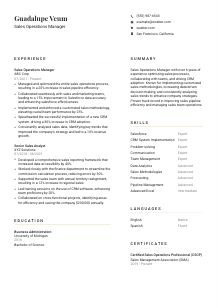
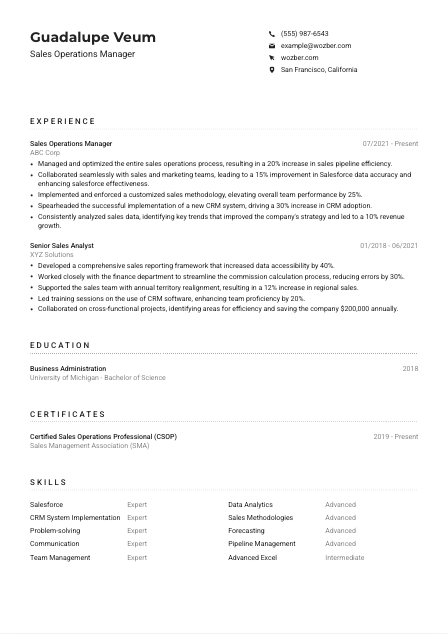
Use bullets that show what you changed in the sales engine. Strong examples include improving pipeline efficiency, raising CRM data accuracy, building reporting frameworks, streamlining commissions, or driving adoption of a new process. The sample resume does this well with bullets such as a 20% increase in pipeline efficiency and a 15% improvement in Salesforce data accuracy.
Metrics matter because sales operations is measured through operational improvement and commercial impact. Include numbers tied to adoption, reporting speed, error reduction, forecast quality, revenue growth, savings, or productivity. A 30% lift in CRM adoption or $200,000 in annual savings is far more persuasive than saying you "supported process improvements."
Prioritize work that shows command of sales process, systems, analytics, and cross-functional execution. If a bullet does not connect to sales performance, data governance, process design, or team effectiveness, trim it. Every line should help the reader picture you running a disciplined sales operations function.
A Sales Operations Manager resume should show that your work changed how the commercial team operated. When your bullets connect systems, process, and measurable outcomes, the role becomes much easier to picture.
Education rarely decides a senior sales operations hire on its own, but it can confirm that you meet a posted requirement without forcing the reader to hunt for it. Keep this section straightforward and aligned with the role's stated academic preference.
This posting asks for a bachelor's degree in Business, Sales, or a related field. If your degree maps cleanly to that requirement, state it clearly. "Bachelor of Science in Business Administration" is a direct match and removes any ambiguity.
List degree, field of study, school, and graduation year in a consistent order. Hiring teams reviewing sales operations resumes often move quickly between your education, systems exposure, and performance metrics, so clarity matters more than decoration.
When your academic background supports the role, let that connection show. Business administration, sales, finance, economics, analytics, or similar fields all reinforce work involving forecasting, reporting logic, and operational decision-making. The sample degree in Business Administration supports that connection well.
Most experienced Sales Operations Managers do not need to list classes. Still, early-career candidates can use coursework in analytics, sales management, business intelligence, statistics, or operations to bridge limited hands-on experience. Include it only if it helps explain your readiness for the work.
Honors, leadership roles, or capstone projects are worth including when they relate to analysis, business process, team coordination, or commercial strategy. Keep the emphasis on relevance. A generic campus achievement adds less value than one tied to data, operations, or organizational performance.
For this role, education should quickly establish that you meet the baseline and then get out of the way. The real weight still sits with your operational results, systems knowledge, and commercial impact.
Certifications are optional in many Sales Operations Manager searches, but the right one can strengthen your profile. They are most useful when they support the kind of process ownership, CRM expertise, analytics discipline, or sales methodology work the role calls for.
This job description does not require a certification, so relevance matters more than volume. Prioritize credentials tied to sales operations, CRM platforms, analytics, revenue process, or sales methodology. A certification such as CSOP works because it reinforces specialized knowledge in the field.
Only include certifications that add something meaningful to your candidacy. A short list of role-relevant credentials is easier to trust than a long catalog with weak connection to forecasting, pipeline management, CRM administration, or reporting operations.
If a credential is active, recently earned, or renewed, show that. Date information helps the reader understand whether your training reflects current tools and practices, especially in areas like Salesforce administration, analytics platforms, or process frameworks.
Sales operations changes with the tooling. Ongoing learning in CRM customization, dashboarding, data governance, automation, or revenue process design tells employers that you keep your operating approach current rather than relying on outdated workflows.
A certification will not replace real experience running sales operations, but it can strengthen how your resume reads. Keep the emphasis on credentials that support the systems, process, and analytical parts of the job.
A skills section should read like the operating toolkit behind your resume, not like a generic list of strengths. For Sales Operations Managers, that means balancing platform knowledge, analytical capability, process design, and communication with sales-facing teams.
Start with the obvious requirements, then add the capabilities the work depends on. Here that includes CRM systems, ideally Salesforce, analytics tools, forecasting, reporting, pipeline management, communication, and problem-solving. You can also infer process improvement, cross-functional collaboration, and sales methodology enforcement from the responsibilities.
This role sits between data and execution, so your skill mix should reflect both. A useful list might include Salesforce, CRM system implementation, forecasting, pipeline management, data analytics, reporting, communication, and team coordination. The sample resume pairs technical and interpersonal strengths well, which helps the profile read as operationally credible rather than narrowly technical.
Order the section around what the employer is most likely to scan for first. In this case, CRM expertise, analytics, forecasting, reporting, and process leadership belong near the top. Keep the list tight enough that each skill feels connected to the work you already proved in your experience section.
When the skills section mirrors the real operating demands of the role, it supports both ATS optimization and human review. It should reinforce the systems you know, the processes you run, and the way you improve sales performance.
Language ability is not the centerpiece of most Sales Operations Manager resumes, but it can matter when a posting names a communication requirement or when the team works across regions. Present it clearly and keep the emphasis on business usability.
If the job description explicitly calls out English communication, list English first with an honest proficiency level. That immediately addresses a stated requirement and confirms you can handle reporting discussions, process rollout, and cross-functional coordination in the working language.
Start with the language the role requires, then list any others that could help in the commercial environment. This is a practical ordering choice, not a cosmetic one. It tells the reader what matters first for day-to-day execution.
Extra languages can be useful in organizations with distributed teams, international markets, or multilingual customer-facing functions. Spanish, for example, may strengthen collaboration across broader sales or support teams, even when English is the primary business language.
Use clear labels such as Native, Fluent, Advanced, or Conversational. Avoid overstating. In a role that depends on clean communication around metrics, process changes, and system adoption, accuracy in how you describe language ability matters.
Treat this section as supporting information unless multilingual communication is central to the role. For many sales operations positions, language skills are a bonus. The core story still needs to revolve around forecasting, reporting, CRM effectiveness, and analytical leadership.
Use the language section to confirm communication capability without overstating its importance. For this kind of role, it should support the profile rather than compete with your operational achievements.
Your summary should quickly establish the level and type of sales operations work you do. It is most effective when it combines scope, systems, and measurable outcomes in a few lines that match the employer's priorities.
Before writing, identify the two or three themes that define the target role. Here, those are operational management of the sales process, CRM expertise, data-driven decision-making, and cross-functional collaboration. Let those themes guide the opening instead of writing a broad statement that could fit any sales support role.
Open with your title or closest equivalent, plus your years of experience. For example, a summary that starts with "Sales Operations Manager with 6+ years of experience" immediately sets the level, especially when the role asks for at least 5 years in sales operations or a related field.
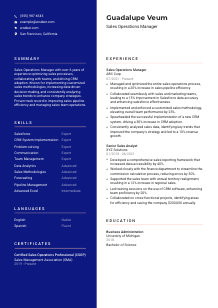
Use one or two high-value achievements to show how you improve performance. Metrics such as increased pipeline efficiency, stronger CRM adoption, better data accuracy, or revenue lift work well because they connect directly to how sales operations contributes to business results. The sample summary succeeds by tying process optimization and CRM adoption to measurable impact.
Aim for a short paragraph that can be read in seconds. Cut generic traits and focus on what you run, improve, and influence. If every sentence points back to sales operations systems, process discipline, analytics, or team effectiveness, the summary will do its job.
A well-written summary should make the rest of the resume easier to interpret. When it clearly positions you as someone who improves sales process, CRM performance, and data-driven execution, the hiring team knows what to look for in every section that follows.
A Sales Operations Manager resume works when it makes your operating scope easy to understand. Forecasting, reporting, CRM adoption, pipeline discipline, and cross-functional execution should all show up in clear, measurable terms rather than broad management language.
Use Wozber's free resume builder, ATS-friendly resume templates, and ATS resume scanner to tailor each section around the role's real priorities. When your wording, metrics, and structure align with the posting, your resume gives hiring teams a much clearer read on whether you can run the systems and processes behind sales performance.




