



Use Wozber and land your dream job
Create Resume
No registration required
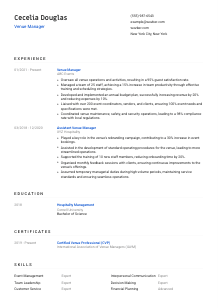
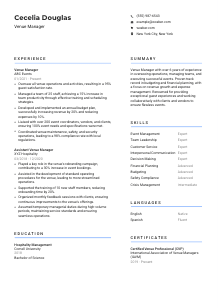
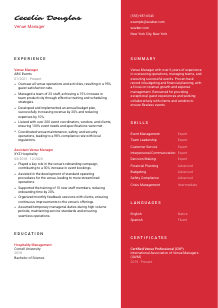
Mastering event spaces, but your resume feels out of place? Check out this Venue Manager resume example, created with Wozber free resume builder. Learn how to spotlight your talent for hosting and match it naturally with job criteria, setting your career stage for standing ovations!
Venue management is operational work under public pressure. When a guest experience slips, a vendor misses a setup window, or a safety issue interrupts an event, the Venue Manager is the person expected to steady the room, protect revenue, and keep service standards intact. Your resume should make that responsibility visible through examples of event execution, team leadership, financial control, and venue compliance.
A tailored resume changes the first read from "hospitality experience" to "can run this venue." Using Wozber's free resume builder to align your wording with the posting and produce an ATS-compliant resume helps hiring teams quickly connect your background to the work they need done, whether that means staffing busy event calendars, managing budgets, or coordinating vendors without operational gaps.
This section is simple, but it still does important work. For a Venue Manager, the header should confirm professional identity, reliable contact information, and any location detail that affects availability for on-site operations and event coverage.
Your name should be the most visible text on the page. Use a clean, professional format so the resume reads like someone who can run a venue floor, not someone trying to decorate a document.
Use "Venue Manager" directly under your name when that is the role you are pursuing. This creates immediate alignment with the posting and helps frame your experience around venue operations, guest experience, staff supervision, and event execution from the first line.
Add a phone number you answer, a professional email address, and, if relevant, a website or LinkedIn profile that reflects your hospitality or events background. Hiring teams often move quickly when filling operations roles, especially for venues with active booking calendars.
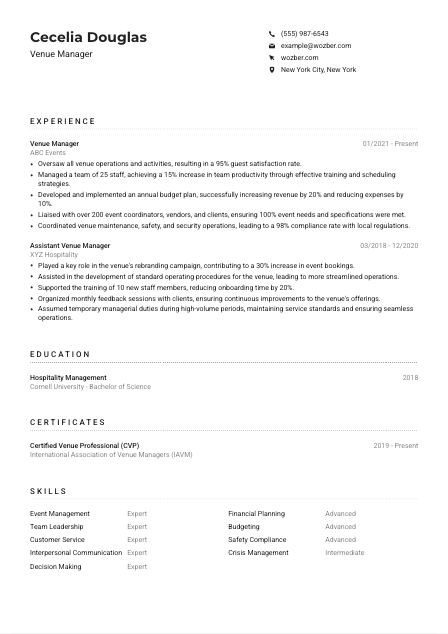
If the employer asks for a specific location, include it clearly. Here, "New York City, New York" matters because the job requires the candidate to be based there, and venue roles often depend on immediate on-site presence for events, vendor coordination, and issue resolution.
A LinkedIn page, portfolio, or company profile can help if it supports your resume with event work, leadership scope, or hospitality credentials. Keep it current. If the profile is thin or outdated, leave it off rather than sending employers to conflicting information.
Your personal details should confirm that you are reachable, professionally presented, and available for the role's location demands. That is enough. Save the proof of operations, leadership, and event performance for the sections that follow.




This is the section hiring teams read most closely for Venue Manager roles. They want to see what size operation you handled, how you led staff, how you supported clients and vendors, and whether your decisions improved service, revenue, and compliance.
Start by marking the responsibilities that define the job. For this role, those include overseeing venue operations, managing staff, building budgets, coordinating with clients and vendors, and maintaining safety and regulatory compliance. Those points should guide which bullets you feature and how you describe them.
List your jobs in reverse chronological order and prioritize titles connected to venue operations, events, hospitality management, or facility supervision. If you moved up from Assistant Venue Manager or Event Operations roles, that progression helps show that you have grown into broader leadership and decision-making responsibility.
Generic bullets like "responsible for venue operations" do not tell much. Stronger bullets show what changed because of your work. The sample resume does this well with lines such as achieving a 95% guest satisfaction rate, increasing team productivity by 15%, and ensuring 100% event specifications were met. That is the level of operational detail you want.
Metrics make your scope easier to understand. For Venue Manager roles, strong numbers include guest satisfaction scores, booking growth, revenue gains, expense reduction, staff headcount, compliance rates, turnaround times, number of events handled, or vendor and client volume. These measures show whether you ran a busy operation effectively.
Keep experience focused on event delivery, staffing, service standards, budgeting, vendor coordination, maintenance, security, and problem-solving under pressure. If an older role does not connect clearly to managing operations or guest-facing environments, shorten it so stronger venue-related work gets more room.
Your experience section should leave no doubt that you can run a venue, lead a team during live events, and protect both guest experience and business performance. If those outcomes are visible in the bullets, the section is doing its job.
Education matters here because many Venue Manager postings ask for a bachelor's degree in hospitality, business, or a related field. Keep this section straightforward and make it easy to confirm that you meet the requirement.
When a posting asks for a bachelor's degree, list yours clearly with the degree type and field. If your background is in Hospitality Management, Business Administration, or a closely related discipline, that alignment should be obvious at a glance.
Include your degree, school, field of study, and graduation year or date. Hiring teams do not need a long academic narrative here. They need a quick read that confirms your formal preparation for hospitality, operations, or business leadership work.
A degree such as "Bachelor of Science in Hospitality Management" maps neatly to this type of role because it supports the operational and service side of venue work. The example resume uses that exact alignment well, which helps reinforce the candidate's credibility before the experience section is even finished.
Relevant coursework, honors, or leadership activities can help if you are earlier in your career or if they connect directly to hospitality operations, events, finance, or customer experience. If you already have several years of venue leadership, keep this section lean.
Awards, scholarships, or distinctions are worth including when they add real context, especially for recent graduates. For an experienced Venue Manager, they should stay secondary to your operational results, staffing scope, and event record.
Education should quickly show that you meet the degree expectation without crowding out stronger professional proof. For this role, the heavy lifting still belongs to experience, budgets, teams, and event operations.
Certifications carry weight in venue management when they reflect recognized standards in operations, safety, or industry practice. If a posting names one specifically, this section becomes much more important.
When the posting says a credential is highly preferred, put it near the top of your resume and list it clearly in this section. Here, the Certified Venue Professional, or CVP, is a strong advantage because it directly supports the employer's preference.
List certifications that support how venues are actually run, such as industry credentials in venue management, safety, events, or facilities. Avoid padding the section with unrelated courses. Relevance matters more than volume.
Add the name of the certifying organization and the date earned, especially for credentials that remain active or need renewal. The sample resume handles this well by pairing the CVP with the issuing association and current status.
Venue work changes with regulation updates, guest expectations, and operational standards. Ongoing certification or professional development shows that you stay current in areas that affect service quality, compliance, and event execution.
A well-chosen certificate can reinforce that you understand venue standards beyond day-to-day experience. When the credential matches the posting directly, it becomes an easy advantage for both hiring teams and ATS screening.
Venue Manager skills should reflect how the venue runs day to day. That means operational control, staff leadership, client coordination, financial discipline, guest service, and the judgment to keep events moving when conditions change quickly.
Pull skills from the posting, then keep only the ones you can support elsewhere in the resume. For this role, strong examples include event management, team leadership, budgeting, financial planning, vendor coordination, safety compliance, customer service, and multitasking in high-volume environments.
Communication and leadership matter, but do not stop there. Venue hiring teams also want practical capabilities tied to staffing, scheduling, crisis response, revenue management, and compliance. The example skill list works because it combines people management with financial and operational strengths.
Do not turn the skills section into a long inventory. Choose the capabilities that define successful venue management and match the role's language closely. A shorter list with direct links to your experience is far more convincing than a crowded one.
Your skills should show that you can manage people, guests, budgets, and operations at the same time. That blend is what makes a Venue Manager credible on paper before the interview starts.
Language ability matters in venue management because the job involves constant coordination with guests, clients, vendors, and staff. Include this section when language proficiency is part of the role or when it strengthens your ability to serve a diverse client base.
If the posting calls for professional English, list English first and state your proficiency accurately. That matters in a role where instructions, client communication, event briefs, vendor discussions, and incident handling all depend on clear language.
Extra languages can be valuable in venues that host diverse audiences, corporate events, weddings, or international guests. In the example, Spanish adds practical value because multilingual communication can improve guest interactions and coordination on event day.
Terms such as "Native," "Fluent," or "Conversational" are useful when they reflect what you can actually do in a professional setting. Inflating language ability is risky in a job that depends on live communication and quick problem-solving.
A second language can support customer service, vendor relations, and smoother communication with frontline staff. It is not always a formal requirement, but in hospitality and events, it can be a genuine operational advantage.
List only languages that you can use with confidence. This section should support your ability to manage service and communication, not distract from your operational record.
For Venue Managers, language skills matter most when they improve communication during planning and live events. Keep the section accurate, relevant, and tied to guest and client experience.
The summary should read like a concise operating profile. In a few lines, show the scale of your venue experience, the business outcomes you influence, and the kind of environment you are equipped to manage.
Open with your title and years of relevant experience. For this role, a line such as "Venue Manager with 6+ years of experience in venue operations and event management" gives immediate context and aligns with the posting's experience requirement.
Mention the responsibilities that define your value, such as overseeing venue operations, leading staff, managing budgets, improving guest experience, and coordinating clients and vendors. Keep it grounded in the realities of the role rather than broad personality claims.
A summary becomes stronger when it includes outcomes. The sample does this by pointing to revenue growth, expense control, and strong event execution. Even one brief metric or business result can make the opening more credible.
Aim for 3 to 5 lines that mirror the language of the target posting. The example summary works because it reflects the employer's needs without sounding copied, covering operations, budgeting, team leadership, and client collaboration in a compact format.
Your summary should quickly position you as someone who can run operations, support profitable events, and keep guests and clients well served. When those priorities are clear, the rest of the resume has a strong opening to build on.
A Venue Manager resume should show more than hospitality experience. It should make your operational judgment, team leadership, financial control, and event execution easy to see in every section.
Use Wozber's free resume builder, ATS-friendly resume templates, and ATS resume scanner to tailor your content around the posting's requirements and strengthen ATS optimization without losing the specifics that matter in venue work.
When the resume clearly shows that you can lead staff, coordinate vendors, protect compliance, and deliver a smooth guest experience, you are ready to apply with confidence.




