



Use Wozber and land your dream job
Create Resume
No registration required
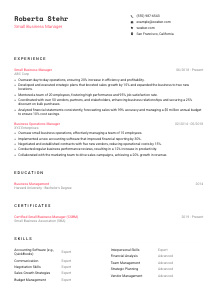
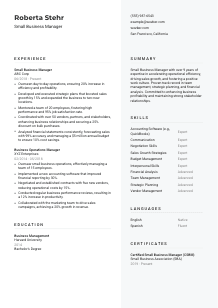
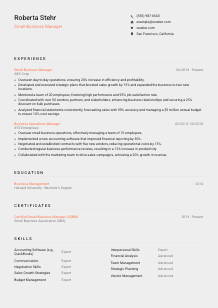
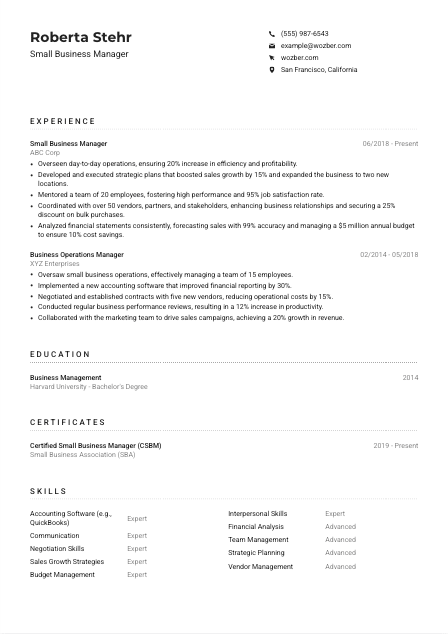
Navigating commerce, but your resume feels niche? Explore this Small Business Manager resume example, created with Wozber free resume builder. Learn how to effortlessly fuse your adaptive oversight with the job's scale, positioning your career trajectory for grand growth and pint-sized profits!
Small Business Managers are usually hired to steady the engine while growing the business. That means your resume needs to show more than general leadership. It should make your operating range clear: improving day-to-day efficiency, keeping budgets under control, guiding staff performance, and turning plans into measurable sales or margin gains.
A tailored resume also helps hiring teams quickly tell whether your experience comes from true business operations ownership or from a narrower support role. Using Wozber's free resume builder to align your wording with the posting and keep an ATS-compliant resume structure makes it easier to surface the details that matter here, such as budget size, team leadership, vendor coordination, and revenue-driving results.
For a Small Business Manager, the header should read like someone ready to run an operation. Keep it clean, professional, and easy to scan so hiring teams can immediately confirm your identity, target role, and any location requirement tied to the position.
Use your full name in a larger, readable font so it stands apart from the rest of the page. Small business hiring often moves quickly, and a clean header helps your resume feel organized from the first glance, which matters for a role expected to manage people, processes, and daily execution.
Place the job title "Small Business Manager" directly beneath your name when that is the role you are pursuing. This instantly frames your background around operations, profitability, team oversight, and business growth rather than leaving the reader to infer your direction from past titles alone.
Your contact information should be simple, current, and professional so nothing slows down outreach.
If the employer specifies a location, include yours plainly. In the example opening, San Francisco, California is a stated requirement, so listing that city and state helps remove avoidable doubt early in the review process. Keep in mind that location is a posting-specific filter, not a universal rule for every Small Business Manager job.
If you include LinkedIn or a professional website, make sure it supports the same story as your resume. For this kind of role, that means your profile should reinforce operational leadership, financial oversight, team management, and business growth rather than presenting a scattered mix of unrelated experience.
Your personal details should do a few practical things well: identify you clearly, show the role you are targeting, and satisfy any straightforward requirement such as location. Keep this section polished and direct so the rest of the resume can focus on how you run a business well.




This is the section hiring teams read most closely for a Small Business Manager. They want to see operating ownership, commercial judgment, and evidence that your decisions improved efficiency, sales, team performance, or financial control.
Start by marking the responsibilities and requirements that define the role. In this case, the essentials include day-to-day operations, sales growth planning, staff management, vendor coordination, and financial analysis. Those priorities should shape which achievements you feature and how you phrase them, especially when you are aiming for ATS alignment as well as human review.
List your positions in reverse chronological order and emphasize jobs where you owned business performance, not just one function within it. Titles such as Small Business Manager or Business Operations Manager naturally support that story because they suggest accountability across staff, budgeting, reporting, and execution.
Each bullet should show what you managed and what changed because of your work. Instead of saying you handled operations, show the operational outcome. The example resume does this well with bullets covering efficiency gains, sales growth, team satisfaction, vendor savings, and accurate forecasting. That mix reflects the broad scope many small business employers expect.
Small business management is measured through outcomes, so quantify your work whenever you can. Useful metrics include profit improvement, cost savings, revenue growth, forecast accuracy, budget size, staff headcount, number of vendors managed, retention, or expansion results. A line like managing a $5 million annual budget or improving profitability by 20% gives far more context than a generic claim about leadership.
Trim experience that does not strengthen your case for this kind of role. If a bullet does not connect to operations, team leadership, financial oversight, strategic growth, or stakeholder management, rewrite it or remove it. Relevance matters here because hiring teams need to see that you can run a business unit, not simply contribute to one.
Your experience section should read like a record of business stewardship. When your bullets show operational control, measurable growth, sound financial management, and strong team leadership, you make it much easier for an employer to picture you handling the realities of a small business environment.
Education matters here because it supports the business fundamentals behind the role. Even when your experience carries the most weight, the degree section still helps confirm training in management, finance, operations, or related decision-making disciplines.
Review the posting for any stated academic requirement before you format this section. The example job asks for a bachelor's degree in Business Management, Finance, or a related field, so candidates with matching education should present that connection clearly and early.
List your degree, field of study, school, and graduation year in a straightforward order. Hiring teams scanning for business qualifications should be able to confirm your educational background in a few seconds without searching through extra wording.
If your degree is directly relevant, state the field precisely. A Business Management degree, like the one in the sample resume, immediately reinforces your grounding in operations, planning, and organizational performance. If your degree is adjacent, use the exact formal wording and let your experience carry the rest.
Early-career candidates can strengthen this section with coursework, projects, or academic activities tied to finance, accounting, entrepreneurship, operations, or leadership. If you already have extensive management experience, keep those extras only if they sharpen your business profile rather than clutter the page.
Academic honors, distinctions, or leadership roles can be useful if they reinforce discipline, analytical strength, or business initiative. Keep them brief and relevant. For a seasoned manager, the education section should support credibility without overshadowing the results in your experience section.
Present your education as a clean confirmation of business grounding. A well-listed degree in management, finance, or a related area helps complete the picture of a candidate who can interpret numbers, manage resources, and make sound operating decisions.
Certificates are especially helpful in small business management when they sharpen your profile in operations, finance, leadership, or business development. They are not always mandatory, but the right one can reinforce your commitment to current practice and practical management skill.
Start with the posting. If no certification is required, choose credentials that still support the work, such as small business management, bookkeeping systems, financial analysis, leadership, or project oversight. The sample resume's Certified Small Business Manager credential is a good illustration of a certificate that clearly supports the target role.
List certifications that connect directly to the job's daily demands. For this profession, that usually means business operations, budgeting, accounting software, team leadership, compliance, or sales planning. A shorter list of relevant credentials is stronger than a long list of loosely connected courses.
If a certificate is active, recent, or renewed periodically, include the date. That detail can matter for subjects tied to current tools, reporting practices, or management standards. It also shows that your learning did not stop once you moved into leadership.
As your responsibilities expand, your certifications should reflect that progression. For example, someone moving from operations support into full business management might add training in financial reporting, negotiation, or leadership development to better match broader ownership of profit, staff, and vendor relationships.
Use certifications to reinforce business credibility, not to pad the page. When they connect clearly to financial oversight, operational management, or leadership, they add useful depth to your application.
The best Small Business Manager skills section feels practical, not generic. It should show that you can keep the operation running, make sound financial decisions, lead people effectively, and support growth with the right mix of analysis and execution.
Read the job description closely and note both technical and managerial requirements. Here, the obvious priorities include financial analysis, reporting, accounting software, team management, communication, negotiation, and strategic planning. Those should guide the shortlist you place on the resume.
A Small Business Manager is rarely hired for one strength alone. Combine hard skills such as budget management, forecasting, and accounting software with leadership strengths such as employee coaching, vendor negotiation, and cross-functional communication. The sample resume does this well by pairing QuickBooks-related capability with sales growth strategies and team management.
Do not overload this section with every skill you have touched. Prioritize the ones most likely to matter in the target job and that you can support elsewhere in the resume with real examples. If you claim financial analysis, your experience section should show forecasting, reporting, margin control, or budgeting outcomes to back it up.
Choose skills that reflect how the business actually runs. A focused list built around operations, finance, leadership, and growth gives hiring teams a quick read on whether your background matches the demands of the role.
Language ability matters in small business management when the role involves staff communication, vendor relationships, customer interaction, or written reporting. Keep this section straightforward and tied to how you actually work.
If the posting names a required language, list it clearly. The example job specifically requires clear written English, so English should appear prominently with an honest proficiency level that matches your ability to manage communication, reporting, and negotiation in the role.
After the required language, include additional languages that could help with team communication, customer service, supplier relationships, or market expansion. Spanish, for example, can be useful in many business settings, but only include languages you can use with confidence in a professional context.
Stick with simple terms such as Native, Fluent, Intermediate, or Basic. Avoid vague wording. Hiring teams need to know whether you can write reports, lead conversations, or negotiate terms in that language, not guess from an unclear label.
If a second language has real operational value, let that be implied by the rest of your resume or mention it briefly elsewhere when relevant. For a Small Business Manager, languages can support vendor coordination, staff supervision, and customer-facing growth in multilingual markets.
Not every Small Business Manager role needs multilingual ability, so do not force this section to carry more weight than it should. Include additional languages when they strengthen your profile, especially for businesses serving diverse communities, managing international suppliers, or expanding into new markets.
Present languages as practical communication assets. Clear English proficiency is often essential in this role, and any additional language should support real business interaction rather than serve as filler.
Your summary should give a compact picture of how you manage a business. For this role, that usually means a blend of operational control, financial judgment, leadership, and growth-minded execution.
Before writing, identify the few themes that matter most in the target opening. For a Small Business Manager, those often include running daily operations, improving profitability, leading employees, managing vendors, and using financial reporting to guide decisions. Your summary should reflect that scope without turning into a keyword list.
Start with your title and years of experience so the reader immediately understands your level. The sample resume's opening, "Small Business Manager with over 9 years of expertise," works because it quickly establishes seniority and relevance before moving into operations and growth.
Use the next sentence to highlight two or three core strengths tied to the job, such as strategic planning, budget management, team leadership, sales growth, or financial analysis. Keep those strengths aligned with the work you can prove in the experience section.
Aim for a short paragraph that sounds concrete and mature. Avoid broad claims about being dynamic or results-driven unless you immediately anchor them in something real, such as improving efficiency, guiding a team, or strengthening profitability. Four focused lines will usually do more than a long introduction.
Your summary should quickly establish that you can run operations, manage people, and make commercially sound decisions. When it is specific, concise, and aligned with the target job, it sets up the rest of the resume to read with much more clarity.
A Small Business Manager resume works when it makes your operational judgment visible. Hiring teams should be able to see how you improve efficiency, guide staff, manage budgets, build vendor relationships, and turn plans into measurable business growth.
Use Wozber's free resume builder, ATS-friendly resume template, and ATS resume scanner to align your experience with the posting, strengthen ATS optimization, and present your background in a clean ATS-friendly resume format. The final read should leave no doubt that you can take ownership of day-to-day performance and business outcomes.