



Use Wozber and land your dream job
Create Resume
No registration required
Navigating managerial waters, but your resume seems a bit deputy? Anchor it with this Deputy Manager resume example, created with Wozber free resume builder. Learn how to showcase your leadership expertise in line with job demands, propelling your career to the helm of professional success!
Deputy Manager hiring usually turns on one practical question: can you keep daily operations moving while stepping into the manager's seat when needed. That means your resume has to show more than general leadership. It should make your operational judgment, team oversight, and contribution to performance targets visible through real examples such as policy rollout, productivity gains, cost control, or staff development.
A tailored Deputy Manager resume also helps employers quickly separate broad supervisory experience from role-ready management support. Using Wozber's free resume builder and an ATS-friendly resume format, you can align your language with the posting so terms like operations, performance metrics, team management, and reporting responsibilities surface cleanly. That makes it easier for the hiring team to see whether you can support department goals and make sound decisions when leadership coverage matters.
For a Deputy Manager, the header should communicate professionalism and remove any avoidable questions about role alignment or availability. Keep it clean, accurate, and closely matched to the position you are targeting.
Place your full name at the top in a clear, easy-to-read format. This section does not need styling tricks. For management roles, a polished header sets the tone for the operational discipline and professional judgment the rest of the resume should reinforce.
Use the job title directly under your name when it reflects the role you are pursuing. Writing "Deputy Manager" immediately frames your experience around second-in-command leadership, team supervision, and operational support rather than a broader administrative profile.
Your phone number and email should be current and professional, since management hiring often moves through several rounds of coordination and follow-up.
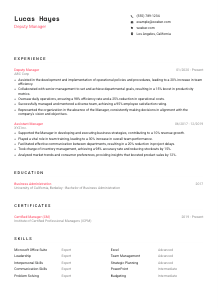
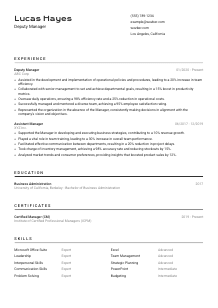
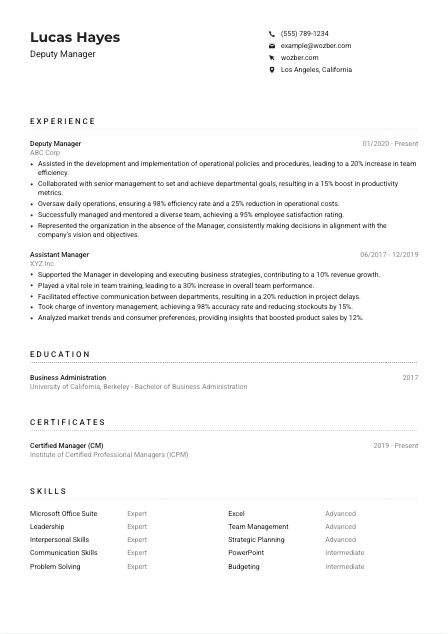
If the posting specifies a location requirement, include your city and state so the employer does not have to guess. In the example, listing Los Angeles, California directly supports the posted requirement and removes concerns about relocation or local availability.
Include LinkedIn or a professional website only if it supports the same career story as your resume. For a Deputy Manager, that might mean a profile showing leadership progression, operations experience, team size, or measurable business results. Keep the information aligned across both places.
This section should answer basic hiring questions fast: who you are, what role you are pursuing, how to reach you, and whether you meet any stated location requirement. Clean details let the employer move straight to your management experience.




Deputy Manager resumes are won in the experience section. Hiring teams want to see how you supported leadership, improved operations, managed people, and handled responsibility when the manager was unavailable. Broad claims are less persuasive than measurable examples tied to day-to-day execution.
Start by pulling the main responsibilities from the job description and matching each one to work you have actually done. For this kind of role, that often includes policy implementation, departmental goal setting, operational oversight, coaching staff, and decision-making in leadership coverage situations. If a posting asks for help developing procedures, do not just say you were involved in operations. Show the process you improved and the result it produced.
List roles in reverse chronological order and make the progression easy to follow. A move from Assistant Manager to Deputy Manager, like in the example, helps establish growing responsibility. Include job title, employer, and dates, then let the bullets show how your scope expanded across operations, team supervision, cross-functional coordination, or reporting to senior management.
Each bullet should connect what you did to what changed. Good Deputy Manager bullets often cover workflow improvements, productivity metrics, cost reductions, service consistency, staff performance, or execution against departmental goals. The example line about overseeing daily operations and reaching a 98% efficiency rate works because it links operational ownership to a measurable outcome the employer can understand immediately.
Quantify results where the numbers are meaningful to management work. Efficiency rates, cost savings, employee satisfaction, project delays reduced, inventory accuracy, revenue growth, and team performance improvements are all credible measures in this field. The example resume uses metrics well because the numbers are attached to specific responsibilities, not added as decoration.
Prioritize experience that supports Deputy Manager work, even if you have other strong achievements. Bullets about operations, mentoring, reporting, process improvement, and coordination with senior leaders should stay near the top. Less relevant wins can be trimmed if they do not help show that you can run daily activity, support strategy, and step into leadership decisions when needed.
When this section is working, the employer can see how you improve team performance, keep operations on track, and support management decisions under real business conditions. That is the core case your resume needs to make.
Education matters here as a baseline qualification. For most Deputy Manager roles, the degree section is not where you win the interview, but it does need to confirm that you meet the academic requirement and have a relevant business or management foundation.
If the posting asks for a bachelor's degree in Business Administration, Management, or a related field, make sure that information is easy to find. The example does this well with a Bachelor of Business Administration, which aligns directly with the requirement and needs no extra explanation.
List your degree, field of study, school, and graduation year. That is usually enough for an experienced management candidate. Clean formatting helps this section support the application without pulling attention away from the experience section, where most of your value will be judged.
If your degree closely matches the role, state it plainly rather than dressing it up. A degree in Business Administration or Management naturally supports work involving team oversight, operational planning, and departmental coordination. Let the match speak for itself.
Most candidates with 5+ years of management experience do not need to list coursework, but it can help if it strengthens a specific angle. Subjects such as operations management, organizational behavior, finance, or strategic planning may support your positioning if your background is less conventional or the role has a stronger analytical component.
If you have workshops, short programs, or management training that adds something your degree does not show, include them only when they support the role. Keep this section focused. For a Deputy Manager application, education should confirm preparation, not compete with your operational track record.
This section should quickly show that you meet the academic requirement and have a relevant management foundation. Once that is clear, your experience can carry the heavier argument.
Certifications can strengthen a Deputy Manager resume when they support leadership, supervision, operations, or formal management training. They are especially useful when the posting mentions certifications as preferred or applicable within the profession.
Look for certifications that reinforce the type of work Deputy Managers handle, such as team leadership, business operations, project coordination, compliance, or people management. Even when a posting does not name a specific credential, relevant certification shows structured professional development in areas tied to management responsibility.
Choose certificates that clearly connect to the position instead of listing every training course you have completed. In the example, "Certified Manager (CM)" is a strong inclusion because it supports the management focus of the role directly and complements the candidate's supervisory experience.
Certification dates help employers understand whether the credential is current or recently completed. That matters more for active licenses, continuing education, or management programs tied to current practices in leadership, operations, or compliance.
A certificate section should suggest that you keep your management skills current, whether through formal credentials, leadership development, or role-specific training. Keep the tone factual. The value comes from relevance and recency, not from presenting every certificate as a major career milestone.
Relevant credentials can sharpen your profile, especially when they support operational leadership or supervisory scope already shown in your work history. Keep the list selective and tied to the responsibilities of the job.
A Deputy Manager skill list should read like the job in compact form. It needs a practical mix of operational tools, management capabilities, and communication strengths that match how the role is actually performed.
Start with the language used in the job description. Here, that includes Microsoft Office Suite, especially Excel and PowerPoint, along with leadership, interpersonal communication, and team oversight. These are not filler terms. They reflect common management work such as reporting, presentations, planning, performance tracking, and staff coordination.
Deputy Managers often sit between execution and oversight, so the skill section should show both sides. Pair software and operational skills such as Excel, budgeting, reporting, or process tracking with leadership skills such as coaching, conflict resolution, communication, and team management. The example handles this balance well by combining Office proficiency with strategic planning and people leadership.
Do not overload this section. Choose skills that support the actual work of supervising teams, supporting departmental goals, analyzing performance, and communicating with senior management. A shorter, targeted list is more credible than a long catalog of generic strengths.
Your skills should support the story told by your experience. If the role involves Excel reporting, team mentorship, and operational oversight, those capabilities should appear here in the same language employers use to describe the job.
Language ability matters most when the posting names it directly or the work involves diverse teams, customer-facing communication, or cross-regional coordination. For a Deputy Manager, this section should stay practical and honest.
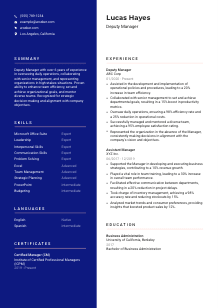
If the employer specifies language fluency, list it clearly. In this posting, English fluency is a core competency, so it should appear first with an accurate proficiency level. That instantly confirms an explicit requirement instead of leaving it for the employer to infer.
Place the most job-relevant language first, then follow with additional languages that may help in the workplace. In the example, English leads and Spanish follows, which is sensible for a management role that may involve communication across a broader staff or customer base.
Extra language ability can strengthen a Deputy Manager profile when it helps with team communication, client interactions, or multicultural environments. It should be presented as added capability, not as a substitute for management experience.
Use clear levels such as native, fluent, advanced, intermediate, or basic. Management roles often involve meetings, coaching, conflict resolution, and written communication, so inflated language claims can become obvious quickly.
If the department serves multilingual teams, customers, or partners, language skills may carry more weight. Include them when they improve your ability to lead, explain procedures, or represent the organization effectively, especially in people-facing environments.
This section works best when it confirms required fluency and adds relevant communication range. Keep it accurate, concise, and tied to how you would operate in the role.
The summary should quickly establish your level, your management scope, and the kind of operational value you bring. For a Deputy Manager, that usually means showing leadership support, day-to-day execution, and the ability to keep teams aligned with business goals.
Read the posting for the responsibilities that define success, then reflect those themes in your opening lines. For this role, useful anchors include overseeing operations, supporting departmental goals, mentoring staff, and making aligned decisions in the manager's absence. That gives your summary a clear management focus instead of sounding like a generic leadership statement.
Start with your title or management background, then specify your area of strength. A line such as having 6+ years in management support and operations oversight works because it places your experience in the exact context the employer is hiring for. The example summary does this effectively by combining tenure with operational and leadership scope.
Use one or two achievements or strengths that mirror the posting. Productivity gains, efficiency improvements, team mentorship, and strategic decision-making are all stronger summary material than broad claims about being results-driven. Pull details that preview the evidence later found in your experience section.
Aim for three to five lines with clear language and no wasted space. This section should give a fast, credible picture of your management value, not repeat your whole work history. If every sentence points toward operational leadership and team oversight, it is doing its job.
A strong summary tells the employer, early and clearly, that you can support leadership, run day-to-day operations, and contribute to departmental performance. That is the lens through which the rest of your resume should now be read.
A Deputy Manager resume should leave little doubt about your ability to support senior leadership, keep operations steady, and guide teams toward measurable goals. When each section reinforces that story with relevant tools, management scope, and outcomes, your application reads as practical and role-ready.
Use Wozber to tighten that alignment through structured writing, ATS optimization, and targeted phrasing drawn from the job description. With an ATS resume scanner, stronger keyword coverage, and an ATS-compliant resume built around real management results, your resume can make the hiring decision easier for the employer. The final document should make your operational judgment and leadership range easy to recognize.




