



Use Wozber and land your dream job
Create Resume
No registration required
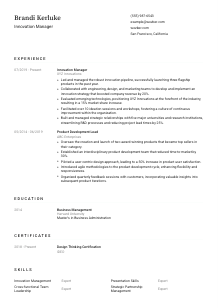
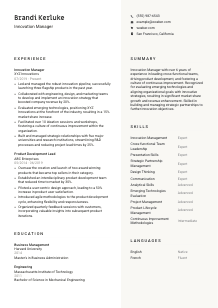
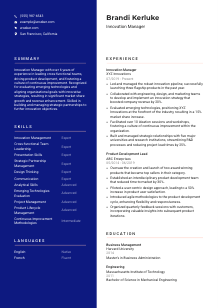
Pioneering new ideas, but your resume feels outdated? Check out this Innovation Manager resume example, revamped with Wozber free resume builder. It shows how to present your forward-thinking prowess to match job expectations, making certain your career is always at the forefront of progress.
Innovation Manager resumes tend to fall flat when they sound like brainstorming decks instead of operating records. Hiring teams want to see how you move ideas through an innovation pipeline, test them against business goals, align product, engineering, and commercial teams, and turn promising concepts into launches, partnerships, or measurable growth.
A tailored resume changes how quickly that story comes through. When your wording reflects the role's language around innovation strategy, emerging technologies, workshops, and cross-functional delivery, Wozber's free resume builder helps you organize it into an ATS-friendly resume format that makes your track record easier to read as execution, not just ideation.
The Personal Details section is simple, but it still does real work for an Innovation Manager application. It should identify you clearly, match the target role, and remove avoidable friction such as unclear contact information or unanswered location requirements.
Your name should be the most visible element at the top of the page. Use a clean, readable style so the resume opens with confidence and looks consistent with the strategic, polished communication expected from someone who leads workshops, presents recommendations, and works across senior stakeholders.
Place "Innovation Manager" directly under your name when that is the role you are pursuing. This keeps your positioning immediate and avoids ambiguity with adjacent titles like Product Manager, R&D Lead, or Strategy Manager. If your background spans those areas, the title helps frame the rest of the resume in the right direction from the first line.
List a current phone number and a professional email address you check regularly. Innovation roles often involve multi-round interviews, presentations, and cross-functional conversations, so your contact information should feel business-ready. A straightforward format such as "firstname.lastname@email.com" keeps the focus on your experience.
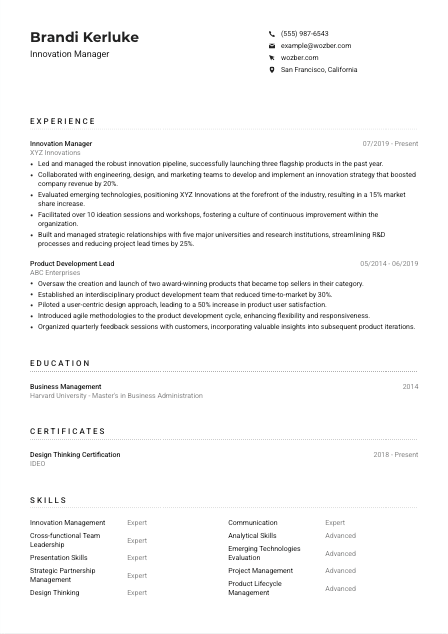
If a job explicitly asks for a specific location or willingness to relocate, include that information here. In this example, listing San Francisco, California immediately answers a stated requirement and avoids unnecessary uncertainty. Use this only when location matters to the posting rather than treating it as a universal rule for every application.
Include a LinkedIn profile or personal website if it strengthens your application. For Innovation Managers, that can be useful when it shows product launches, speaking engagements, innovation programs, partnership work, or thought leadership around design thinking and emerging technologies. Make sure the content aligns with your resume rather than introducing conflicting details.
This section does not need personality flourishes. It needs accuracy, professionalism, and a clean match to the practical requirements of the role so the reader can move straight to your innovation track record.




The Experience section carries the most weight for an Innovation Manager. This is where hiring teams look for evidence that you have led initiatives across functions, shaped strategy, evaluated market or technology opportunities, and delivered outcomes the business could actually use.
Read the posting for the actual work patterns behind the title. For Innovation Manager roles, that often includes owning an innovation pipeline, running ideation sessions, translating trends into strategic recommendations, partnering with product and engineering, and working with external ecosystems such as startups or universities. Those priorities should guide which accomplishments you bring forward and which language you mirror for ATS optimization.
Use reverse chronological order and make each entry easy to scan: job title, company, dates, and then accomplishment bullets. Innovation careers often span product development, R&D, strategy, and transformation work, so a clear timeline helps the reader understand progression from execution into leadership and portfolio ownership.
Each bullet should show what you led, how you moved the work forward, and what changed because of it. Strong Innovation Manager bullets often involve launching products, improving time-to-market, increasing adoption, validating new opportunities, or building a repeatable innovation process. The sample resume does this well by tying innovation strategy to a 20% revenue increase and emerging technology evaluation to a 15% market share gain.
Quantification matters here because innovation can otherwise sound vague. Use metrics such as products launched, pipeline throughput, revenue impact, market share growth, user satisfaction, pilot conversion, lead time reduction, or time-to-market improvement. In the example, reporting three flagship launches, a 25% reduction in project lead times, and a 30% faster time-to-market makes the scope of contribution much easier to understand.
Keep the section centered on innovation leadership, cross-functional execution, and commercial or operational outcomes. A bullet about facilitating workshops is stronger when it connects to better idea generation, alignment, or implementation. A line about customer feedback matters more when it shows how insight informed product iterations or portfolio decisions. Edit with that standard and remove details that do not help position you for innovation ownership.
By the end of this section, the reader should be able to see how you evaluate opportunities, mobilize teams, and bring new solutions closer to market. That is the core hiring question for this role.
Education matters for Innovation Manager roles because the work often sits between business strategy, technical feasibility, and product or R&D execution. Your degrees help explain the lens you bring to opportunity assessment, stakeholder communication, and innovation planning.
Start with the educational baseline in the posting. Here, the role asks for a bachelor's degree in Business, Engineering, or a related field, with a master's preferred. If you meet that mix, make it easy to see. If your field is adjacent, use the full degree and specialization so the relevance is still clear.
List each degree with institution, degree name, field of study, and graduation year. Clean formatting helps both ATS parsing and human review, especially when the hiring team is scanning for a business or engineering foundation before moving on to your experience.
When your academic background directly supports innovation work, let that come through. An MBA can support strategy, commercialization, and stakeholder alignment. An engineering degree can support technical evaluation and product development credibility. The sample combination of an MBA and a mechanical engineering degree is a strong illustration of how business and technical grounding can work together, though not every Innovation Manager needs that exact path.
Relevant coursework can help early-career candidates or career changers, especially if it covers product development, innovation strategy, design research, technology management, or entrepreneurship. For experienced applicants, coursework usually matters less than market outcomes, so include it only when it adds something the rest of the resume does not already show.
Honors, capstone projects, research, incubator programs, or leadership in entrepreneurship clubs can strengthen this section when they connect to innovation work. Choose examples that show experimentation, problem-solving, commercialization, or cross-disciplinary collaboration rather than listing every academic distinction.
This section works best when it quickly confirms the academic foundation behind your innovation work and then gets out of the way. Let your degrees reinforce your credibility in strategy, product development, or technical evaluation.
Certifications can help an Innovation Manager resume when they point to practical methods you use on the job. The most useful ones connect to innovation frameworks, facilitation, experimentation, product discovery, or strategic problem-solving rather than general professional development.
Look for certifications that are required or preferred. In this case, Design Thinking or a related innovation methodology is preferred, so any credential in that area deserves attention. This gives you a clear tailoring opportunity without overstating certification as a universal hiring requirement.
Feature certifications that support how Innovation Managers actually operate, such as Design Thinking, innovation management, agile product development, customer discovery, or change leadership. A Design Thinking Certification or a recognized innovation management credential carries more value here than generic training because it connects directly to workshops, ideation, and concept development.
Include the issue date and, if relevant, an active status or renewal period. This helps when the certification reflects current methodology knowledge or ongoing engagement with the field. It also makes recent upskilling visible if you have been expanding into facilitation, strategy, or new product development.
Innovation work changes fast, especially where technology scouting, product experimentation, and customer-centered methods are concerned. Updating this section with relevant certifications shows that your toolkit is active and current, which matters more than building a long list of outdated credentials.
Use this section to show the frameworks and practices behind your work. A few well-chosen certifications can reinforce that your innovation leadership is grounded in repeatable methodology, not just title progression.
Innovation Manager skill lists work best when they balance strategic thinking with execution. Hiring teams want to see whether you can move from trend insight and idea generation into cross-functional delivery, stakeholder alignment, and measurable business outcomes.
Job descriptions usually name some skills directly and imply others through responsibilities. Here, cross-functional leadership, analytical ability, communication, presentation, and innovation strategy are explicit. The responsibility set also points to facilitation, technology evaluation, partnership management, and product development fluency. Pull both types into your short list.
Include skills that reflect how you actually work, not a broad wish list. For this kind of role, that may include innovation management, design thinking, emerging technology evaluation, workshop facilitation, partnership development, project management, or product lifecycle management. The sample resume uses this approach well by pairing strategic skills with execution-oriented ones like cross-functional team leadership and strategic partnership management.
A focused skill section is easier to trust and easier for ATS systems to parse. Put the most role-aligned capabilities first, especially the ones the posting emphasizes. If your resume already shows strong product development and R&D experience in your bullets, use the skills section to reinforce those themes rather than introducing unrelated software or generic business traits.
When this section is tailored well, it confirms the methods, leadership range, and analytical strengths already shown in your experience. That combination makes your profile easier to read as innovation leadership with execution discipline.
Language ability is rarely the main reason an Innovation Manager gets hired, but it can matter when the role involves global teams, external partners, research collaboration, or market expansion. Keep this section factual and tied to practical communication needs.
If the posting names a required language, list it clearly and use an accurate proficiency level. Here, strong English is mandatory, so English should appear first. That gives the hiring team a quick answer on a basic requirement before they continue into the rest of your resume.
Start with the required or strongest language, then add others in descending order of proficiency. Use standard labels such as Native, Fluent, Advanced, Intermediate, or Basic. Clear labeling matters because Innovation Managers often present to leadership, facilitate workshops, and coordinate with varied stakeholders where communication level affects credibility.
Additional languages can strengthen your profile when the company works across regions, collaborates with international research institutions, or serves multilingual markets. They are especially useful if part of your innovation work involves partnership building or customer insight gathering beyond one market. Mention them as an asset, not as filler.
Avoid vague terms. If you can lead workshops, negotiate with partners, or deliver presentations in a language, your level should reflect that honestly. If your ability is conversational only, label it accordingly. Precision keeps expectations aligned and protects your credibility.
For some Innovation Manager applications, languages are highly relevant. For others, they are secondary to market launches, portfolio results, and innovation process leadership. Include the section when it adds genuine value, especially if your background includes multinational collaboration or external ecosystem work.
Used well, this section shows where you can communicate, present, and build partnerships effectively. Keep it concise and grounded in the actual communication demands of the role.
The summary should give the reader a quick, accurate read on the kind of Innovation Manager you are. In a few lines, it should connect your years of experience to the outcomes, methods, and leadership scope that matter most for the target role.
Start by identifying the core thread in your background. That could be innovation pipeline leadership, new product commercialization, R&D collaboration, venture partnerships, or innovation strategy across business units. Your summary should reflect the kind of innovation work you have already owned rather than offering a broad claim about being creative or forward-thinking.
Lead with your title or closest equivalent and your level of experience. A line such as "Innovation Manager with 6+ years of experience in product development and cross-functional innovation programs" gives the reader immediate context. It also helps position candidates whose previous titles were adjacent, such as Product Development Lead or Innovation Program Lead.
Choose strengths that match the posting and back them with outcomes. For this role, strong options include leading cross-functional teams, evaluating emerging technologies, facilitating innovation workshops, and building external partnerships. The sample summary works because it links those themes to market share growth and revenue improvement rather than stopping at capability statements.
Aim for a compact paragraph, not a mini cover letter. Every phrase should earn its place by clarifying scope, methods, or business results. If a sentence could fit a general manager, strategy analyst, or product lead equally well, make it more specific to innovation work before you keep it.
After reading these lines, the hiring team should already understand your level, your innovation focus, and the kind of results you tend to produce. That clarity sets up the rest of the resume well.
Your Innovation Manager resume should show more than curiosity and ideas. It should show how you identify opportunities, rally cross-functional teams, evaluate what is worth pursuing, and move concepts toward measurable business value.
Use Wozber's AI resume builder to tailor your language to the job description, strengthen ATS optimization, and present your experience in an ATS-compliant resume that stays clear to human reviewers. The finished document should make one thing easy to judge: whether you can lead innovation work from concept to outcome.




