



Use Wozber and land your dream job
Create Resume
No registration required
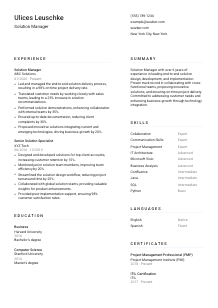
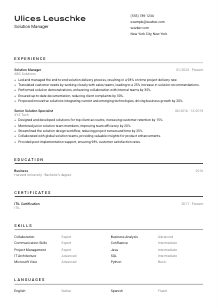
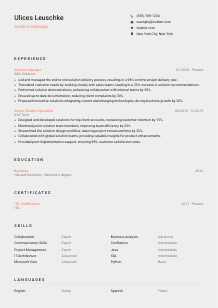
Unraveling complex puzzles, but your resume is missing the solution? Check out this Solution Manager resume example, created with Wozber free resume builder. Learn how to weave your solution-finding prowess with job criteria, so your career trajectory never hits a dead end!
Solution Managers sit at the point where commercial conversations, technical design, and delivery execution meet. Hiring teams want to see whether you can turn customer needs into workable solutions, keep implementation moving, and stay credible with both sales and technical stakeholders. Your resume should make that operating range visible early, with clear proof of delivery ownership, architecture fluency, and client-facing judgment.
When that story is tailored well, the first scan becomes much easier. A hiring manager can quickly connect your background to solution delivery, stakeholder communication, and post-launch support instead of trying to infer it from generic project language. Wozber's free resume builder helps shape that into an ATS-compliant resume by aligning your wording with the job description and keeping the structure clean, so the resume immediately reads like a Solution Manager profile rather than a broad IT or project management one.
For a Solution Manager, the header should read like a clean business contact card. It needs to confirm who you are, how to reach you, and, when relevant, whether you meet practical filters such as location. Keep it simple, accurate, and aligned with the kind of client-facing professionalism the role requires.
Make your full name the most visible item in the header. In a role built on stakeholder trust and clear communication, a clean presentation matters. Use the name you use in business settings and keep formatting consistent with the rest of the resume.
Place "Solution Manager" directly below your name when that is the role you are pursuing. This helps position your background around solution design, delivery ownership, and customer-facing collaboration from the first line. If your current title differs, you can still use the target title when your experience genuinely supports it.
List a reliable phone number and a professional email address. Double-check both. For a role that involves client discussions, internal coordination, and senior stakeholder communication, avoid casual email handles or missing contact information that creates friction before the first conversation.
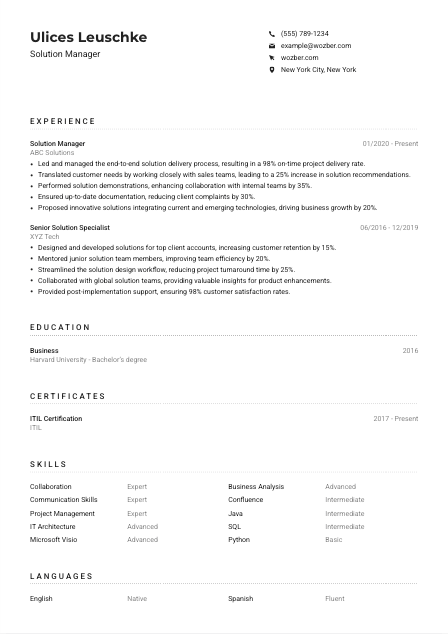
Some Solution Manager roles include an explicit location requirement because of customer meetings, office presence, or regional delivery coverage. In the example role, "New York City, New York" belongs in the header because it answers a stated filter immediately. Use this same approach whenever geography is part of the screening criteria.
Include a LinkedIn profile or personal site only if it supports your candidacy. For Solution Managers, that usually means a profile with clear role progression, solution-focused achievements, certifications, and technology context. If the link is outdated or thin, improve it before adding it.
This section does not need personality flourishes. It should confirm that you are reachable, professionally presented, and, where required, available in the right market for the Solution Manager role.




Experience is where Solution Manager resumes usually stand or fall. Titles matter less than whether your bullets show real ownership of solution design, implementation, stakeholder alignment, and business outcomes. Focus on work that shows how you moved from customer need to delivered result.
Start by isolating the main hiring priorities in the posting. For this role, that includes end-to-end solution delivery, translating customer requirements into recommendations, collaborating with sales and internal teams, supporting demonstrations, and staying current on emerging technologies. Those themes should shape which bullets you keep and how you phrase them.
List your most recent role first and work backward. Solution Management often builds through adjacent positions such as solution specialist, pre-sales consultant, implementation lead, or technical account roles. Reverse chronological order helps employers see whether your scope has grown from individual solution work into broader delivery and stakeholder leadership.
Each role should include accomplishment bullets that connect what you did to what changed. Good Solution Manager bullets often show actions such as led delivery, translated client requirements, ran demos, coordinated cross-functional teams, or improved documentation. In the sample resume, phrases like leading end-to-end delivery and turning customer needs into solution recommendations work because they describe both the responsibility and the business effect.
Use numbers where they are native to the role. Useful measures include on-time delivery rate, implementation turnaround, customer satisfaction, retention, adoption, complaint reduction, revenue contribution, or growth in recommended solutions. The sample's 98% on-time delivery rate and 30% reduction in client complaints are good illustrations because they tie operational execution to customer impact.
Not every past task belongs here. Prioritize work that shows architecture awareness, client communication, delivery coordination, documentation discipline, and post-implementation support. If a bullet does not help explain how you design, recommend, deliver, or support solutions, remove it or rewrite it so the relevance is obvious.
A hiring team should be able to scan this section and understand your delivery range, your customer-facing credibility, and the outcomes you have produced. That is the standard your experience section needs to meet.
Education matters here because Solution Managers are expected to bridge business context and technical delivery. You do not need an academic story that overshadows your experience, but you do need to show the degree foundation that supports solution design, implementation, and stakeholder communication.
If the posting asks for a bachelor's degree in Business, Computer Science, or a related field, make sure that information is easy to spot. Put the degree, field, school, and graduation year in a clean format. In this example, degrees in Business and Computer Science line up well with the blend of commercial and technical work the role requires.
List your education in reverse chronological order or lead with the highest degree, depending on what best supports your profile. For most mid-career Solution Managers, concise formatting is enough. Recruiters want to confirm qualifications quickly, not work through dense academic detail.
Name the exact degree and field rather than using broad labels alone. A Bachelor's degree in Business, Information Systems, Computer Science, or a related area tells the reader more about your training than a generic degree reference. This matters when the role sits between client needs and technical solutioning.
If you are early in your career, relevant coursework or academic projects can reinforce areas such as IT architecture, systems analysis, business process design, or project delivery. If you already have substantial professional experience, keep this section lean and let your work history carry the weight.
Honors, leadership roles, or notable projects can add value when they connect to the role's demands. For example, a systems design capstone, business case competition, or team leadership activity can support your story. Skip extras that do not strengthen your positioning as a Solution Manager.
This section should confirm that you have the academic base for a role that blends business judgment with technical solution delivery. Keep it concise and relevant to the level you are targeting.
Certifications are especially useful in Solution Manager resumes when they reinforce how you run delivery, manage service quality, or work within structured project environments. They are not mandatory in every case, but the right credentials can sharpen your profile quickly.
Put the most relevant credentials first. For this role, ITIL and project management certifications such as PMP or PRINCE2 directly support the delivery and operational side of the work. If you hold one of these, make it easy to find.
A shorter list of certifications that clearly support solution delivery, service management, architecture, or implementation leadership is stronger than a long inventory of loosely related courses. Choose credentials that help explain how you manage projects, govern processes, or support client outcomes.
Include the issuer and the date or active period when useful. That helps employers understand whether the certification is current and recognized. In the sample resume, listing both the credential and issuing body makes the section more credible and easier to scan.
As the role evolves, certifications in service management, project delivery, cloud platforms, enterprise architecture, or solution-selling frameworks can strengthen your resume when they reflect your actual work. Add new credentials selectively so the section grows with your scope rather than becoming a course archive.
The best credentials add weight to your experience by showing formal grounding in delivery methods, service operations, or project governance. That extra layer can matter when employers are choosing between candidates with similar backgrounds.
A Solution Manager skills section should do more than list broad strengths. It should reflect the mix of technical fluency, delivery discipline, and stakeholder communication the role demands. Think in terms of the tools, methods, and working capabilities you use to move a solution from discussion to implementation.
Read the job description closely and extract the capabilities it actually emphasizes. Here, that includes IT architecture, collaboration, diagramming tools such as Confluence or Microsoft Visio, communication, and cross-functional coordination. That combination tells you the employer wants someone who can speak to both system design and business delivery.
List the skills that help you discover needs, shape solutions, coordinate teams, document decisions, and support rollout. Typical examples include solution design, stakeholder management, business analysis, project management, architecture documentation, workshop facilitation, and client presentations. The sample resume handles this well by mixing architecture and tool skills with communication and project leadership.
Group your skills in a way that makes sense for the role, especially if you have a broader technical background. You might separate technical tools from delivery and stakeholder skills, or list them in order of relevance. If you use proficiency levels, keep them realistic and consistent so the section stays credible.
Every skill listed should help explain how you design, communicate, document, or deliver solutions. If a skill does not support that story, it probably belongs elsewhere or not on the resume at all.
Language ability matters in Solution Management when the role includes client meetings, workshops, documentation, or cross-regional collaboration. This section should be brief, but it can still strengthen your profile when the posting names a required business language or when multilingual communication is part of your working environment.
If the posting specifies a language requirement, list it first with an honest proficiency level. In this case, English for business communication is explicitly required, so English should appear prominently. That gives the employer a quick answer to a stated screening point.
Use clear labels such as Native, Fluent, Intermediate, or Basic. Avoid vague terms that leave room for interpretation. A Solution Manager may need to present recommendations, handle objections, or document implementation details, so accuracy matters here.
Extra languages can be useful when you work with global customers, multilingual teams, or regional delivery groups. They are especially helpful when they strengthen your ability to run discovery calls, support implementations, or build rapport across markets. The sample's inclusion of Spanish adds breadth without distracting from the required English proficiency.
Do not overstate your proficiency. If you can handle casual conversation but not solution workshops or technical documentation, say so. Employers may test language ability during interviews, especially for client-facing roles.
Some Solution Manager positions are heavily domestic, while others involve international delivery teams or customer accounts across regions. If your language skills have been used in demos, implementation support, or stakeholder meetings, that context can also appear elsewhere in your resume to make the value more concrete.
For this role, language skills matter when they help you communicate clearly with customers, internal teams, and senior stakeholders. Keep the section concise and directly tied to that reality.
The summary should quickly tell the reader what kind of Solution Manager you are. It works best when it combines years of experience, delivery scope, customer-facing strength, and one or two concrete outcomes or specialties. Generic leadership language will not do enough here.
Use the job description to identify the few points your summary must cover. For this role, those are solution design and implementation experience, client-facing collaboration, architecture understanding, and delivery ownership. Build your first sentence around that mix instead of writing a broad IT profile.
State your years of experience and your main area of work clearly. For example, "Solution Manager with 6+ years leading solution design, implementation, and cross-functional delivery" says much more than a generic statement about being results-driven. The sample summary does this well by anchoring the candidate in end-to-end solution work.
Use a few targeted details that match the role, such as improving on-time delivery, translating customer needs into recommendations, leading demos, or integrating emerging technologies. These should reflect the strongest threads in your experience section rather than introduce new claims.
Aim for three to five lines with direct language and strong nouns. A hiring manager should be able to read the summary in seconds and understand your scope, industry value, and likely contribution. Save the deeper detail for your experience bullets.
By the time someone finishes this section, they should already understand that you can translate business needs into workable solutions and carry delivery through to results. That clarity makes the rest of the resume easier to trust.
A Solution Manager resume works when every section points to the same conclusion: you can understand customer needs, shape the right solution, coordinate delivery, and stay effective with both technical teams and business stakeholders. That consistency matters as much as any individual bullet.
Use Wozber to tighten that story into an ATS-friendly resume format, align your language with the posting, and surface missing requirements before you apply. The finished resume should make it easy to judge your delivery ownership, client-facing range, and readiness for the specific Solution Manager role in front of you.




