



Use Wozber and land your dream job
Create Resume
No registration required
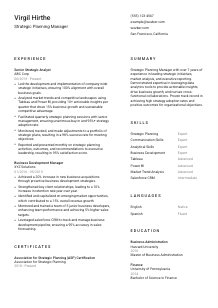
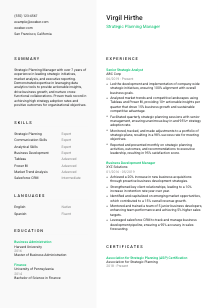
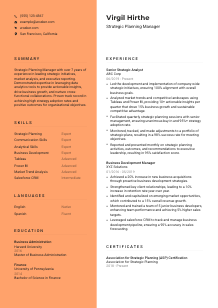
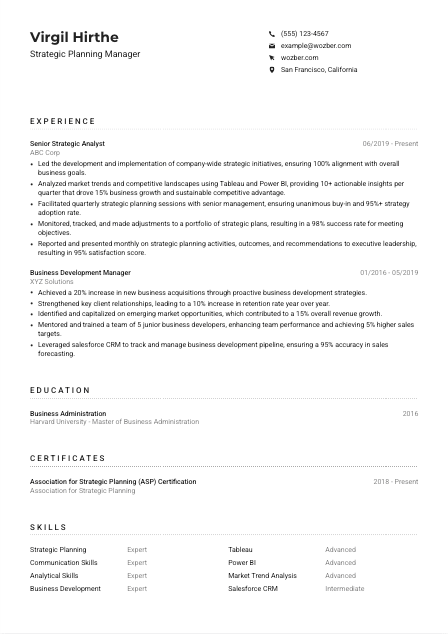
Navigating corporate chessboards, but your resume feels like a random roll of the dice? Check out this Strategic Planning Manager resume example, created with Wozber free resume builder. It shows how to map out your long-term vision and short-term tactics to match job requirements, putting your career on the most compelling path to success!
Strategic Planning Managers are hired to turn broad business goals into decisions, priorities, and measurable progress. That makes your resume less about listing planning tasks and more about showing how you have shaped direction, interpreted market data, aligned senior stakeholders, and kept initiatives moving when conditions changed.
When the resume is tailored well, hiring teams can quickly separate pure analysts from candidates who can influence executives and carry strategy into execution. Wozber's free resume builder helps you build an ATS-compliant resume that mirrors the language of the role without sounding forced, so your experience reads clearly as strategic leadership rather than general business support.
For a Strategic Planning Manager, the header should read as clean, credible, and immediately relevant. This section will not win the job on its own, but it can remove friction fast by confirming title alignment, location fit, and professional polish before anyone reaches your strategy work.
Place your name at the top in a clear, readable format. Strategic planning roles often involve executive-facing communication, board materials, and cross-functional presentations, so even your header should reflect good information hierarchy and professional judgment.
Add "Strategic Planning Manager" beneath your name when that is the role you are pursuing. Matching the target title helps frame the rest of the resume around enterprise planning, growth strategy, and execution oversight instead of broader business development or analyst work.
Include your phone number and a professional email address, and check both carefully. If a hiring team wants to discuss your work on strategic initiatives, market analysis, or executive reporting, you do not want basic contact errors getting in the way.
If a role specifies a location, include your city and state in the header. In the example, listing San Francisco, California immediately answers a stated requirement and avoids unnecessary questions about relocation or eligibility.
Include LinkedIn or a personal website only if it supports your candidacy with useful context such as career progression, speaking engagements, thought leadership, or major initiatives. Make sure those profiles reinforce the same leadership scope, business focus, and results shown on the resume.
This section should confirm who you are, what role you are targeting, and whether you meet straightforward requirements such as location. Clean basics help the reader move quickly to the part that matters most for this profession, your strategic impact.




Experience is the core of a Strategic Planning Manager resume because this is where employers look for business judgment, influence, and follow-through. They want to see that you have not only analyzed opportunities, but also shaped initiatives, gained stakeholder alignment, tracked performance, and reported progress in ways leadership could act on.
Start by pulling the main responsibilities from the job description and matching them to your own track record. For a strategic planning role, that usually means company-wide initiative development, competitive or market analysis, executive facilitation, progress tracking, and regular reporting. If one of your past roles involved leading portfolio reviews, running planning cycles, or turning analysis into recommended actions, bring that to the surface.
List positions in reverse chronological order and make the progression clear. Titles such as Strategic Analyst, Business Development Manager, Corporate Strategy Manager, or Planning Lead can all support your case when the bullets show increasing ownership over planning processes, business insight, and senior stakeholder communication.
Each bullet should show what you led, how you approached it, and what changed because of your work. The example does this well by tying market and competitive analysis in Tableau and Power BI to 10+ actionable insights per quarter and 15% business growth. That kind of phrasing connects strategic work to business outcomes instead of leaving it at analysis alone.
Quantify impact with measures that fit the role, such as revenue growth, adoption rate, initiative completion, objective attainment, forecast accuracy, operating improvement, or executive satisfaction. Numbers like 95% strategy adoption, 98% objective success, or monthly reporting cadence make it easier to understand the scale and consistency of your contribution.
Keep the emphasis on experience that shows enterprise thinking, cross-functional influence, and commercial judgment. Broader roles can still help if they show adjacent strengths, as the sample's business development work does through revenue growth, pipeline management, and market opportunity identification, but your most relevant planning evidence should carry the section.
A hiring team should be able to see how you analyze, influence, decide, and monitor from this section alone. If your bullets show business context, stakeholder reach, and measurable outcomes, your experience will read as strategic leadership rather than support work.
Education matters in strategic planning because it often signals the financial, commercial, and analytical grounding behind your decisions. This section is usually brief, but it still helps establish that you have the formal background to work across growth strategy, performance analysis, and executive decision support.
Start with the credentials that directly answer the posting. Here, a bachelor's degree in Business, Finance, or a related field is required, so a finance or business degree should be easy to spot on the page.
List degree, field of study, school, and graduation year in a straightforward structure. Strategic planning hiring often involves fast scanning for baseline qualifications before the reader gets into market analysis, initiative ownership, and leadership scope, so clarity matters.
If you hold an MBA or another relevant master's degree, place it prominently because it can strengthen your positioning for roles tied to enterprise strategy and executive collaboration. In the example, the MBA directly supports the posting's preference for a master's degree without needing extra explanation.
Relevant coursework, academic honors, or major projects can add value when they reinforce strategic finance, market analysis, operations, or leadership training. This is especially useful if you are earlier in your career or if a program included substantial analytical or strategy-focused work.
Capstones, leadership roles, or notable research can be worth adding when they show structured problem-solving or business decision-making. Keep the emphasis on material that supports strategic planning work, not general campus involvement.
This section does not need to be long. It needs to show that your academic background supports the level of commercial analysis and strategic decision-making the role requires.
Certifications are especially useful in strategy roles when they show formal planning methodology, business framework knowledge, or ongoing development beyond core education. They can strengthen your positioning when the employer values structured strategic planning practice or industry-recognized credentials.
Check whether the employer calls out a preferred credential and mirror it when you have it. In this case, an Association for Strategic Planning certification is a plus, so listing it directly creates a clear match with the role's stated preference.
Choose certifications that support strategic planning, business analysis, finance, transformation, or executive decision support. A short, targeted list is more effective than a long set of unrelated credentials.
Include issue dates or active status when the certification is current or needs renewal. For roles involving enterprise planning discipline and leadership credibility, current certifications can signal that your frameworks and methods are up to date.
If you are actively maintaining a certification or pursuing one tied to strategy, portfolio management, or analytics, that is worth noting when relevant. It shows that you continue to refine the tools and frameworks behind your planning work.
Certifications will rarely carry the resume by themselves, but they do strengthen your profile when they reinforce the strategic methods, analytical rigor, and professional commitment the role values.
A Strategic Planning Manager skills section should balance analytical tools, business capabilities, and communication strengths. Employers are looking for someone who can interpret data, guide planning discussions, and influence action across functions, so the list should reflect how strategy work actually gets done.
Start with the skills the employer names directly, then add adjacent capabilities you genuinely use. For this role, that includes strategic planning, market analysis, data visualization tools, executive communication, and cross-functional collaboration. If the posting names Tableau or Power BI, include those exact tools when they are part of your experience.
Do not build this section around software alone. Strategy roles also depend on facilitation, influence, business acumen, presentation skills, and the ability to translate analysis into recommendations that executives and functional teams can act on.
Prioritize skills that support planning cycles, business insight, and enterprise execution. The example works because it combines role-defining capabilities such as Strategic Planning and Market Trend Analysis with tools like Tableau and Power BI, then adds a relevant adjacent platform in Salesforce CRM rather than drifting into generic keywords.
This section should echo the language of the job description while staying grounded in your actual experience. A focused mix of analytics, planning, and stakeholder-facing skills makes your profile easier to read in both ATS screening and human review.
Language skills are usually a secondary section for Strategic Planning Managers, but they can still help when the role requires clear executive communication, collaboration across regions, or work with diverse teams. Keep the section factual and relevant to how communication happens in the business.
If the posting requires English proficiency, list English clearly with an accurate level. In this case, strong English communication is essential, so the resume should make that visible without leaving it to assumption.
List the languages most useful to the role first. For many strategic planning positions, English will lead because it is the language of reporting, presentations, workshop facilitation, and executive communication.
Extra languages can strengthen your profile if the company operates across markets or if the role involves cross-border collaboration. They are not mandatory in every strategy role, but they can suggest added range in stakeholder communication.
Label proficiency with clear terms such as Native, Fluent, Intermediate, or Basic. Strategic planning work often involves nuanced communication, so accuracy matters more than trying to make the section look impressive.
If you speak multiple languages, treat that as a practical communication asset rather than a decorative detail. It can support workshops, market understanding, client interaction, or collaboration with regional teams when those are part of the role.
This section should confirm you can communicate at the level the role requires and, where relevant, show additional range. For a Strategic Planning Manager, clarity and accuracy matter more than volume.
The summary needs to establish your level quickly. In a few lines, it should show your planning scope, business orientation, analytical strength, and ability to influence decisions. For this role, that usually matters more than a broad personal statement or generic career objective.
Pull out the central themes of the role before you write. Here, those themes include leading strategic initiatives, analyzing market and competitive data, facilitating planning with senior leaders, and tracking outcomes over time. Your summary should reflect that operating reality.
Start with a direct line that states who you are and how long you have worked in relevant functions. A phrase like "Strategic Planning Manager with 7+ years of experience" works because it gives immediate context and aligns with a requirement for at least 5 years in strategic planning, business development, or related work.
Use the next lines to highlight the strengths that matter most for this kind of role, such as turning market analysis into growth recommendations, guiding cross-functional planning sessions, and reporting strategic progress to executives. The example summary earns its space by tying analytics tools, collaboration, and business growth together in a compact way.
Aim for three to five lines with specific language and no filler. If every sentence names a planning strength, decision-making contribution, tool set, or business result, the summary will set up the rest of the resume well.
A well-written summary tells the reader, from the first glance, that you can lead planning work, interpret business signals, and keep strategy connected to results. That is the standard this role needs to see.
A Strategic Planning Manager resume should make three things easy to recognize: the scale of the initiatives you have shaped, the quality of your analysis, and your ability to align leaders around a plan that produces measurable business results.
Use Wozber's free resume builder to organize those strengths in an ATS-friendly resume format, then refine the language with its ATS resume scanner so the final document reflects the role's priorities with accuracy. When the resume is tailored well, your planning experience reads the way hiring teams need to see it, as strategic leadership with business impact.




