



Use Wozber and land your dream job
Create Resume
No registration required
Curating literary adventures, but your resume feels overdue? Check out this Library Director resume example, created with Wozber free resume builder. Learn how to align your leadership tales with job expectations, ensuring your career narrative is as captivating as the stories lining your shelves!
Library Director hiring usually turns on one question fast: have you led a library operation in a way that improved service for patrons, staff, and the wider community. A resume for this role needs to show more than time in libraries. It should make your command of policy, collection management, budgeting, staff leadership, and public service visible in concrete terms.
When those responsibilities are tailored to the posting, the resume is easier to process in both human review and ATS screening. Wozber's free resume builder helps you align titles, achievements, and library-specific terminology with an ATS-friendly resume format, so a hiring team can quickly see whether your background matches the level of strategic and operational oversight the position requires.
For a Library Director, the top of the resume should immediately read as senior, credible, and easy to contact. Keep this section clean and practical so nothing gets in the way of your experience in library leadership and public service.
Use your full name prominently and keep the styling simple. This is an executive-level public service role, so readability matters more than visual flair. A hiring committee scanning multiple applications should be able to identify your name instantly.
Place "Library Director" directly below your name when that is the role you are pursuing. Matching the job title helps frame your background around leadership, policy, and operational oversight from the first line.
Your contact information should support fast outreach and remove any friction from scheduling interviews or follow-up conversations.
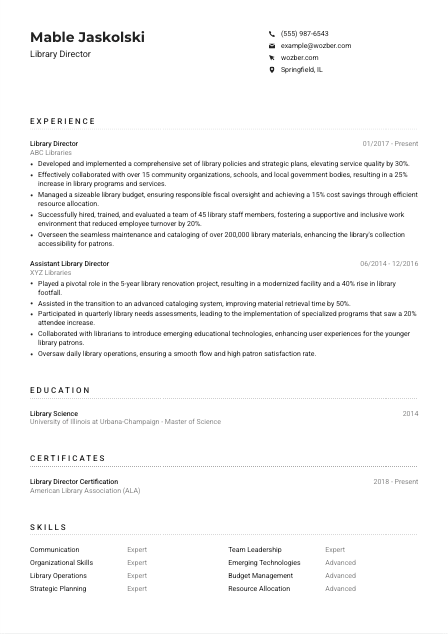
If the posting specifies a city or relocation expectation, include your city and state. In the example, listing Springfield, IL directly answers the employer's location requirement and avoids questions about availability.
Include LinkedIn or a professional profile only if it reinforces your candidacy. For a Library Director, that might mean leadership history, speaking engagements, board participation, major projects, or public-facing initiatives in library services.
This section should confirm who you are, where you are based if relevant, and how to reach you. Then the reader can move straight to the parts that prove you can run a library system well.




Experience carries the most weight in a Library Director resume because this is where you show operational judgment. Hiring teams want to see how you led staff, improved services, managed resources, and worked with community partners, not just that you held senior library titles.
Before rewriting your experience, mark the responsibilities and requirements that define the job. For this role, that includes strategic planning, cataloging oversight, budgeting, community collaboration, and supervising staff. Those themes should appear in your bullets using language that matches your real work.
Start with your most recent position and work backward. For director and assistant director roles, include employer name, title, and dates clearly so reviewers can track your progression into broader operational and supervisory responsibility.
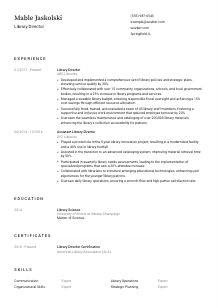
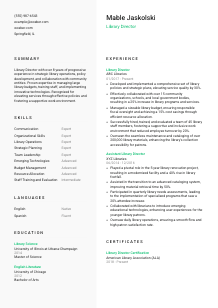
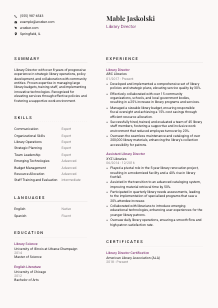
Each bullet should show what you led, changed, or improved. For library leadership, that often means policy rollout, collection access, staffing outcomes, partnerships, or service expansion. The example does this well by tying strategic plans to a 30% rise in service quality and community collaboration to a 25% increase in programs and services.
Use metrics that make sense in library operations. Good examples include budget savings, collection size, program attendance, footfall, retrieval time, turnover reduction, number of staff supervised, or number of partner organizations. Numbers like 200,000 materials maintained or a 15% cost savings tell a hiring panel far more than broad claims about improvement.
Prioritize experience that supports public service leadership, resource management, technology adoption, collection oversight, and staff supervision. If older roles are less relevant, shorten them so your recent library management work carries the section.
A strong experience section lets the reader picture you managing a real library operation. Focus on staff, services, collections, budgets, and partnerships, and make the outcomes easy to see.
Education matters here because the role has a specific academic threshold. Your resume should make it easy to confirm that you meet the master's-level library science requirement before the reader moves on to your leadership record.
If the role requires a Master's degree in Library Science from an ALA-accredited institution, list that degree first and spell out the field clearly. In the example, the Master of Science in Library Science immediately supports a key qualification for the position.
Keep each entry simple: degree, field, school, and graduation year. That format is easy to scan and works well in ATS parsing as well as committee review.
For a Library Director, the exact field matters. "Library Science" should appear plainly rather than being buried in abbreviations or generalized under a broader humanities or education degree.
Most experienced candidates do not need coursework, but you can include honors, leadership work, or academic projects if they relate to archives, cataloging, information services, or library administration. Use them only when they add real value beyond the degree itself.
If you have recent training in public library leadership, digital services, accessibility, data-informed programming, or collection technologies, place it here or in another appropriate section. Continued learning is especially useful when it supports emerging technology or management expectations in the posting.
This section should answer the degree requirement without effort from the reviewer. Once that box is clearly checked, your management experience can do the heavier lifting.
Certifications can matter a great deal in library leadership roles, especially when a state-issued credential is required or preferred. Present them in a way that shows current professional standing and relevance to the scope of the job.
Start with certifications that directly support eligibility or leadership scope. If a Library Director certification is listed in the posting, put that first. The example uses this well by naming the Library Director Certification prominently.
You do not need to include every workshop or short training. Prioritize credentials tied to library administration, leadership, public service management, or regulatory requirements so the section stays relevant and easy to scan.
Add the issue date, renewal date, or active range where appropriate. That helps employers quickly understand whether the certification is current, especially for roles that depend on state compliance or formal authorization.
If you continue to update your credentials or complete leadership-related training, include the most relevant items. For a Library Director, this can reinforce that you stay current with governance, service models, and evolving library technologies.
A well-chosen certification section can answer eligibility questions immediately. Keep it concise, current, and closely tied to library leadership responsibilities.
The skills section should reflect the operating realities of the job. For a Library Director, that means balancing day-to-day library systems knowledge with leadership, planning, budgeting, and communication across staff and community stakeholders.
Pull skills from the posting and from the actual work of library leadership. Here, that includes library operations, cataloging systems, strategic planning, budget management, team leadership, communication, and emerging technologies in library services.
Include both the operational side of the role and the management side. A useful mix might include collection management, library systems, policy development, staff evaluation, public communication, and community partnership building. The sample skill list does this by pairing library operations and emerging technologies with leadership and organizational strengths.
Avoid filling this section with broad office skills or generic traits. A shorter list of highly relevant capabilities gives a clearer picture of how you would run services, supervise staff, and allocate resources in a library setting.
Every skill listed should support a real part of the job, from operational oversight to public-facing leadership. If the section feels specific to library administration, it is doing its job.
Language skills are especially useful in libraries because the role often includes public communication, staff support, and community outreach. Still, this section should stay grounded in actual proficiency and service value, not aspiration.
If the posting states that clear English communication is required, list English with an accurate proficiency level. For this position, that directly addresses a stated requirement and supports the public-facing nature of the work.
Additional languages can be a real asset in communities with diverse patron populations. In the example, Spanish adds useful context for outreach, programming, and front-line accessibility, though it is an advantage rather than a universal requirement.
Use levels such as Native, Fluent, Conversational, or Basic only if they reflect how well you can actually speak, write, or serve patrons in that language. Accuracy matters, especially in roles that may involve public interaction.
If a second language has helped you support bilingual programming, community events, or patron communication, it strengthens the value of listing it. That connection matters more than simply naming the language.
Do not overbuild this section unless languages are a major part of the role. For most Library Director resumes, a concise list is enough to show communication range and community awareness.
When listed well, languages show more than personal ability. They point to how you can communicate with patrons, support inclusive services, and lead in a diverse public setting.
The summary should quickly establish the scale and type of library leadership you bring. It works best when it combines years of experience, core areas of oversight, and one or two concrete strengths that match the opening.
Open with your title or professional identity and your years of progressively responsible experience. For example, stating that you are a Library Director with 8+ years in library operations and leadership immediately aligns with a posting that asks for progressive experience and management responsibility.
Use the next line to highlight the functions that define your work, such as policy development, strategic planning, collection oversight, budgeting, staff management, or community partnerships. Keep the wording tied to work you have already done, not responsibilities you hope to pick up later.
Borrow important terms from the posting where they match your background. Words like "library operations," "cataloging systems," "strategic plans," and "emerging technologies" can strengthen ATS optimization when they appear in natural, truthful phrasing. Wozber's AI resume builder can help identify those terms and tighten the match without turning the summary into a keyword list.
Aim for 3 to 5 lines. The example summary works because it covers progressive experience, strategic operations, budgeting, staff development, and technology adoption without drifting into vague leadership language.
Your summary should give the hiring team a fast, accurate picture of your leadership scope in libraries. When it is specific enough to match the role and concise enough to scan quickly, it sets up the rest of the resume well.
A Library Director resume should make three things easy to understand: the level of library operation you have managed, the public service outcomes you improved, and the staff and resources you led responsibly. When those elements are clear, the resume reads like a leadership document rather than a general library application.
Wozber helps you build that kind of targeted application with ATS-friendly resume templates, AI-assisted tailoring, and an ATS resume scanner that surfaces missing requirements and aligns your language with the posting. Use that structure to present your experience with the same clarity and organization the job demands.
The final draft should leave no confusion about your readiness to lead a library system, support its community, and manage its operations with confidence.




