



Use Wozber and land your dream job
Create Resume
No registration required
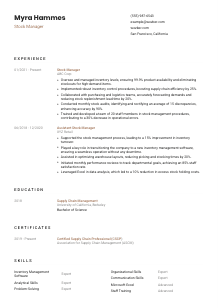
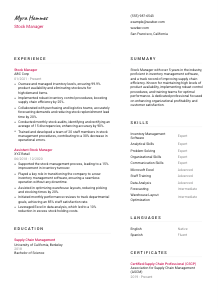
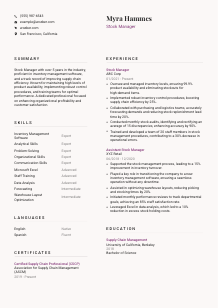
Juggling inventory, but your resume seems out of stock? Check out this Stock Manager resume example, created with Wozber free resume builder. Learn how to highlight your supply chain savvy to match job requirements, restocking your professional prospects to the fullest!
Stock management gets judged in the numbers long before anyone talks about leadership style. Hiring teams want to see whether you can keep inventory accurate, prevent stockouts, tighten control procedures, and coordinate replenishment without slowing warehouse or retail operations. Your resume should make that operational discipline visible from the first section.
A tailored Stock Manager resume quickly separates broad warehouse experience from hands-on inventory ownership. Using Wozber's free resume builder to align your wording with the posting and keep an ATS-compliant resume structure helps surface the right details first, such as audit cadence, forecasting support, inventory system use, and measurable improvements in availability or accuracy. That makes it much easier to see whether you can run stock reliably.
This section is brief, but it still carries hiring value. For a Stock Manager, clean personal details suggest organization and make it easy for the employer to confirm practical basics such as role alignment, contactability, and, when relevant, location for on-site inventory operations.
Use your full name in a clear, readable format so it stands out immediately. There is no need for design flourishes. In operations-focused hiring, clarity beats decoration. A simple presentation keeps attention on the substance of your inventory, audit, and replenishment experience.
Place "Stock Manager" directly beneath your name if that is the role you are pursuing. Matching the posted title helps frame the rest of the resume correctly, especially when your background includes adjacent positions such as Assistant Stock Manager, Warehouse Supervisor, or Inventory Coordinator.
List a current phone number and a professional email address. Add LinkedIn or a professional website only if it supports the application with relevant experience, process improvements, or supply chain credentials. Every item here should make it easier to reach you, not create noise.
If the employer requires on-site presence or relocation, state your city and state clearly. In this example, San Francisco, California matters because the posting names it directly. If you are relocating, note that plainly so location does not become an avoidable screening issue.
A LinkedIn profile can help if it mirrors your resume and adds useful context, such as inventory systems, warehouse operations, supply chain coursework, or certifications. Keep dates, titles, and achievements consistent across both. Mismatched details can raise questions before your experience is even reviewed.
This section should confirm the basics fast: who you are, what role you are targeting, how to reach you, and whether location is workable. For a Stock Manager, that clean start supports the bigger story your resume needs to tell about control, accuracy, and dependable execution.




Experience is where Stock Manager resumes earn credibility. Employers look for proof that you have managed inventory levels, improved control processes, worked across purchasing and logistics, and corrected discrepancies before they turned into service or cost problems.
Read the job description line by line and isolate the operational themes behind it. For this role, the core themes are inventory availability, stock control procedures, replenishment planning, audit accuracy, and team training. Those themes should guide which bullets you keep, rewrite, or move higher in your experience section.
Lead with your most recent position and include your job title, employer, and dates. Stock management responsibilities usually build with scale, from supporting counts and system updates to owning replenishment, audits, and staff oversight. A reverse-chronological format makes that progression easy to follow.
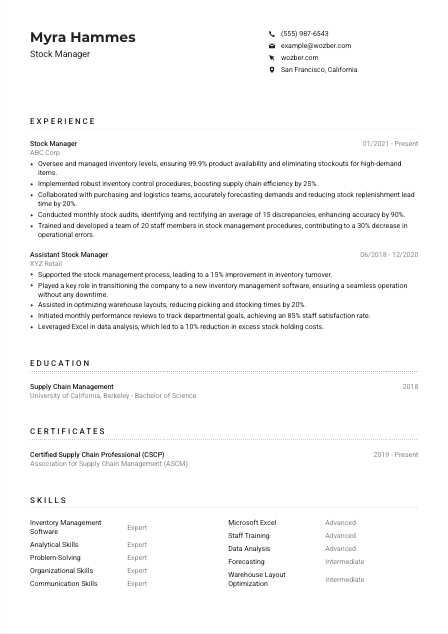
Focus each bullet on work that affected availability, efficiency, accuracy, lead time, or labor performance. The example resume does this well with results such as 99.9% product availability, a 25% supply chain efficiency gain, and a 20% reduction in replenishment lead time. Those are the kinds of outcomes that show you were managing stock, not just being around it.
Numbers matter here because stock management is measured in service levels, variance, turnover, carrying cost, audit findings, and process speed. If you improved cycle count accuracy, cut excess stock, reduced picking time, or lowered operational errors through training, quantify it. Specific figures make your ownership of the work much more believable.
Prioritize bullets that show stock control, forecasting support, warehouse coordination, discrepancy resolution, system adoption, or team supervision. General duties with no operational result can crowd out stronger material. Even if you handled many tasks, the resume should emphasize the ones that map to inventory performance and supply chain execution.
A hiring team should be able to scan your experience and understand the scale you handled, the processes you improved, and the business outcomes you influenced. When your bullets connect inventory decisions to availability, accuracy, cost, or team performance, your fit for a Stock Manager role becomes much clearer.
Education usually will not outweigh hands-on stock experience, but it still matters when the posting asks for a specific academic foundation. For Stock Manager roles, degrees tied to supply chain, business, operations, or logistics can reinforce your understanding of inventory flow, forecasting, and process control.
Check the posting for any required field of study before you format this section. Here, the employer asks for a bachelor's degree in Supply Chain Management, Business, or a related field. If your degree matches directly, make that easy to spot by listing the degree and field clearly.
List your degree, field of study, school, and graduation year in a straightforward format. This section does not need extra wording. Clear structure helps the reviewer confirm qualifications quickly and move on to the parts of your resume that show inventory control and operational impact.
If your education lines up closely with the requirement, let that work for you. The example resume lists a Bachelor of Science in Supply Chain Management, which directly supports a role centered on stock levels, replenishment, and supply chain efficiency. When the connection is this clear, you do not need to oversell it.
If you have limited stock management experience, include coursework, academic projects, or research tied to inventory systems, forecasting, logistics, warehouse operations, or data analysis. This can help bridge the gap between formal education and practical stock responsibility.
Honors, leadership roles, or capstone work are worth listing when they show analytical ability, process thinking, or supply chain knowledge. A project on warehouse optimization or demand planning says more for this profession than a generic campus activity with no operational link.
This section should quickly answer one question: do you meet the academic bar for the role? Once that is established, any extra detail should strengthen your connection to inventory management, forecasting, or supply chain operations.
Certifications are not always required for Stock Manager jobs, but they can strengthen your profile when they show current knowledge in supply chain operations, inventory control, or process improvement. They are especially useful if you want to signal growth beyond day-to-day stock handling.
Some employers require certifications, while others treat them as a bonus. This posting does not list one, so certificates should support your candidacy rather than dominate it. Use them to add depth, not to compensate for weak experience.
Choose certificates tied to stock management, supply chain operations, logistics, inventory planning, or warehouse process improvement. The CSCP in the example is relevant because it supports broader supply chain understanding behind replenishment, inventory flow, and operational efficiency.
Add the year earned and, if relevant, the validity period. This helps employers see that your knowledge is current, especially when processes, systems, and reporting expectations continue to evolve across supply chain and warehouse environments.
Stock managers are often expected to improve procedures, work across functions, and adapt to new systems. Certifications can reinforce that you stay engaged with better inventory practices, process discipline, and operational problem-solving rather than relying only on past routines.
Include certifications that genuinely support inventory management work and keep them current. A focused list can strengthen your profile, especially when it connects clearly to stock control, supply chain coordination, or process improvement.
The skills section should read like the operating toolkit behind your results. For a Stock Manager, that usually means a mix of inventory systems, Excel-based analysis, process discipline, forecasting support, audit work, and team coordination across warehouse, purchasing, and logistics functions.
Start with the job description and note the skills named directly, then add closely related abilities you genuinely use. In this case, inventory management software, Microsoft Excel, analytical ability, problem-solving, organization, and communication are all central to the work.
List skills that appear elsewhere in your resume through results or responsibilities. If you claim forecasting, your experience should show demand planning or replenishment coordination. If you list inventory management software, there should be evidence of system use, control procedures, or stock accuracy improvements to support it.
Do not turn this section into a long inventory of every ability you have ever used. A sharper list is more convincing. The example's mix of inventory software, Excel, data analysis, staff training, forecasting, and warehouse layout optimization works because those skills connect directly to stock availability, efficiency, and team execution.
When this section is done well, it reinforces the methods behind your experience bullets. A hiring manager should see the systems, analytical strengths, and operational capabilities that enable you to keep inventory accurate and product flow steady.
Language skills matter in stock management when the role depends on clear communication across teams, vendors, warehouse staff, or distribution partners. Even when only one language is required, listing proficiency accurately helps employers understand how you can operate in their environment.
Check the posting first. Here, English proficiency is mandatory, so it should appear clearly in your Languages section. If the role includes written reporting, audit documentation, or cross-functional coordination, the ability to communicate accurately in English has direct operational value.
List the employer's required language at the top with an honest proficiency level. In the example resume, "English - Native" addresses the requirement immediately and leaves no ambiguity for the reviewer.
Additional languages can be useful in warehouse environments, retail back-room operations, or supplier coordination, especially when teams are multilingual. They are not a replacement for inventory skills, but they can strengthen your ability to train staff, resolve issues, and coordinate efficiently.
Terms like Native, Fluent, Intermediate, and Basic are enough. Avoid vague wording. Honest ratings are important because language ability can affect training, reporting, safety communication, and cross-team handoffs in stock operations.
Only give this section more space if languages are genuinely useful to the role. For many Stock Manager positions, English is the main requirement and anything additional is secondary. Present it as a supporting asset, not the center of your value.
For this profession, the key question is whether you can communicate clearly where inventory work happens: in reports, audits, training, and daily coordination. List languages honestly and keep the emphasis where it belongs.
Your summary should quickly establish your level, your inventory focus, and the kind of results you deliver. For Stock Manager roles, that usually means stock accuracy, product availability, control procedures, forecasting support, and team leadership, expressed in a few specific lines rather than broad claims.
Review the posting and identify the two or three themes that matter most. In this case, those themes include inventory control, stock availability, collaboration with purchasing and logistics, and staff development. Your summary should reflect those priorities using language you can support in the rest of the resume.
Start with a direct line such as "Stock Manager with 5+ years of experience" or a close equivalent that fits your background. This gives the reader immediate context and helps distinguish you from candidates whose experience is broader warehouse support rather than stock ownership.
Use one or two sentences to name the capabilities that matter most for the role, then connect them to outcomes. The example summary works because it links inventory software proficiency and control procedures to supply chain efficiency, product availability, and team performance. That combination is much stronger than generic statements about being hardworking or detail-oriented.
Aim for a compact paragraph, usually three to four lines. The summary should set expectations for the experience section, not repeat it bullet by bullet. Focus on your stock management scope, your strongest operational skills, and the results pattern you are known for.
A solid Stock Manager summary gives the employer a quick operational snapshot: your level of experience, the inventory work you handle well, and the outcomes you tend to improve. If those points are clear, the rest of the resume has a strong opening to build on.
A Stock Manager resume works when it shows control over inventory, not just exposure to warehouse activity. Keep the emphasis on availability, accuracy, replenishment, audits, system use, and team execution, then support those points with numbers wherever you can.
Wozber's free resume builder can help you organize those details in an ATS-friendly resume format, tailor wording to the job description, and strengthen alignment with the role through its ATS resume scanner. The finished resume should make one thing easy to judge: whether you can keep stock operations reliable from count to replenishment.




