



Use Wozber and land your dream job
Create Resume
No registration required
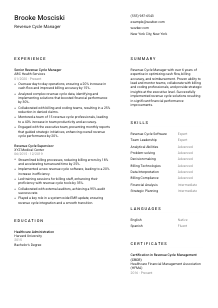
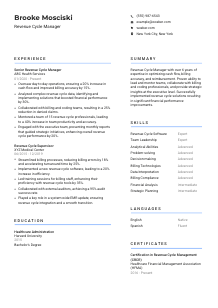
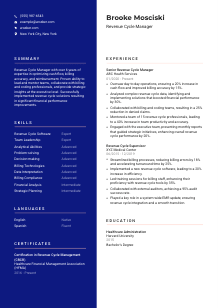
Navigating cash flows, but finding your resume stuck in a billing cycle? Check out this Revenue Cycle Manager resume example, built with Wozber free resume builder. Learn how to present your financial finesse in line with job specifics, making your career trajectory as smooth as a timely payment!
Revenue Cycle Managers sit at the point where billing accuracy, reimbursement discipline, denial management, and cash flow all meet. Hiring teams want to see whether you have actually improved collections, tightened front-to-back revenue cycle processes, and led billing and coding teams through measurable operational gains, not just whether you have worked in healthcare finance.
When your resume is tailored to the target opening, the first scan quickly shows whether your background lines up with the employer's revenue cycle priorities, from reimbursement analysis to staff leadership and reporting to senior leadership. Wozber's free resume builder helps organize that experience into an ATS-compliant resume that reflects the language of the job description, so both the ATS and hiring team can quickly recognize your scope, results, and command of revenue cycle operations.
This section is short, but it still does practical work. For a Revenue Cycle Manager, your header should immediately confirm professional identity, clean contact access, and any location requirement the employer has stated.
Place your full name first, followed by the exact title you are pursuing when it accurately matches your background. Using "Revenue Cycle Manager" directly under your name makes your specialization clear before the reader reaches your experience.
Use a current phone number and a professional email address that will not distract from your application. Healthcare finance leadership roles often move through several interview stages, so make it easy for recruiters, HR, and department leaders to reach you quickly.
If the employer specifies a city or region, list it plainly in your header. In this example, "New York City, New York" matters because the job posting names that location as a requirement, so adding it removes an avoidable screening question early.
Include LinkedIn or a professional website only if it supports your candidacy with consistent information. For this kind of role, that might mean a profile showing healthcare revenue cycle leadership, payer relations, billing systems work, or progression into management.
Do not add age, marital status, photo, or other personal details that do not affect your ability to run revenue cycle operations. Keep the focus on information tied to hiring decisions and job logistics.
A clean header should confirm who you are, what role you do, and whether you meet any stated logistical requirement. That gives the hiring team a straightforward start.




This section carries the most weight for a Revenue Cycle Manager. Employers are looking for operational ownership, financial improvement, denial reduction, process discipline, system knowledge, and the ability to lead teams that keep claims moving accurately and efficiently.
Before writing bullets, identify the operational themes in the posting. Here, the emphasis is on day-to-day revenue cycle oversight, billing and reimbursement performance, data analysis, denied claims, staff leadership, and executive reporting. Those themes should shape which roles and achievements you spotlight first.
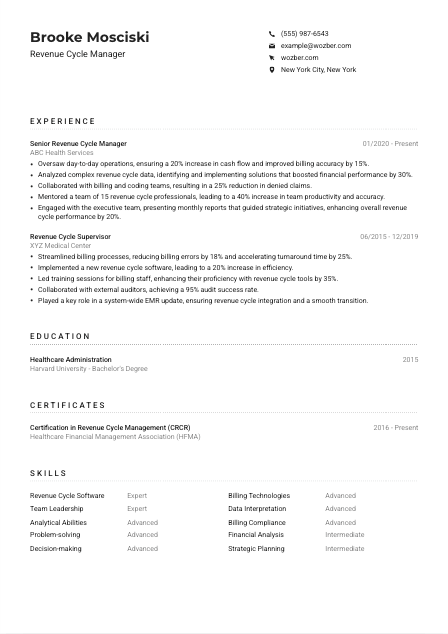
List your most recent positions first and make each entry easy to scan with company, title, and dates. Prioritize roles that show increasing ownership over billing operations, coding coordination, reimbursement workflows, or revenue cycle systems. The sample progression from Revenue Cycle Supervisor to Senior Revenue Cycle Manager works well because it shows growth in scope and leadership.
Revenue cycle hiring decisions are heavily influenced by numbers. Replace generic duty statements with outcomes tied to cash flow, billing accuracy, denial rate, turnaround time, collections, productivity, audit performance, or reimbursement improvement. The sample bullet about increasing cash flow by 20% and improving billing accuracy by 15% is strong because it ties management work to financial and operational results.
Metrics matter more when the reader can see how you delivered them. Mention the workflows you managed, such as denial follow-up, claims submission, coding coordination, reimbursement analysis, reporting cadence, software implementation, or EMR integration. If you led staff, include team size, coaching responsibilities, or process training, like the example that notes mentoring 15 revenue cycle professionals.
Keep bullets focused on experience that strengthens your case for managing revenue performance. A hiring team for this role will care far more about denied claims reduction, billing technology rollout, audit success, and executive reporting than about unrelated administrative tasks. Trim aggressively so the evidence for revenue cycle leadership stays sharp.
Your experience should show that you can run revenue cycle operations, improve financial outcomes, and lead the people and processes behind those results. If those points are easy to find, the section is doing its job.
Education matters here because many employers use it as a baseline screen before they look deeper into your operational history. For Revenue Cycle Manager roles, the degree should reinforce your grounding in healthcare administration, business, finance, or another closely related field.
If the posting asks for a bachelor's degree in Healthcare Administration, Business, or a related field, make that qualification easy to spot. In the example resume, a Bachelor's Degree in Healthcare Administration aligns neatly with the employer's stated requirement.
List degree, field of study, school, and graduation year or date in a clean order. Recruiters and ATS systems should be able to read this section without guessing at what you studied or whether you meet the minimum education threshold.
If your degree is in a related area rather than an exact match, you do not need to overexplain it. Just present it clearly and let the rest of the resume reinforce the connection through healthcare finance, billing, reimbursement, compliance, or operations experience.
Early-career candidates can strengthen this section by adding coursework or academic projects tied to healthcare finance, coding, reimbursement, compliance, data analysis, or information systems. For more experienced managers, this is optional and usually less important than measurable work history.
Academic honors, leadership roles, or distinctions can be worth including if they add credible context and do not crowd out more relevant content. Keep extras brief and only retain them if they support the professional story you are telling.
Make the degree easy to confirm and clearly connected to the role's baseline requirements. Then let your experience carry the deeper argument.
In revenue cycle leadership, certifications help show current knowledge of reimbursement practices, billing standards, and the financial side of healthcare operations. They are especially useful when the employer names a preferred credential in the posting.
Start with certifications that directly support revenue cycle management. In this job description, CRCR is strongly preferred, so it should appear prominently if you have it. The sample resume handles this well by listing the Certification in Revenue Cycle Management from HFMA.
Do not overload this section with unrelated credentials. Prioritize certifications tied to revenue cycle operations, healthcare finance, compliance, coding, reimbursement, or practice management so the section strengthens the exact case you are making.
Add the earned date and, if relevant, the active period or renewal status. That helps employers see whether your credential is current, which matters in areas shaped by payer rules, compliance expectations, and changing billing practices.
If you are working toward a new credential or regularly complete relevant training, that can reinforce your commitment to staying current with billing technologies, reimbursement changes, and process improvement methods. Keep the wording concrete rather than vague.
A well-chosen certification list tells the employer that your knowledge of revenue cycle operations is current, formalized, and relevant to the demands of the role.
A Revenue Cycle Manager needs a mix of operational, analytical, technical, and leadership skills. This section should mirror the language of the posting while staying grounded in the capabilities you actually use to improve billing performance and reimbursement outcomes.
Start with the skills the employer states directly, then add the ones embedded in the responsibilities. Here that includes revenue cycle software, billing technologies, analytical ability, problem-solving, decision-making, team leadership, reimbursement knowledge, and denied claims management.
Use the same terminology the employer uses when it accurately describes your background. If you have deep experience with revenue cycle platforms, billing systems, compliance workflows, or financial analysis, name those skills clearly. The sample list works best where it stays close to actual role language, such as Revenue Cycle Software, Billing Technologies, and Data Interpretation.
Put the skills most tied to this job near the top. A long list is less useful than a focused one that quickly shows you can run operations, analyze revenue cycle data, guide staff, and improve reimbursement performance. Save lower-priority or generic skills for later, if they belong at all.
Your skills should reinforce the way you operate as a revenue cycle leader, from billing systems and analysis to staff management and financial decision-making.
Language skills are usually secondary for a Revenue Cycle Manager, but they still matter when the posting names a required proficiency or when multilingual communication supports staff coordination, patient-facing billing issues, or work in a diverse market.
Always review the job description first. In this case, advanced English proficiency is explicitly required, so your resume should state your English level clearly rather than leaving it implied.
Use direct labels such as Native, Fluent, Advanced, Intermediate, or Basic. If English is essential to reporting, staff guidance, and communication with leadership, mark it in a way that removes doubt about your ability to perform those parts of the job.
Additional languages can be worth listing when they support communication with patients, front-office teams, or diverse billing environments. Spanish, for example, may be a practical asset in some healthcare organizations, but it should remain secondary to the core revenue cycle qualifications unless the employer emphasizes it.
Be accurate about your language level. Overstating fluency can become a problem quickly in interviews or on the job, especially when leadership communication, documentation, or cross-team coordination depend on precision.
If the employer operates in a multilingual market, extra language ability can strengthen your profile, but do not force the point. Treat it as a supporting advantage rather than a substitute for revenue cycle performance, billing expertise, or leadership experience.
List required language proficiency clearly, then add other languages only when they support the actual communication demands of the role.
Your summary should give a hiring team a fast, accurate read on your level, your specialty, and the business results you have produced. For a Revenue Cycle Manager, that usually means a short statement covering years of experience, core operational focus, leadership scope, and two or three outcomes tied to financial performance.
Read the posting and identify the points that deserve immediate emphasis. For this role, that means revenue cycle oversight, billing and coding coordination, reimbursement performance, analytical decision-making, and team leadership. Those ideas should anchor your opening lines.
Open with your title or specialty, followed by your years of experience and primary area of expertise. A line similar to the sample's "Revenue Cycle Manager with over 6 years of expertise" works because it establishes seniority and role alignment right away.
Use brief, high-value metrics that match how the function is measured, such as improved cash flow, reduced denied claims, higher billing accuracy, stronger productivity, or better financial performance. The sample summary is most effective where it points to significant performance improvements rather than broad claims alone.
Aim for a compact paragraph that can be read in seconds. Skip generic adjectives and focus on what you manage, what you improve, and the kind of teams or systems you lead. Detailed examples belong in the Experience section, while the summary should frame the case clearly at the top.
After reading your summary, the employer should already understand that you can lead revenue cycle operations, improve reimbursement performance, and communicate at a management level. That is the standard to aim for.
A Revenue Cycle Manager resume should make one point easy to confirm: you improve revenue performance by managing the process, the data, and the people behind it. When your experience, skills, education, and certifications all support that story, the document reads with much more authority.
Use Wozber's AI resume builder to tighten your wording, align your content with the job description, and present it in an ATS-friendly resume format that supports accurate ATS optimization. The finished resume should make it easy to judge your command of billing operations, denial reduction, reimbursement strategy, and team leadership.




