



Use Wozber and land your dream job
Create Resume
No registration required
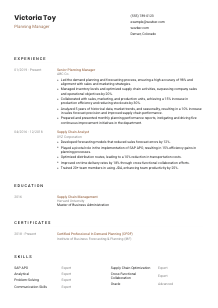
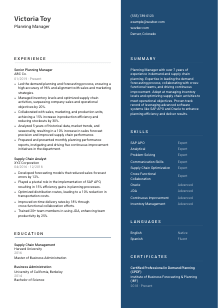
Charting strategies, but your resume feels off course? Navigate this Planning Manager resume example, created with Wozber free resume builder. Learn how to align your strategy-setting skills with job requirements, ensuring your career trajectory is always heading towards success!
Planning Managers work where forecast quality, inventory decisions, and operational trade-offs meet. Hiring teams look for people who can turn sales inputs, production limits, and market shifts into plans the business can actually execute. Your resume should make that visible through forecast ownership, supply chain decisions, and measurable planning outcomes.
When the resume mirrors the language of demand planning, forecasting systems, and cross-functional planning work, it is much easier to sort you into the right candidate pool during ATS screening. Wozber's free resume builder helps structure that alignment in an ATS-friendly resume format, so your experience reads clearly as planning leadership rather than general operations support.
This section is simple, but it still carries hiring value. For a Planning Manager, clear contact details and the right location cue remove friction before anyone even reaches your forecasting or inventory experience.
Use your full name in the largest text on the page so it anchors the resume immediately. Keep it clean and professional. For management roles in supply chain and planning, a polished header sets the tone for the structured, detail-aware work the role requires.
Place "Planning Manager" directly under your name if that is the role you are pursuing. Matching the job title helps recruiters and ATS tools connect your background to the opening quickly, especially when your recent titles vary between demand planning, supply chain planning, or senior planning leadership.
Include a current phone number and a professional email address with no typos. Planning roles often involve multiple interview stages across supply chain, operations, and commercial teams, so you want every stakeholder to be able to reach you without delay.
If the employer wants someone based in Denver or open to relocation, state that directly in your contact line. That is a posting-specific requirement, not a universal rule for every Planning Manager role, but when location is named this clearly, you should remove any doubt early.
Include LinkedIn or a professional website only if it supports your candidacy with consistent information. For example, a profile that reinforces planning systems, S&OP work, supply chain results, or leadership scope can strengthen the overall read of your application.
Your personal details do not need personality flourishes. They need to confirm who you are, what role you target, and whether basic requirements like location and accessibility are already covered.




This is the section most likely to decide whether you move forward. For Planning Manager hiring, employers want to see how you improved forecast accuracy, balanced inventory against service levels, partnered with sales and production, and used planning systems to drive better decisions.
Read the posting for the operating priorities behind the title. Here, the recurring themes are demand forecasting, inventory control, planning software, cross-functional coordination, and reporting. Those themes should shape which achievements you choose and how you phrase them.
List your experience in reverse chronological order and give the strongest planning roles the most space. A title such as "Senior Planning Manager" naturally carries weight, but the real value comes from showing ownership of forecasting cycles, inventory decisions, production alignment, and planning performance.
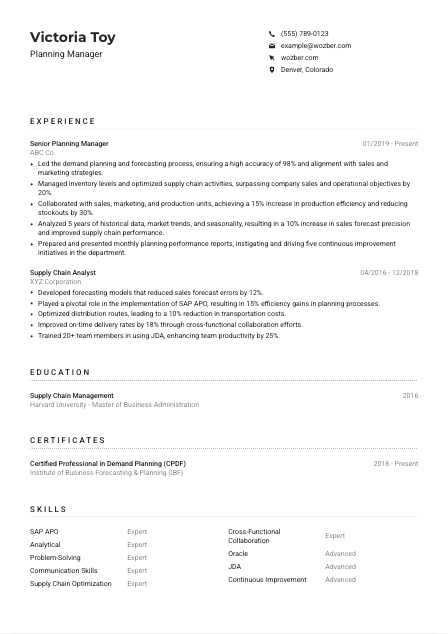
Do not stop at "managed demand planning" or "worked with sales and marketing." Show what changed because of your work. The sample resume does this well with outcomes like 98% forecast accuracy, a 15% increase in production efficiency, and a 30% reduction in stockouts. Those are the kinds of numbers that hiring teams recognize immediately.
Planning managers are hired to improve operational performance, not to describe process steps. Use metrics tied to service levels, inventory health, transportation cost, on-time delivery, forecast error, or production efficiency. Results such as exceeding operational objectives by 20% or reducing forecast errors by 12% show that your planning decisions held up in real business conditions.
Prioritize bullets that support demand planning, supply chain planning, reporting, system use, and cross-functional execution. If an older accomplishment does not connect to forecasting, inventory optimization, or operational improvement, trim it. Space should go to the experience that best supports a Planning Manager hire.
A hiring manager should be able to scan your experience section and see forecast ownership, system fluency, supply chain judgment, and clear operational outcomes. That combination carries much more weight than a long list of duties.
Education matters here because the job asks for a bachelor's degree in Business, Supply Chain Management, Operations Research, or a related field. Once that baseline is met, the section should confirm relevant academic grounding without taking space away from your planning achievements.
If you hold a bachelor's degree in a related field, make sure it is easy to find and clearly labeled. When the posting names acceptable fields directly, mirror that language where it fits your background so the requirement is easy to confirm.
For each entry, include degree, field of study, school, and graduation year. Planning roles already involve heavy data and reporting work, so even the education section should feel structured and easy to scan.
If you have advanced education that strengthens your planning profile, place it above your bachelor's degree. In the sample, an MBA focused on Supply Chain Management adds useful context because it reinforces leadership and supply chain expertise beyond the minimum requirement.
Most experienced Planning Managers do not need to list classes. Include coursework or major academic projects only if they directly support the role, such as forecasting models, operations research, inventory optimization, or supply chain analytics.
Honors, leadership roles, or notable projects can stay if they add something specific, especially for early-career candidates. For someone with more than 5 years in planning, these details should support the story rather than compete with stronger professional results.
This section should quickly answer one question: do you have the academic background expected for planning leadership? Once that is clear, let your forecasting, inventory, and cross-functional results carry the application.
Certifications are not always mandatory for Planning Manager roles, but they can add real weight when they reinforce forecasting discipline, supply chain knowledge, or continuous development in planning systems and operations.
Choose certifications that connect directly to demand planning, supply chain management, inventory strategy, or forecasting. In the sample resume, CPDF and CSCP work well because they support the exact kind of planning leadership and supply chain judgment the role calls for.
A short list of respected credentials is stronger than including every course completion you have collected. Prioritize certifications that help explain your understanding of planning processes, operational trade-offs, and end-to-end supply chain performance.
Add the completion year or active date range, especially for certifications that remain current through renewal. That helps show continued engagement with evolving planning practices, forecasting methods, and supply chain standards.
Planning work changes with new systems, demand patterns, and business pressures. A current certification can quietly reinforce that you stay current with the field. Let the credential do that work without turning the section into a training history.
When your certifications align with forecasting, supply chain planning, or inventory management, they add another layer of credibility to the resume. Keep the list focused and clearly tied to the role you want.
A Planning Manager skills section should read like the toolkit behind your results. Hiring teams expect to see planning systems, analytical capability, communication across functions, and operational problem-solving that supports forecasting and inventory decisions.
Start with the skills the employer names directly, then add the adjacent capabilities needed to do the work well. Here that includes planning platforms such as SAP APO, Oracle, or JDA, along with analytical ability, communication, collaboration, and problem-solving.
Group hard skills and softer execution skills in a way that reflects the role. Planning software, forecasting, inventory management, and supply chain optimization should sit alongside cross-functional collaboration, reporting, and communication, because Planning Managers need both system fluency and influence across departments.
Do not overload this section with every platform or trait you have used. Choose skills that reinforce your experience section. The sample list works because it stays close to the role's needs, with tools like SAP APO, Oracle, and JDA supported by planning-specific strengths such as continuous improvement and inventory management.
The best skills sections echo the work already proven in your experience. If someone reads this section after your bullets, the match between systems, planning strengths, and business outcomes should feel consistent.
Planning Managers spend a lot of time translating data into decisions for sales, marketing, production, and leadership teams. Language skills matter when they affect reporting clarity, stakeholder communication, or coordination across regions and teams.
If the posting asks for good English proficiency, list English prominently and use a clear level such as "Native" or "Fluent." For roles involving planning meetings, reports, and executive updates, this is a practical qualification, not a minor detail.
Start with the language most important to the role, then add others that may support supplier communication, regional coordination, or broader team collaboration. If you also speak Spanish fluently, that can be worth listing when it reflects the environments you work in.
Extra languages are useful when they support international supply chain work, multilingual teams, or regional operations. They are not mandatory for every Planning Manager role, but they can add range to your profile when they are relevant.
Keep proficiency descriptions simple and recognizable. Terms like "Native," "Fluent," "Advanced," or "Conversational" are easier to interpret than vague wording and help hiring teams understand your communication range quickly.
If your planning work involves global suppliers, regional demand inputs, or coordination across countries, language capability can support faster alignment and fewer communication gaps. Include it when it reflects how you actually operate, not just as an extra line item.
For this kind of role, language skills matter most when they support reporting, coordination, and execution across functions or markets. Keep the section honest, clear, and relevant to the planning environment you work in.
The summary should give a fast, accurate read on your planning scope. In a few lines, it needs to establish your experience level, your core planning strengths, and the kind of operational results you are used to delivering.
Before writing, identify the themes the employer is hiring for. In this case, that means demand planning, forecasting accuracy, inventory management, planning software, cross-functional coordination, and continuous improvement.
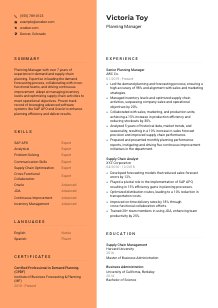
Begin with a direct line that states your title or specialty and years of experience. A line such as "Planning Manager with over 7 years of experience in demand and supply chain planning" works because it immediately establishes level and domain.
Follow with two or three specifics that match the job. Mention areas like leading forecasting cycles, managing inventory, working across sales and production, or using tools such as SAP APO or Oracle when those reflect your real background. The sample summary handles this well by pairing software proficiency with planning leadership and operational improvement.
Aim for a short paragraph, usually 3 to 5 lines. Avoid broad claims that could fit any manager. Instead, use concrete planning language and a few outcome-oriented phrases so the reader enters the experience section already expecting forecast improvement, supply chain optimization, and execution discipline.
If this section is doing its job, the reader should already understand your planning scope, systems familiarity, and operational strengths before they reach your first bullet point. That is the right setup for the rest of the resume.
A Planning Manager resume should make three things easy to spot: forecasting ownership, supply chain decision-making, and measurable operational improvement. When each section supports those themes, the document reads as a focused case for planning leadership rather than a general operations profile.
Use Wozber's free resume builder to tighten that alignment, apply ATS optimization thoughtfully, and build an ATS-compliant resume that reflects the language of the role. The finished resume should make it easy to see how you improve forecast quality, inventory performance, and cross-functional execution.




