




Use Wozber and land your dream job
Create Resume
No registration required
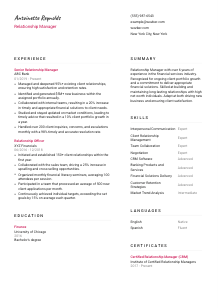
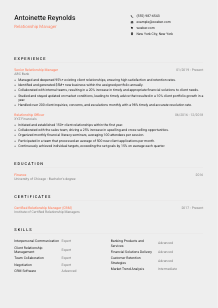
Bridging bonds, but feeling disconnected from your resume? Check out this Relationship Manager resume example, created with Wozber free resume builder. Learn how to spotlight your interpersonal expertise so it resonates with job requirements, positioning your career as a set of perfectly nurtured connections!
Relationship Managers are trusted with revenue, retention, and the day-to-day client experience at the same time. Hiring teams look for clear proof that you can grow an assigned portfolio, handle escalations with judgment, and coordinate internal partners so clients get the right financial solution without friction. Your resume needs to make that commercial and service balance visible quickly.
When that balance is buried under generic client-service language, it becomes hard to tell whether you have handled a true book of business or simply supported accounts. Wozber's free resume builder helps you shape an ATS-compliant resume around the terms banks and financial firms actually use, so portfolio growth, CRM work, retention results, and client-facing scope are easier to recognize in both ATS screening and human review.
In relationship management, your contact details do more than identify you. They show whether you are easy to reach, professionally presented, and aligned with practical requirements such as location for in-market client coverage. Keep this section clean, businesslike, and directly relevant to the role.
Use your full name as the most prominent line on the page so it is easy to find during a quick resume scan. A simple, readable presentation works best for a finance-facing role where credibility and polish matter more than design flourishes.
Place a current or target title directly under your name. If you are applying for a Relationship Manager position, using "Relationship Manager" or a closely aligned title such as "Senior Relationship Manager" immediately frames your background in the right context.
List a reliable phone number and a professional email address. Relationship managers are expected to be responsive and client-ready, so even small details like an outdated voicemail or casual email handle can undermine the impression you want to create.
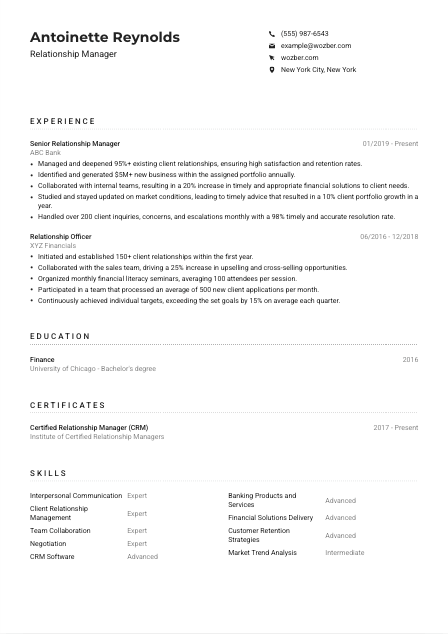
If the job calls for candidates to be based in a specific market, state your city and state clearly. Here, listing "New York City, New York" answers a stated requirement right away and removes avoidable uncertainty about local availability.
A LinkedIn profile or professional website can help when it reinforces your banking or financial services background, client portfolio scope, or market focus. Make sure the titles, dates, and core achievements match your resume exactly.
This section should answer the basic access questions fast: who you are, what role you do, how to reach you, and whether you meet any location-based requirement. For a Relationship Manager, that clean start supports the dependable, client-facing image the rest of the resume needs to build.




The strongest experience sections for Relationship Managers show business impact, not just account coverage. Hiring teams want to see how you retained clients, expanded wallet share, handled service issues, and worked across product or operations teams to deliver timely solutions.
Start by identifying the performance areas the employer cares about most. In this posting, that means existing client retention, new business generation, collaboration with internal teams, market-informed advice, and prompt resolution of client issues. Use those priorities to decide which accomplishments deserve space.
List positions in reverse chronological order and include job title, employer, and employment dates. Then use bullet points that show the size of your client responsibility, the type of financial environment you worked in, and the outcomes you produced across portfolio growth, service quality, or cross-functional delivery.
Relationship management is judged heavily by retention, revenue growth, response quality, and client satisfaction. Replace vague lines like "managed client accounts" with result-driven bullets such as the example's "Generated $5M+ new business within the assigned portfolio annually" or "Handled over 200 client inquiries monthly with a 98% timely and accurate resolution rate." Those numbers show both ownership and consistency.
Prioritize measures that are natural for the role: retention rate, portfolio growth, cross-sell volume, new assets or revenue, response time, client satisfaction, escalation resolution, and referral generation. The sample resume uses 95%+ retention, $5M+ new business, and 10% portfolio growth, which are much stronger signals than generic claims about being good with clients.
Do not overload this section with every task you have ever handled. Keep the bullets that support a financial services relationship role, especially work involving portfolio management, banking products, CRM usage, client communication, and coordination with internal teams. A focused experience section makes it easier to see that you already operate at the level the job requires.
A hiring manager should be able to read your experience section and understand the kind of clients you handled, the business you grew, and the service standard you maintained. If those three points are clear, your background will read like relationship management experience rather than general customer support.
For a Relationship Manager role in financial services, education usually serves as a qualification check rather than the main selling point. It should confirm that you have the academic grounding expected for advising clients, understanding products, and working within a regulated business environment.
Read the education requirement closely and mirror it where you can. This posting asks for a Bachelor's degree in Business, Finance, or a related field, so candidates with that background should make it easy to spot immediately.
List your degree, field of study, school name, and graduation year. A straightforward structure helps both ATS parsing and human review, especially in finance roles where clarity and accuracy matter.
If your degree is directly tied to the work, say so plainly. The example resume lists a Bachelor's degree in Finance, which aligns neatly with the employer's stated requirement and supports credibility for discussing banking products and financial solutions.
If you are early in your career or changing into relationship management, relevant coursework in finance, banking, economics, or client advisory work can add useful context. If you already have 5+ years of financial services experience, keep this section lean unless the coursework is unusually relevant.
Honors, leadership roles, or substantial academic projects can help when they connect to finance, business analysis, or client-facing work. For experienced candidates, these details are optional and should only stay if they add something your experience section does not already cover.
This section should quickly confirm that you meet the degree baseline and have a relevant field of study. Once that is clear, your experience and results can carry the heavier weight of the application.
Certifications are not always required for Relationship Manager roles, but the right one can strengthen your profile, especially when it shows commitment to client advisory work, banking knowledge, or ongoing professional development in finance.
Some employers require licenses or industry credentials, while others treat them as a plus. This role does not list a mandatory certification, so the section should support your candidacy rather than try to fill a gap that the job description never named.
Choose certifications that reinforce the kind of client and portfolio work you do. A credential such as "Certified Relationship Manager (CRM)" is relevant because it speaks directly to client relationship strategy and long-term account development.
Include the year earned or validity range if it helps establish recency or active status. In regulated or fast-moving financial environments, current credentials can matter more than older training with no timeline attached.
Relationship Managers need to stay current on products, market changes, and client expectations. Relevant certifications can reinforce that you invest in staying informed, especially when your target roles involve advisory conversations or more complex portfolios.
One relevant credential is worth more than a long list of loosely connected courses. Keep the section focused on learning that strengthens your authority with clients and your credibility in financial services.
A Relationship Manager skills section should balance commercial ability, client communication, and financial services knowledge. It needs to show that you can manage relationships in a structured way, not just that you are personable.
Review the posting for explicit skills and the abilities implied by the work. Here that includes CRM software, knowledge of banking products and services, written and verbal communication, client relationship building, and collaboration across internal teams.
Lead with skills that support portfolio growth, retention, and client service in a financial setting. The example does this well by pairing client-facing strengths such as Interpersonal Communication and Negotiation with role-specific capabilities like CRM Software, Banking Products and Services, and Customer Retention Strategies.
Avoid loading this section with broad traits that do not add hiring value. Choose skills you can back up in your experience section, especially those tied to client portfolio management, escalation handling, financial solution delivery, and market awareness. A concise list with real relevance will outperform a longer list of generic strengths.
Anyone can claim communication skills. A stronger resume shows the specific mix of CRM proficiency, banking knowledge, client management, and internal coordination that Relationship Managers use every day to retain and grow accounts.
Language ability matters in relationship management when it affects how well you can serve clients, explain products, and build trust. Present it clearly, especially when the job description names a required language.
If the posting specifies a language, list it at the top with an accurate proficiency level. In this case, English is required, so it should be clearly visible rather than buried behind optional languages.
Terms such as Native, Fluent, Professional, or Conversational are usually enough. Keep them consistent and realistic. In client-facing financial work, overstating fluency can create problems quickly when conversations move into product details or issue resolution.
Extra languages can strengthen your profile when they help with relationship building in a diverse client base. The sample's Spanish proficiency is a useful addition because it suggests broader communication reach, even though English is the required language here.
Only list languages you can use with confidence in a business setting at the level claimed. If you can greet clients but cannot explain account terms, service issues, or product differences, choose a lower proficiency rating.
For Relationship Managers, language skills matter most when they improve trust, responsiveness, and client understanding. Frame them as practical communication strengths rather than decorative resume extras.
Lead with the language the employer requires, then add others that genuinely support client communication. That keeps the section relevant to day-to-day relationship management rather than turning it into a general profile note.
Your summary should establish, in a few lines, the kind of client book you can manage and the results you are known for. For this role, that usually means balancing retention, revenue growth, and trusted financial guidance.
Before writing, identify the two or three capabilities the employer is hiring for most urgently. In this case, those include financial services experience, client relationship growth, product or solution knowledge, and the ability to resolve client needs effectively.
Your first line should quickly place you. A summary such as "Relationship Manager with over 6 years of experience in the financial services industry" works because it tells the reader both seniority and sector relevance without delay.
Choose strengths that connect directly to portfolio management and client outcomes. The example summary does this well by highlighting client portfolio growth, financial solutions, long-lasting relationships, and a mix of new business generation with client satisfaction.
Aim for 3 to 5 lines that combine tenure, industry, core strengths, and one or two concrete outcomes or areas of specialization. Skip soft introductions and focus on what you manage, how you perform, and the kind of clients or portfolios you support.
Your summary should make it clear that you are comfortable owning client relationships in a financial setting, expanding business where appropriate, and delivering responsive service. If those themes are visible in the opening lines, the rest of the resume has a much stronger foundation.
A well-tailored Relationship Manager resume should make three things easy to understand fast: the clients or portfolio you have handled, the business results you have delivered, and the level of trust you maintained through service and follow-through.
Use Wozber's free resume builder to shape that story into an ATS-friendly resume format, and use its ATS resume scanner to align your wording with the banking, CRM, retention, and portfolio terms that appear in the job description. That gives hiring teams a clearer read on whether you can step into the relationship book and grow it responsibly.




