




Use Wozber and land your dream job
Create Resume
No registration required
Decoding consumer trends, but your resume feels cryptic? Unravel this Market Researcher resume example, created with Wozber free resume builder. Learn how to showcase your analytical acumen to match job demands, ensuring your career stays on the pulse of market insights!
Market research work is judged by how well you turn raw responses, trend data, and behavioral patterns into decisions a business can actually use. That same standard applies to your resume. Hiring teams need to see that you can run sound quantitative and qualitative studies, interpret findings responsibly, and connect your analysis to product, marketing, or growth strategy.
When that connection is vague, a Market Researcher can look interchangeable with a general analyst or marketing coordinator. Using Wozber's free resume builder helps you shape an ATS-compliant resume around the research methods, tools, and stakeholder communication the role calls for, so your document quickly shows where you have already influenced strategy through market insight.
This section is simple, but it still carries useful screening information. For Market Researcher roles, clean contact details and a role-matched headline help the reader move quickly to the substance of your research background without unnecessary friction.
Place your name at the top in a readable font and slightly larger size than the rest of the resume. Keep it straightforward. For research roles, polished presentation matters because it reflects the same clarity you would bring to survey reporting, insight decks, and executive summaries.
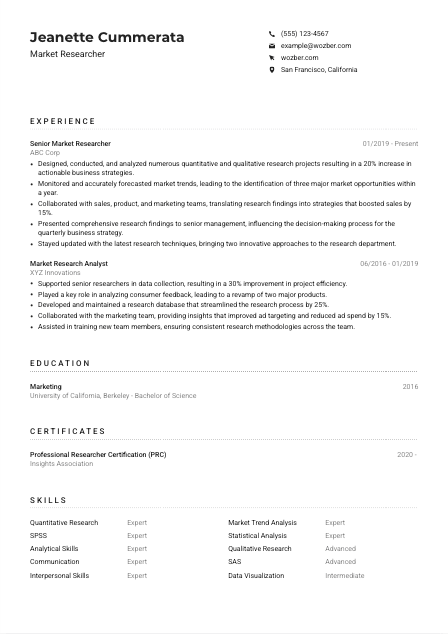
If you are applying for a Market Researcher position, use that title under your name when it honestly matches your background. This immediately frames your experience through the right lens. In the example resume, "Market Researcher" makes the application feel aligned before the reader reaches the experience section.
Include a working phone number and a professional email address. If you also share a LinkedIn profile or portfolio, make sure the information matches your resume and supports your research credibility with items like presentations, published insights, or project work.
Some openings include a firm location requirement. Here, being based in San Francisco, California is directly relevant, so listing the city and state helps remove a basic screening question. Treat this as posting-specific tailoring, not a universal rule for every Market Researcher resume.
A LinkedIn profile, portfolio, or personal site can strengthen your application if it includes useful material such as dashboards, case studies, writing samples, or conference speaking. Skip it if the link is empty or outdated. Every item in this section should support a credible professional profile.
Your personal details do not need flair. They need to confirm who you are, how to reach you, and whether you meet any obvious screening requirements tied to the role.




For Market Researcher hiring, experience carries the most weight because it shows how you structure studies, handle evidence, and influence decisions. Employers want to see the kind of research you have run, the teams you supported, the tools you used, and what changed because of your findings.
Read the job description closely and underline the work that appears repeatedly. In this case, that includes quantitative and qualitative research, market trend forecasting, statistical analysis, and presenting findings to senior stakeholders. Those points should guide which achievements you place first and how you phrase them.
Start with your most recent role and work backward. For research hiring, recent work usually carries the most relevant signals, especially if it includes current methods, active stakeholder management, and modern reporting workflows. Make each entry easy to scan with company, title, and dates clearly separated.
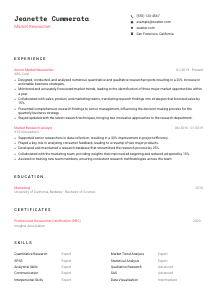
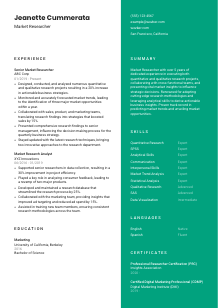
Focus each bullet on a concrete piece of research work and its result. Strong bullets show what you designed or analyzed, how you translated findings, and what business action followed. The sample resume does this well with lines about research projects leading to a 20% increase in actionable business strategies and market forecasting that uncovered three major opportunities.
Metrics matter here because they show whether your analysis led to measurable change. Use figures tied to strategy adoption, campaign efficiency, sales lift, product improvements, database efficiency, response rates, or time saved in the research process. Numbers are especially persuasive when they connect research activity to a commercial or operational result.
Market Researchers are typically hired for more than data collection alone. Surface work involving methodology selection, questionnaire or interview design, segmentation, competitive analysis, statistical interpretation, and presentations to decision-makers. If you collaborated with product, sales, or marketing teams, show how those partnerships turned findings into action, as the example resume does with cross-functional strategy work that boosted sales by 15%.
Your experience section should leave no doubt that you can run research, interpret the results, and move business conversations forward with credible insight.
Education matters in market research because it often signals training in consumer behavior, statistics, marketing, or business analysis. Even when experience leads the decision, the degree still helps confirm that you have the academic foundation for structured research work.
If the posting asks for a bachelor's degree in Marketing, Business, or a related field, make sure your degree is written clearly and completely. A degree such as "Bachelor of Science in Marketing" should be easy to spot. In the example, the Berkeley marketing degree directly supports the educational requirement.
List degree, school, and graduation year in a simple structure. Recruiters and hiring managers often skim this section quickly, so readability matters. Clean formatting also helps ATS parsing pick up degree and field information accurately.
Do not shorten or generalize your degree if the exact field helps your case. "Bachelor of Science in Marketing" is stronger than just "Bachelor's degree" because it ties directly to the employer's requirement and to the commercial context behind market research work.
If you are earlier in your career, a short line of coursework can help, especially if it includes statistics, consumer behavior, econometrics, research methods, or marketing analytics. For more experienced candidates, coursework is usually less important than your project history and measurable outcomes.
Honors, research assistant work, academic projects, or student organizations can strengthen this section when they relate to survey design, data analysis, business strategy, or market behavior. Keep only the details that reinforce your professional direction rather than filling space.
For an experienced Market Researcher, education confirms your foundation. The heavier proof still comes from the research work you have already delivered.
Certifications are useful when they add something specific to your profile, such as research standards, digital market knowledge, analytics depth, or ongoing professional development. They are most effective when they strengthen the way your experience is read rather than sitting on the page as generic extras.
Choose certifications that support the actual responsibilities of a Market Researcher. Credentials related to professional research practice, analytics, insights, or digital marketing can all be relevant if they sharpen your profile. The example's PRC and CDMP work because they reinforce both formal research credibility and market-facing commercial understanding.
If a certification is active, recently earned, or tied to current practice, include the date range. This helps show that your knowledge is current, especially in areas where methodologies, tools, and consumer research practices continue to evolve.
Research methods do not stand still. If you have invested in newer training around analytics, data visualization, behavioral research, or digital measurement, include it. This is particularly useful when the role expects you to stay current with evolving techniques and methodologies.
Review this section before each application. Add newer credentials that support the target role and remove anything that no longer contributes to your value as a researcher. A short, relevant list is more persuasive than a longer list with weak connection to the work.
Certifications work best when they reinforce the kind of research judgment, commercial awareness, or analytical capability your experience already demonstrates.
The skills section should quickly confirm that you cover the technical and professional range the role requires. For Market Researchers, that usually means a mix of methods, analysis tools, interpretation skills, and stakeholder communication.
Pull the essential capabilities straight from the job description when they reflect your real background. Here, that includes quantitative research, qualitative research, SPSS or SAS, analytical skills, and strong communication. Matching the employer's language helps both ATS alignment and human readability.
Order matters. Lead with the tools and capabilities most central to the job, then follow with supporting strengths. For this role, research methodologies, statistical analysis software, market trend analysis, and presentation skills should appear before broader traits or less relevant software knowledge.
Avoid turning the section into a generic keyword bank. Choose skills that map to how Market Researchers are actually evaluated, such as survey design, interview moderation, segmentation, forecasting, SPSS, SAS, data visualization, and stakeholder presentations. The example resume stays on track by listing both core methods and the software used to execute them.
A focused skills list should quickly confirm that you can handle the research process from methodology through analysis to insight delivery.
Language ability can matter in market research when the role involves multilingual audiences, regional studies, or frequent communication with diverse stakeholders. Even when only one language is required, listing proficiency clearly helps remove uncertainty.
Start with the job description. In this case, a high level of English proficiency is explicitly required, so English should be listed clearly. If a role includes international markets or multilingual respondent groups, additional languages may also become highly relevant.
When a posting specifies a language, place it prominently and describe your level accurately. The example resume lists English as Native, which addresses the requirement directly and cleanly.
Additional languages can strengthen your profile if they expand your ability to conduct interviews, interpret local market behavior, or collaborate across regions. Spanish, for example, may be useful in some consumer research contexts, but include extra languages only when they are real working strengths.
Stick to standard terms such as Native, Fluent, Intermediate, or Basic. Avoid vague descriptions. Precision matters in research work, and your language section should reflect the same discipline you would apply when reporting findings or defining respondent groups.
If language skills have helped you run interviews, understand customer segments, or support research across markets, that value can also appear in your experience section. Here in the languages section, keep it concise and factual while making the business relevance easy to infer.
For Market Researcher roles, language details should clarify communication readiness and, where relevant, broaden the markets you can research effectively.
A Market Researcher summary should do more than say you are analytical. It should quickly show your level of experience, the research methods you use, and the kind of decisions your work informs. This is often the first place a hiring manager looks to understand your professional range.
Review the posting before you write. If the employer needs someone who can design studies, analyze quantitative and qualitative data, forecast trends, and brief senior leaders, those themes should shape your opening lines. Keep the focus on the work, not on generic enthusiasm.
Start with a direct line such as "Market Researcher with 5+ years of experience" if that is accurate. This gives immediate context and helps the reader place your level quickly. The example summary does this effectively, then moves straight into research execution and cross-functional collaboration.
Include two or three of your strongest role-relevant capabilities, such as quantitative and qualitative research, statistical analysis, market forecasting, stakeholder presentations, or turning findings into strategy. The best summaries show both technical range and business usefulness.
Aim for a short paragraph that can be scanned in seconds. Cut broad claims and replace them with concrete language about methodology, insight generation, and commercial impact. A concise summary with clear terminology is far more convincing than a longer paragraph filled with generic strengths.
When this section is written well, the reader immediately understands your research scope, your analytical toolkit, and the level of decision-making your insights support.
A Market Researcher resume works when it shows how you investigate markets, interpret findings, and turn data into decisions that matter to the business. If your sections align around research methods, analytical tools, stakeholder communication, and measurable outcomes, hiring teams can quickly understand the value you bring.
Wozber's free resume builder and ATS resume scanner can help you tailor that story to each opening, from matching terminology such as quantitative research, SPSS, or market forecasting to strengthening ATS optimization across the whole document. The finished resume should make one thing easy to judge: you can deliver research that leads to action.




