




Use Wozber and land your dream job
Create Resume
No registration required
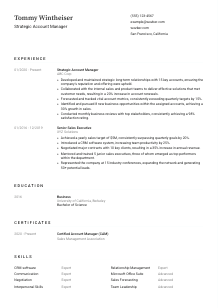
Navigating big partnerships, but your resume feels lost at sea? Check out this Strategic Account Manager resume example, created with Wozber free resume builder. Learn how to map your multi-million dollar wins to match job anchors, steering your career toward the most lucrative horizons!
Strategic account management sits at the point where revenue growth, client retention, and internal execution meet. Hiring teams want to see whether you can expand complex accounts over time, run productive stakeholder conversations, and turn customer needs into plans that sales, product, and service teams can actually deliver. Your resume should make that commercial judgment easy from the first few lines.
When account management resumes are tailored well, the reader can quickly separate someone who simply handled customers from someone who owned renewals, growth targets, business reviews, and account strategy. Wozber's free resume builder helps you shape that story into an ATS-compliant resume by aligning your wording with the job description, surfacing missing requirements, and keeping the structure clean enough for both ATS screening and hiring managers to see your account ownership clearly.
Strategic Account Managers spend their time building trust, coordinating across teams, and staying easy to reach for clients and internal stakeholders. The contact section should reflect that same professionalism and remove any friction around location, title, or availability.
Use your full name as the clearest identifier on the page. Keep it larger than the rest of the header so a recruiter or sales leader can immediately connect your application to later interview notes, CRM exports, or internal candidate discussions.
Place "Strategic Account Manager" directly under your name when it matches the role you are pursuing. That simple alignment helps frame your background around account growth, renewals, and stakeholder management instead of leaving the reader to interpret adjacent titles like sales executive or account executive.
Include a reliable phone number, a professional email address, and, if relevant, a LinkedIn profile or personal site. For client-facing commercial roles, that small detail matters. It shows you understand professional presentation and makes follow-up easy when interview scheduling moves quickly.
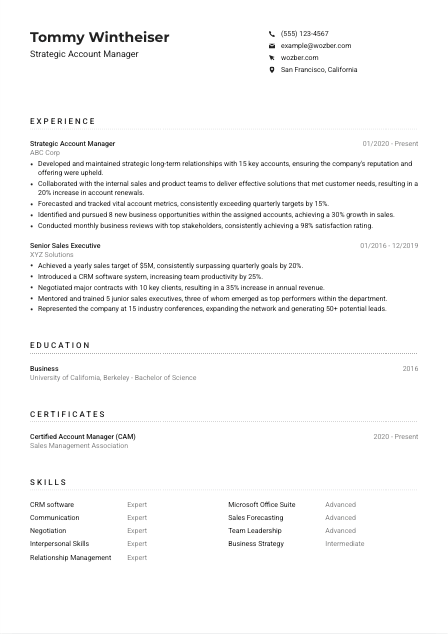
If a posting names a location, reflect it clearly when you meet it. In this example, listing "San Francisco, California" immediately answers a stated requirement and avoids unnecessary concern about relocation or territory coverage. Only do this when the location is accurate for you.
A LinkedIn profile is often enough, but include a website only if it adds substance such as speaking appearances, account leadership content, or a polished professional brand. Strategic account management rarely needs a portfolio, so any extra link should support your credibility rather than distract from it.
This section should confirm who you are, what role you are targeting, and whether you meet practical requirements such as location. Keep it clean and businesslike so the hiring team can move straight to your account results and client leadership experience.




For Strategic Account Managers, the experience section does the real selling. Hiring teams look for ownership of key accounts, measurable expansion, retention performance, forecasting discipline, and evidence that you can work across functions without losing momentum with the client.
Before you write or revise bullets, isolate the commercial priorities in the posting. Here, the central themes are long-term account relationships, cross-functional collaboration, business growth inside existing accounts, metric tracking, and business reviews. Those priorities should shape which achievements you feature first.
List roles in reverse chronological order with job title, company, and dates clearly shown. For account management, progression matters. A move from Senior Sales Executive to Strategic Account Manager, as in the example, tells a useful story about taking on larger accounts, more strategic planning, and broader client ownership.
Lead with achievements, not task lists. Focus on account retention, upsell or cross-sell growth, renewal improvement, stakeholder satisfaction, forecasting accuracy, and the ability to coordinate internal teams around client needs. The sample does this well by naming 15 key accounts, renewal growth, new opportunities within assigned accounts, and monthly business reviews.
Numbers matter because strategic account management is measured through growth, retention, account penetration, satisfaction, and target attainment. Use figures that show scale and business effect, such as portfolio size, renewal lift, sales growth, quarterly performance, or satisfaction scores. Metrics like 20% higher renewals, 30% sales growth, or 98% stakeholder satisfaction give the hiring team something concrete to evaluate.
Choose bullets that match the specific account-facing work the role requires. Contract negotiation, CRM adoption, executive reviews, and identifying expansion opportunities are all more useful here than generic statements about being motivated or team-oriented. If a past sales role included account development, frame it in terms of client retention, revenue expansion, and strategic relationship management.
Your experience section should show that you can protect revenue, grow existing business, and guide client relationships with structure and consistency. When the bullets tie account strategy to measurable results, the hiring team can quickly picture you running a portfolio of key accounts.
Education carries less weight than your account results once you have several years of experience, but it still matters when the job asks for a business-related degree. Present it cleanly so the reader can confirm you meet the requirement and move on to the parts that show commercial impact.
If the role asks for a bachelor's degree in Business, Sales, or a related field, make that easy to find. A Bachelor of Science in Business, like the example uses, directly supports a resume built around account planning, negotiation, and revenue management.
List your degree, field of study, school, and graduation year. Avoid over-formatting. Strategic account management hiring is usually fast-moving, and a straightforward education section helps the reader confirm qualifications without digging.
When your degree closely matches the posting language, use that wording naturally. If your field is adjacent, such as marketing, management, or economics, keep the official degree title but let your experience section do the heavier work of proving account and sales capability.
Most experienced Strategic Account Managers do not need course lists. Add relevant coursework only if you are earlier in your career or if a program included useful subjects like sales strategy, negotiation, business analytics, or customer relationship management.
Honors, leadership roles, or competition wins are worth listing when they reinforce commercial strengths such as presentation, client communication, or business problem-solving. Keep them brief. At this level, they should support your profile, not compete with your track record in the field.
This section only needs to answer one main question. Do you meet the educational bar for the role? Once that is clear, let your experience and account results carry the weight of the application.
Certifications are not mandatory in every Strategic Account Manager search, but they can strengthen your profile when they support account leadership, industry knowledge, or sector-specific compliance. They are especially helpful when a posting mentions licensure or certification familiarity.
Start with the posting. Some roles simply value ongoing development, while others work in regulated industries where certification knowledge affects client conversations and implementation. Here, familiarity with industry licensure or certification requirements is mentioned, so relevant credentials can reinforce your preparedness.
Prioritize certifications connected to account management, consultative selling, industry regulation, or customer success. A credential such as Certified Account Manager fits naturally because it supports the relationship, growth, and portfolio-management side of the role.
Include dates so employers can see whether the certification is current. That is useful in commercial roles where methods, compliance expectations, and customer-facing best practices evolve over time.
If your target accounts sit in a specialized industry, look for learning that sharpens your value in that market, whether around regulation, product domain knowledge, negotiation, or executive account planning. Ongoing development is most persuasive when it supports the type of customers you manage.
A well-chosen certification can add weight to your resume, especially when it reflects the type of accounts, industry context, or strategic client work the role involves. Keep this section relevant and current.
The skills section should reflect how Strategic Account Managers actually operate. That usually means a mix of client-facing strengths, commercial judgment, and practical tools used to track pipeline, renewals, account plans, and stakeholder communication.
Review the job description for explicit requirements and repeated themes. In this case, CRM software, Microsoft Office Suite, communication, negotiation, and interpersonal skills are direct matches. Include them if they reflect your real working toolkit.
Order matters. Lead with the abilities most tied to account performance, such as relationship management, strategic planning, forecasting, negotiation, business reviews, and CRM fluency. Save broader traits or lower-priority tools for later in the list.
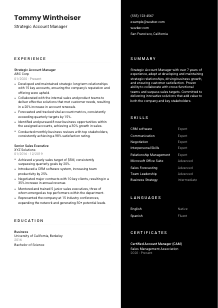
Do not build this section as a soft-skill list alone. Strategic account roles usually involve CRM reporting, pipeline visibility, forecasting, presentation work, and internal coordination, so pair tools and operating skills together. The example's mix of CRM software, sales forecasting, relationship management, communication, and Microsoft Office Suite is a solid model.
A useful skills section should sound like the day-to-day mechanics of managing and growing accounts. When the list reflects both the client relationship side and the operational side of the role, it supports the rest of your resume instead of repeating generic strengths.
Language skills matter in account management when they improve client access, support cross-regional relationships, or help you work smoothly with varied stakeholder groups. Even when only one language is required, listing proficiency clearly prevents uncertainty around a basic job filter.
If the role requires professional English, list your English proficiency clearly and accurately. That matters in Strategic Account Manager positions because executive emails, business reviews, negotiations, and internal updates all depend on precise communication.
Extra languages can strengthen your profile when they relate to your book of business, territory, or customer base. Spanish, for example, can be useful in multilingual markets or in client environments where relationship-building benefits from added language flexibility.
Use accurate levels such as Native, Fluent, Professional, or Conversational. In client-facing work, overstating a language can become obvious quickly during a stakeholder meeting or renewal discussion.
If you manage regional, national, or international accounts, language ability can support smoother communication and stronger rapport. Include languages that genuinely help with account reviews, issue resolution, or executive relationship management.
List only languages you can actually use in a business setting or that meaningfully broaden your client communication range. A short, truthful list is more credible than a long one with weak proficiency levels.
For this role, language skills should point to smoother client communication and broader relationship coverage. Keep the section honest and business-relevant, especially when the posting specifies English as a working requirement.
The summary should quickly establish the scale of your experience and the type of account work you handle well. For Strategic Account Managers, that usually means a short statement covering years in account or sales roles, core strengths in relationship growth, and a few measurable business themes such as renewals, expansion, or stakeholder satisfaction.
Review the posting before writing your summary so you know which themes belong in those opening lines. Here, the role centers on strategic relationships, collaboration across teams, account metrics, and business growth inside existing accounts.
Open with your title and experience level in a straightforward way. A line such as "Strategic Account Manager with 7+ years of experience" works because it immediately tells the reader your level and professional direction.
Choose two or three strengths that match the role and connect them to outcomes. Good options include growing key accounts, improving renewals, leading business reviews, expanding revenue within existing portfolios, or working cross-functionally to solve customer needs. The example summary does this by linking relationship management, business growth, and customer satisfaction.
Aim for a short paragraph that reads with authority, not a long profile full of general claims. Four to six lines are usually enough to position you as someone who can manage strategic relationships, report on account performance, and drive growth without repeating the full experience section.
A sharp summary should tell the hiring team, within seconds, that you understand strategic account ownership and have the track record to handle it. Once that framing is in place, the rest of your resume can prove the scale, metrics, and client outcomes behind it.
A Strategic Account Manager resume should leave little doubt about three things: the accounts you have owned, the revenue or retention outcomes you influenced, and the way you work with clients and internal teams to keep business moving. When those points are clear across your summary, experience, skills, and credentials, the application reads like a candidate ready to manage key relationships from day one.
Use Wozber's free resume builder, ATS-friendly resume templates, and ATS resume scanner to align your wording with the job description, strengthen ATS optimization, and present your results in a clean structure. The finished resume should make it easy to judge your ability to grow strategic accounts, run effective business reviews, and protect long-term customer value.




