



Use Wozber and land your dream job
Create Resume
No registration required
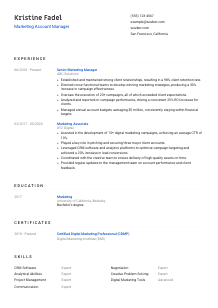
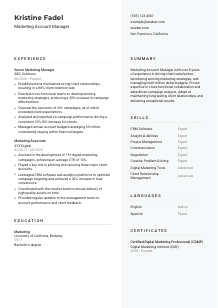
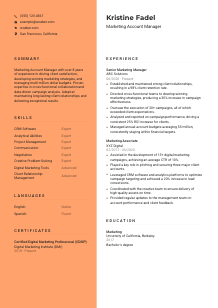
Masterminding campaigns, but your resume feels off-brand? Check out this Marketing Account Manager resume example, created with Wozber free resume builder. Learn how to blend your strategic vision with client expectations, making your career story as captivating as your ad copy!
Marketing Account Managers sit at the point where client expectations, campaign execution, and commercial accountability meet. Hiring teams want to see that you can hold a client relationship, translate goals into a usable brief, keep internal teams moving, and talk confidently about performance, budgets, and ROI. Your resume should make that operating range visible from the first screen.
When the resume is tailored well, reviewers can quickly tell whether your background leans toward client-facing account ownership rather than general marketing support. Wozber's free resume builder helps organize that story in an ATS-friendly resume format, so terms like client retention, campaign analysis, cross-functional coordination, and budget management are easy to surface and easy to read in the context of real account work.
For a client-facing marketing role, the header needs to do one practical job well. It should confirm who you are, how to reach you, and whether you meet any immediate screening details before a hiring manager gets into campaign results or account scope.
Use your full name in a clear, prominent format. For a Marketing Account Manager, that top line should feel polished and business-ready, similar to how your name would appear on a client presentation or meeting deck.
Place "Marketing Account Manager" directly under your name if that is the role you are pursuing and your background supports it. This keeps your positioning clear, especially when your recent titles vary, such as Senior Marketing Manager or Account-focused marketing roles with overlapping responsibilities.
Include a reliable phone number and a professional email address that will not distract from your client-facing credibility. If you add a website or LinkedIn profile, make sure it supports the story in your resume with relevant campaign work, account achievements, presentations, or recommendations.
Some account management roles are tied to client meetings, agency teams, or hybrid schedules in a specific market. Here, listing San Francisco, California directly addresses the stated location requirement. Use that kind of location tailoring when the employer makes geography part of the screening criteria.
If you include a portfolio, website, or LinkedIn profile, make sure it reflects marketing account work rather than generic personal branding. Case studies, campaign summaries, client sectors, speaking clips, or examples of strategic planning add more value here than broad marketing statements.
This section should confirm the basics fast. For a Marketing Account Manager, that means clear contact details, a relevant title, and any required location cue that helps move your resume forward without delay.




This is the section that carries the most weight for a Marketing Account Manager. Hiring teams look for signs that you have handled clients directly, worked across creative and digital functions, kept campaigns on track, and translated performance into recommendations a client would actually trust.
Read the posting for the operational responsibilities behind the title. In this case, the important threads are client ownership, cross-functional collaboration, campaign brief development, performance analysis, and budget control. Those should shape which achievements you choose and how you phrase them.
List your roles in reverse chronological order and make the progression easy to follow. A move from Marketing Associate into Senior Marketing Manager, as in the example, helps show growth from campaign support into broader strategic and client-facing ownership. That kind of progression matters in agency and account-driven hiring.
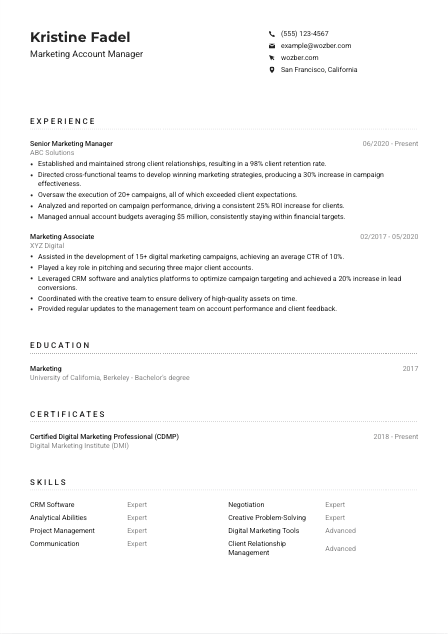
Focus each bullet on a concrete result tied to account management work. Strong examples include retaining clients, improving campaign performance, securing new business, coordinating delivery across teams, or improving lead conversion through better targeting. The sample resume does this well with results such as a 98% retention rate and a 25% ROI increase for clients.
Numbers help hiring managers understand scale. Include campaign volume, budget size, retention rate, ROI lift, conversion gains, CTR, or number of accounts handled when those metrics reflect your actual work. Managing annual budgets averaging $5 million or overseeing 20+ campaigns gives far more context than saying you "managed multiple projects."
Trim duties that do not support the role you are targeting. For this profession, the strongest bullets usually connect marketing execution to client communication, strategic recommendation, revenue impact, reporting, or team coordination. If a detail would not matter in a client review, it probably does not need space on the page.
A Marketing Account Manager resume should read like someone who can hold the account, guide the work, and explain the results. If your bullets make that clear through outcomes, collaboration, and commercial scope, this section is doing its job.
Education will not outweigh proven account and campaign results at this level, but it still matters because many postings use degree requirements as an early filter. Present it cleanly and match the employer's wording when your background aligns.
When the role asks for a Bachelor's degree in Marketing, Business, or a related field, make sure your degree is easy to find. For this opening, a Bachelor's degree in Marketing meets the requirement directly and should be listed without extra formatting tricks.
Include degree, field of study, school name, and graduation year or date. Straightforward formatting helps recruiters and ATS systems read the section quickly, especially when education is being checked as a qualification threshold rather than a differentiator.
If your degree lines up closely with the posting, reflect that clearly. "Bachelor's degree, Marketing" is stronger here than a vague abbreviation or partial label because it matches the employer's requirement with no interpretation needed.
Most candidates with 5+ years of experience can keep this section brief. Still, if you are earlier in your career or shifting from a nearby role, selected coursework in consumer behavior, digital marketing, analytics, or brand strategy can help connect your academic background to account management work.
Honors, leadership roles, or marketing-related extracurriculars are worth adding only when they reinforce the story of client communication, business judgment, or campaign thinking. Keep this section lean if your professional experience already carries the stronger proof.
For this role, education is usually a checkpoint rather than the main selling point. A concise entry that clearly covers the degree requirement is enough to support the rest of your application.
Certifications are especially useful when they reinforce tools, channels, or analytical depth that show up in account management work. They are not mandatory in every posting, but they can sharpen your positioning when they connect to campaign strategy, reporting, or digital execution.
Look first for certifications tied to digital marketing, analytics, CRM usage, paid media, email automation, or client strategy. The job posting here does not require a certification, but it does call for proficiency with marketing tools and analytics platforms, so related credentials strengthen that claim.
Prioritize certifications that help explain how you manage or improve campaigns. A credential like Certified Digital Marketing Professional works well because it supports a role that combines client advising with channel knowledge and performance analysis.
Certification dates help readers judge whether your training is current, especially in fast-moving areas like digital channels, attribution, automation, and reporting platforms. If the certification is active or recently renewed, say so clearly.
Marketing Account Managers often need to speak credibly with specialists in paid media, content, analytics, CRM, and creative teams. Ongoing certification activity helps show that your knowledge has kept pace with the tools and practices clients expect agencies and in-house teams to understand.
List credentials that support the kind of campaigns, tools, and analytical conversations the role involves. The best ones make your account leadership look more current and more commercially useful.
The skills section should reinforce what your experience already shows. For a Marketing Account Manager, that usually means a mix of client-facing strengths, campaign operations, analytical ability, and the tools used to manage relationships and measure results.
Start with the requirements stated directly in the job description. Here, that includes CRM software, digital marketing tools, analytics platforms, communication, negotiation, presentation skills, project management, and organization. Those are not filler keywords. They describe how the work gets done.
Only include skills you can back up through experience, tools, or results. If you claim CRM expertise, your work history should show how you used it to improve targeting, lead conversion, reporting, or client account management. The example resume supports this by tying CRM and analytics use to a 20% increase in lead conversions.
Lead with the abilities most central to the role, such as client relationship management, campaign analysis, project coordination, budgeting, communication, and cross-functional collaboration. Save broader or less relevant marketing skills for later, or leave them out if they do not help this target role.
A useful skills section should reflect how Marketing Account Managers operate across clients, campaigns, teams, and reporting. Keep it targeted enough that every item supports the role you want next.
Language ability matters more in marketing account work than in many internal-only roles because presentations, client updates, negotiation, and written briefs all depend on clarity. If a posting names a language requirement, address it directly and without ambiguity.
This role requires fluent English, so English should appear first in your languages section with an honest proficiency level. That immediately answers a stated requirement and supports the client-facing nature of the job.
Additional languages can be valuable when agencies or marketing teams serve multilingual audiences or international accounts. Spanish, for example, can be useful in client communication, campaign localization, or market-specific coordination when relevant to the business.
Choose familiar labels such as Native, Fluent, Advanced, or Intermediate. In a role built around communication and presentation, vague wording around language level can create doubt where precision would help.
Not every Marketing Account Manager role has an international scope, but some do involve regional audiences, multilingual campaigns, or cross-border stakeholders. If your language skills help you support those environments, they are worth including.
List languages when they strengthen your ability to manage clients, shape messaging, or work across markets. The section is most persuasive when it reads as a communication asset, not just a personal fact.
For this profession, language skills matter when they improve communication, presentation, and market reach. Lead with required English proficiency, then add other languages that support the kind of accounts you want to manage.
Your summary should quickly establish your level, your mix of marketing and client-management experience, and the kinds of outcomes you have delivered. For this role, a few focused lines are enough to frame you as someone who can manage accounts, guide strategy, and speak credibly about results.
Start from the responsibilities that define the job. Here, that means client relationship management, campaign strategy, cross-functional execution, performance analysis, and budget accountability. Those points should shape the content of your opening lines.
Open with a direct description of who you are professionally, including years of experience if they strengthen your case. A line such as "Marketing Account Manager with 8+ years of experience in client leadership and campaign strategy" gives immediate context and sets the level appropriately.
Use two or three specifics that connect your background to the job. Client retention, campaign effectiveness, ROI improvement, budget ownership, or cross-functional leadership all work well because they show how your marketing work affects both delivery and client satisfaction. The sample summary handles this effectively by pairing years of experience with strategy, collaboration, and budget scale.
Avoid generic claims about being passionate or results-driven unless they are backed by something concrete. A strong summary for this role sounds confident, specific, and useful, much like an executive account overview rather than a personal statement.
By the time someone finishes these opening lines, they should understand your level, your account-facing strengths, and the kind of marketing outcomes you have managed. That makes the rest of the resume easier to read in the right context.
A well-tailored Marketing Account Manager resume should make three things easy to see: how you manage client relationships, how you coordinate campaigns across teams, and how you connect performance to business results. If those themes are clear across your title, experience, skills, and summary, you are presenting the right story for this kind of role.
Use Wozber's free resume builder to tighten structure, strengthen ATS optimization, and align your wording with the job description through a clean ATS-compliant resume. With the right details in place, your resume will show that you are ready to lead accounts, guide strategy, and speak confidently about campaign performance.




