



Use Wozber and land your dream job
Create Resume
No registration required
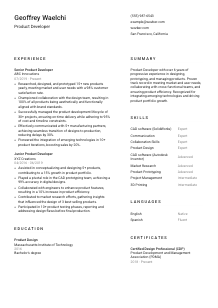
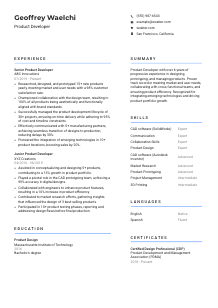
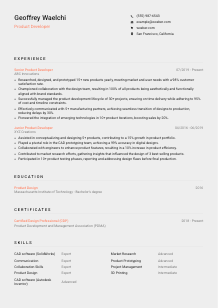
Crafting innovations, but your resume feels off the assembly line? Explore this Product Developer resume example, created with Wozber free resume builder. It shows how to bring your invention acumen in line with job specifics, ensuring your career trajectory parallels the rise of your groundbreaking creations!
Product development work gets judged in the details. Hiring teams want to see how you move an idea from research to prototype to production without losing sight of usability, manufacturability, cost, or brand intent. A Product Developer resume has to make that process visible through the projects you shipped, the tools you used, and the outcomes you influenced.
When the resume is tailored well, reviewers can quickly tell whether your background leans toward concept design only or whether you have hands-on experience guiding products through CAD, prototyping, vendor communication, and launch constraints. Wozber's free resume builder helps you align that story with the posting in an ATS-friendly resume format, so your strengths read clearly in both screening systems and human review.
This section does a practical job first. It tells the employer whether they can contact you easily, whether your professional identity matches the role, and, in some cases, whether you meet a stated location requirement before they read deeper.
Use your full name as the clearest header on the page. Keep the formatting clean and professional so the eye lands on it immediately. For a Product Developer, that simple clarity matters because the rest of the resume will likely carry technical tools, project metrics, and cross-functional work that should not compete with basic identification.
Place "Product Developer" directly below your name if that is the job you are targeting. It helps frame your background before the reader reaches your experience section. If your current title is broader, such as industrial designer or product engineer, you can still use the target title when your work genuinely covers product research, prototyping, and development lifecycle ownership.
List a professional email address and a phone number you actually answer. Double-check every character. If a hiring manager wants to discuss your work on prototyping, CAD development, or manufacturing coordination, they should not hit a typo before they reach you.
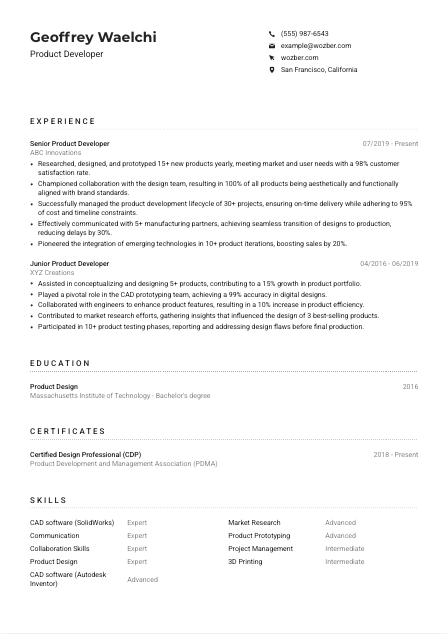
Some Product Developer roles have a firm on-site or location-based requirement because of lab access, prototype reviews, or close collaboration with design and operations teams. In the example here, listing "San Francisco, California" immediately answers that filter. Use the same approach whenever location is a stated requirement, but do not overemphasize it when it is not.
If you have a portfolio site, LinkedIn profile, or project page showing sketches, CAD renders, prototypes, or launched products, include it. Product development is easier to evaluate when employers can see the work behind the bullet points. Make sure the content supports the resume with polished, relevant examples rather than unfinished experiments.
A clean personal details section clears away avoidable questions and lets the employer focus on your development work, technical range, and product outcomes.




For Product Developers, experience carries the most weight because it shows whether you can turn market input and design intent into a manufacturable product. Hiring teams look for evidence of research, CAD work, prototyping, iteration, and coordination with design, engineering, and manufacturing partners.
Start by marking the responsibilities and requirements that define the job. In this posting, those include researching user needs, prototyping new products, managing timelines and cost constraints, collaborating across functions, and working with manufacturing partners. Then rewrite your experience bullets so those themes appear through real projects and outcomes rather than generic duty statements.
Lead with your most recent position and use a consistent structure for title, company, and dates. Product development careers often show growth from supporting design execution to owning larger parts of the lifecycle, so the order should make that progression easy to follow. A senior role should immediately communicate broader scope, such as more products, larger programs, or deeper production responsibility.
Focus each bullet on a product development action and the result it produced. Good examples include leading prototype cycles, improving design accuracy in CAD, shortening transfer-to-production time, reducing delays with manufacturing partners, or contributing to product portfolio growth. The sample resume does this well by tying work to metrics such as 15+ products developed yearly, 30+ projects managed, and a 30% reduction in production delays.
Numbers help hiring teams understand scale and effectiveness. For this profession, useful metrics include number of products developed, prototype turnaround, cost adherence, launch timing, defect reduction, design accuracy, customer satisfaction, sales lift, or efficiency gains. Choose figures that reflect how your work improved the product, the process, or the commercial result.
Keep the section centered on work that proves you can develop products in a real business environment. Bullets about unrelated administrative tasks or loosely relevant responsibilities dilute the story. Prioritize research, concept development, CAD modeling, testing, iteration, project coordination, and production handoff because those are the signals that help distinguish a Product Developer from adjacent design or engineering profiles.
Your experience section should show that you can move from concept to production with control over design quality, collaboration, and delivery constraints. That is what hiring teams want to see first.
Education matters here because many Product Developer roles are built on formal training in product design, industrial design, engineering, or a related discipline. Keep this section direct, but make sure it supports the technical and design-oriented nature of your experience.
If the role asks for a bachelor's degree in Product Design, Industrial Design, Engineering, or a related field, list the most relevant credential clearly. In the example, a Bachelor's degree in Product Design aligns directly with the posting. When your degree is in a related area, use the exact field name shown on your diploma and let your experience reinforce the connection.
Include degree, field of study, school, and graduation year or date. Straightforward formatting helps both ATS parsing and quick human review. Product development resumes often carry technical detail elsewhere, so the education section works best when it is compact and easy to scan.
If the job description uses wording such as "Bachelor's degree in Product Design" or "related field," reflect your education in similarly precise terms when it is truthful to do so. That improves alignment during screening and avoids any ambiguity about whether your academic background fits the role's baseline expectations.
This is especially useful for newer candidates or career changers. Include coursework, capstone work, or studio projects that show prototyping, CAD modeling, materials knowledge, manufacturing methods, or user-centered product research. If you already have several years of strong experience, keep these details brief.
Add academic honors, scholarships, or competition results only if they reinforce your product development profile. Design awards, engineering competitions, or standout senior projects can be relevant. General school activities are less useful unless they directly relate to product design, prototyping, or innovation work.
For this role, education supports the technical and design foundation behind your project work. Present it clearly, then let your experience show how you applied that training.
Certifications are usually not the deciding factor for Product Developer roles, but they can strengthen your resume when they support your technical methods, product process knowledge, or commitment to staying current with industry practice.
Choose certifications tied to product development, design process, CAD tools, manufacturing methods, or project management. The example's Certified Design Professional credential works because it supports the candidate's product development identity, even though the job description does not require a certification.
When space is limited, list the credentials that connect most directly to the job. For a Product Developer, that may mean design, prototyping, project delivery, or tool-specific learning rather than broad professional memberships or unrelated online courses.
Add the issue date or active range, especially for certifications tied to current practices, software, or methodologies. This can help when the employer wants someone who keeps up with new tools, materials, and development approaches.
A short, relevant certifications section is more convincing than a long list of marginal credentials. Product development already spans research, design, engineering coordination, and production readiness. Use certifications to reinforce a real edge, not to pad the resume.
Relevant certifications can strengthen your profile when they back up the kind of product work you already claim in experience and skills. Keep the section focused and credible.
A Product Developer skills section should reflect how the job is actually done. Employers want to see technical tools, development capabilities, and collaboration skills that support design execution, iteration, and production handoff.
Start with the language used in the job description. Here, that includes CAD software such as SolidWorks or Autodesk Inventor, communication, collaboration, and familiarity with project management methods or tools. Add those only where they match your real background, then support them with examples elsewhere in the resume.
Product development is collaborative work. Alongside CAD, prototyping, market research, materials knowledge, or testing, include skills such as communication, stakeholder collaboration, and project coordination when they are part of your actual contribution. The sample resume handles this balance well by pairing SolidWorks and product design with communication and collaboration skills.
Keep the list focused on the skills most likely to influence screening and hiring conversations. Grouping high-value skills near the top improves readability, and using precise terms helps ATS optimization without drifting into keyword stuffing. If you are using Wozber's AI resume builder or ATS resume scanner, check whether the posting's core tools and methods appear naturally in this section and are backed up in experience.
The best skills sections reflect the way you develop products in practice, from CAD and prototyping to team collaboration and project delivery. Keep every skill defensible.
Language ability matters more in some Product Developer roles than others, but when the posting names it directly, include it clearly. This is especially important in roles that involve design reviews, manufacturing communication, documentation, or cross-functional coordination in English.
If the employer specifies English fluency, make sure English appears clearly in your languages section. For a Product Developer, that matters because requirements, design feedback, vendor communication, and project updates often depend on precise language.
List the required language first, then any additional languages that could support collaboration or international product work. In the example, English is shown first, which directly answers the posting before adding Spanish as extra value.
Additional languages can help if you work with overseas suppliers, international teams, or products aimed at multiple markets. They are a bonus, not a substitute for core product development capability, so include them selectively.
Choose straightforward terms such as Native, Fluent, Advanced, or Conversational. Product development often involves technical discussion, feedback cycles, and production documentation, so overstating language ability can create problems quickly.
If a job involves frequent supplier calls, cross-border manufacturing, or market research in multiple regions, language skills carry more weight. If not, keep the section concise. Let the posting guide how prominent this information should be.
When language is listed with clear proficiency and real relevance to the role, it strengthens your profile without distracting from your core product development experience.
The summary should tell the reader what kind of Product Developer you are before they get into the details. In a few lines, show your level of experience, the kind of product work you handle, and the strengths that make your background relevant to the opening.
Before writing the summary, identify the parts of product development you truly own. That may include user research, CAD modeling, prototyping, design-for-manufacture work, lifecycle management, or collaboration with design and engineering teams. Your summary should reflect that real scope, not a generic innovation statement.
Open with your title and years of relevant experience, such as "Product Developer with 6+ years of experience in consumer goods product development." This immediately tells the employer whether your background lines up with the seniority and industry context they need.
Use the next sentence or two to highlight the capabilities most relevant to the role. For this job, that could mean CAD proficiency, product prototyping, managing development from concept to production, and cross-functional collaboration. The sample summary works because it ties experience to designing, prototyping, managing products, and integrating emerging technologies.
Aim for a concise paragraph that reads quickly but still carries substance. Mention one or two concrete outcomes or strengths, such as improving product efficiency, growing a product portfolio, or delivering work that met user and market needs. Save the detailed metrics for the experience section.
A good summary gives the hiring team a fast, accurate read on your product development range. After those first lines, your experience should confirm every claim.
A Product Developer resume should show more than creativity. It should show how you research, model, prototype, coordinate, iterate, and deliver within cost and timeline constraints. When those pieces are clear, hiring teams can picture you working across design, engineering, and manufacturing without guessing.
Use Wozber to tighten that alignment. Wozber's free resume builder, ATS-compliant resume templates, and ATS resume scanner help you match the language of the posting, strengthen section-by-section tailoring, and present your work in a format that is easy to screen. The final result should make one thing obvious: you know how to turn product ideas into production-ready outcomes.




