



Use Wozber and land your dream job
Create Resume
No registration required
Expanding markets, but your resume feels stagnant? Move forward with this Business Development Manager resume example, created with Wozber free resume builder. Clearly present your growth strategies and deal-closing skills to match job specifics, shaping a career journey as dynamic as your business ventures!
Business Development Manager resumes are read through a commercial lens. Hiring teams want to see how you open new markets, move deals forward, strengthen client relationships, and turn market insight into revenue. Generic claims about being a strong communicator or strategic thinker rarely land unless they are tied to outcomes such as pipeline growth, proposal wins, partner expansion, or team performance.
A tailored resume changes what stands out first. When your experience, skills, and summary reflect the language of client acquisition, market research, negotiation, and sales leadership, reviewers can quickly connect your background to the role's revenue targets and account growth priorities. Wozber's free resume builder helps shape that alignment into an ATS-compliant resume, so the business development results you have already delivered are easier to recognize from the first scan.
For a Business Development Manager, the header should do one practical job well: make you easy to contact and immediately place you in the right market and function. Keep it clean, accurate, and tied to how the employer will route candidates for a client-facing leadership role.
Lead with your full name, then place "Business Development Manager" directly beneath it. That makes your positioning clear before a recruiter reaches your experience section. Use the same title when it matches your background and the target opening, especially if your recent work already includes client acquisition, partnership development, or sales team leadership.
List a reliable phone number and a professional email address. For a role built on outreach, follow-up, and relationship management, even small errors here create doubt. Check every character carefully, since missed calls or bounced emails can cost you an interview.
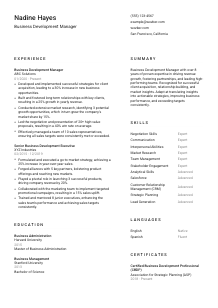
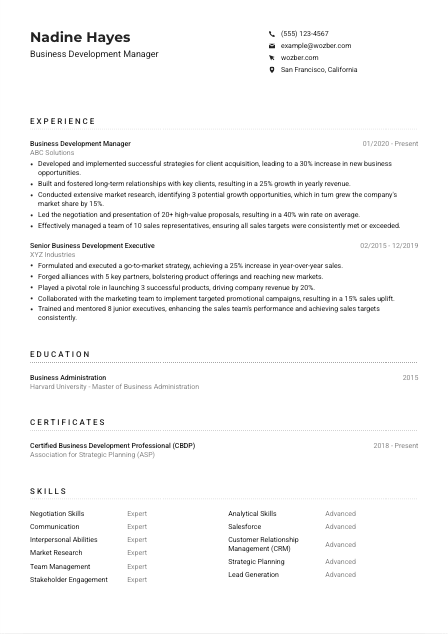
If a role requires candidates to be based in a certain market, show that clearly in your header. In the example, "San Francisco, California" addresses the stated location requirement directly and removes uncertainty about availability. For other openings, only include location when it helps answer a real hiring question.
Include LinkedIn or a professional website if it supports your business development profile. This works best when it reinforces your resume with consistent job titles, industry focus, deal scope, or partnership work. Leave it out if the profile is outdated or thin.
Do not add age, marital status, photo, or other unrelated personal information. Business development hiring should stay focused on territory relevance, client-facing credibility, communication, and commercial results, not details that do nothing for your candidacy.
Your header should answer the basics fast: who you are, what role you do, how to reach you, and whether you match any location requirement. That keeps attention on your sales record and business growth experience.




This is the section most likely to decide whether a Business Development Manager moves forward. Employers look for evidence of pipeline creation, revenue contribution, proposal leadership, negotiation strength, client retention, and team performance. Your bullets should show how you turned relationship-building and market insight into measurable business results.
Start by marking the responsibilities and requirements that define the role. Here, that includes client acquisition strategy, new business generation, long-term client relationships, market research, proposal development, negotiation, presentations, and team leadership. Those themes should shape which achievements you feature and the language you use.
Use reverse chronological order so the reader sees your current commercial scope first. Prioritize positions tied to sales growth, partnerships, account expansion, or business development leadership. If your earlier experience is less relevant, keep it concise and give more space to roles with direct ownership of pipeline, revenue, or sales teams.
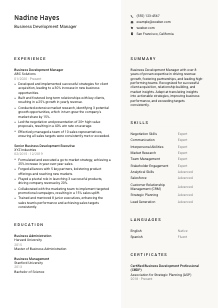
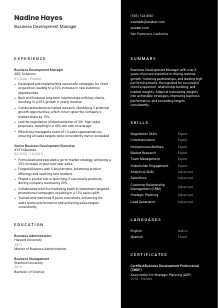
Each bullet should show what you drove, improved, won, or expanded. Strong Business Development Manager bullets usually combine an action with a business outcome, such as increasing qualified opportunities, growing annual revenue, improving proposal win rates, or entering new segments. The example does this well with results like a 30% increase in new business opportunities and a 25% growth in yearly revenue.
Metrics make your impact legible. Use figures tied to revenue growth, market share, sales uplift, proposal volume, close rate, account growth, or team size. In the sample resume, leading 20+ high-value proposals with a 40% average win rate gives hiring teams a clear picture of commercial effectiveness, not just activity.
Trim experience that does not support your case for business growth leadership. A hiring manager should quickly see customer acquisition, partner development, market analysis, negotiation, and team management in your track record. Even when you include cross-functional work with marketing or product teams, frame it around the business result it produced.
Your experience section should make it easy to connect your past work to growth targets, client development, and sales leadership. If your bullets show commercial scope and measurable results, the rest of the resume has a much easier job.
Education usually plays a supporting role for Business Development Manager hiring, but it still matters when a posting asks for a business-related degree. Present it clearly and let it reinforce your grounding in business, marketing, analytics, or commercial strategy without taking focus away from your results.
When a posting asks for a Bachelor's degree in Business, Marketing, or a related field, make sure that information is easy to find. If you hold a directly relevant degree, such as Business Management in the example, list it clearly so the requirement is confirmed without guesswork.
List school, degree, field of study, and graduation year in reverse chronological order. This keeps the section easy to scan and helps recruiters confirm qualifications quickly before they return to the experience section, where your sales and growth results carry more weight.
Degrees in business administration, marketing, economics, finance, or related fields are especially useful to surface for this kind of role. An MBA can also strengthen positioning for leadership-oriented openings, especially when the job includes strategy, negotiation, and team oversight.
Most experienced candidates do not need coursework, but it can help if you are earlier in your career or targeting a specialized sector. Include it only when it supports how you approach market analysis, sales strategy, customer insights, or commercial planning.
Honors, leadership roles, or notable projects are worth adding when they reinforce commercial ability, presentation skills, or analytical strength. Keep these details brief. For established Business Development Managers, they should complement the section rather than compete with your work history.
This section should confirm that you meet the academic baseline and, when relevant, show added business training. Once that is clear, let your deal history, client growth, and leadership results stay at the center of the resume.
Certifications are optional for many Business Development Manager roles, but the right ones can strengthen your profile when they reflect sales strategy, business development practice, negotiation, or account growth. Include them when they add real relevance, not just extra lines.
List credentials that support how Business Development Managers actually operate, such as business development, sales leadership, negotiation, CRM, or strategic account management. In the example, the Certified Business Development Professional credential supports the candidate's focus in a direct and relevant way.
A short, focused list carries more weight than a long inventory of loosely related courses. If a certificate does not strengthen your ability to speak to market expansion, client development, or team leadership, leave it off.
Include the year earned or validity period when it helps show recency. That is especially useful for credentials connected to current sales methods, business development frameworks, or actively maintained professional certifications.
Ongoing professional development matters in business development because sales cycles, customer expectations, and market channels keep changing. New training in negotiation, partnership strategy, consultative selling, or CRM-driven pipeline management can make your profile more current and more targeted.
Certifications should strengthen your case as someone who understands growth strategy and client development in practice. If they are relevant and current, they add another useful layer to your commercial profile.
The skills section should reflect how the role is actually performed. Business Development Managers are assessed on commercial judgment, relationship management, market insight, negotiation, and the ability to move opportunities through a pipeline. Keep the list focused on capabilities that support those outcomes.
Start with the wording used in the job description. Here, the key phrases include analytical skills, negotiation, communication, interpersonal abilities, and experience generating new business opportunities. Using that language helps both ATS matching and human review, as long as the skills reflect real experience.
Show a mix that reflects the full scope of the job. For business development, that often means negotiation, market research, lead generation, stakeholder engagement, CRM use, strategic planning, and team management. The sample skill list works well because it combines client-facing strengths with execution tools like Salesforce and CRM.
Do not overload this section with every soft skill you have ever used. Choose the abilities you can prove through results elsewhere in the resume. If you list negotiation, your experience should show proposals closed or win rates improved. If you list team management, your work history should show targets met through a team you led.
A well-built skills section should mirror the language of the opening while staying grounded in your actual work. That gives hiring teams a quick snapshot of the commercial and leadership capabilities behind your revenue results.
Language ability matters in business development when it affects client communication, presentations, cross-border selling, or market coverage. Even when only one language is required, list it clearly if the job description calls it out, and add others when they expand your reach in a meaningful way.
If the posting states that English communication is crucial, show your level directly. For client-facing work, this matters because proposals, presentations, negotiations, and relationship management all depend on clear written and spoken communication. "Native" or "Fluent" works well when accurate.
Additional languages can strengthen your profile when they help you build relationships in broader territories or multilingual customer bases. In the example, Spanish adds commercial relevance because it may support outreach and communication across a wider set of clients and partners.
Choose clear levels such as Native, Fluent, Intermediate, or Basic. Inflated language ratings can become a problem quickly in interviews, client calls, or presentation settings, so accuracy matters.
If a target role involves international accounts, regional expansion, or diverse customer groups, language skills can become a practical advantage rather than a nice extra. Mention them when they support the business territory or relationship landscape of the role.
Update your language levels as your proficiency changes, especially if you now use a second language in meetings, negotiation, or account management. Current information makes this section more credible and more useful to the employer.
List languages when they strengthen your ability to communicate with clients, support expansion, or operate across markets. For business development work, that is the context that gives this section real value.
The summary should establish your commercial profile in a few lines. For a Business Development Manager, that means years of experience, growth focus, client and partner development, and the kind of business results you are known for. It should read like an executive snapshot, not a list of buzzwords.
Read the job description closely and identify the few themes that define the role. In this case, those include new business development, client acquisition strategy, relationship management, negotiation, and leadership. Your summary should bring those threads together in language that sounds natural and specific.
Start with a direct introduction that places you in the market. A line like "Business Development Manager with over 8 years of experience" works because it immediately establishes seniority and relevance. Adjust the number and title to match your own background exactly.
Choose strengths that matter to commercial hiring decisions, such as revenue growth, partnership building, market expansion, proposal leadership, or team development. The example summary works because it ties relationship building and market insight to improved business performance instead of relying on vague leadership language.
Aim for a short paragraph that can be read in seconds. Every phrase should help explain what kind of business you have grown, what relationships you manage well, or what performance you consistently deliver. Save the detail for your experience section, where you can support it with metrics.
Your summary should quickly position you as someone who can generate opportunities, build durable client relationships, and lead growth efforts with measurable results. When that message is clear, the rest of the resume reads with much stronger momentum.
A Business Development Manager resume works when it makes commercial impact easy to follow. Client acquisition, revenue growth, proposal wins, market insight, and team leadership should show up consistently from the summary through the experience section.
Use the job description to guide what you emphasize, then refine the wording so it matches your real scope and results. Wozber's AI resume builder can help align your content with role-specific terminology, strengthen ATS optimization, and organize everything into an ATS-friendly resume format that keeps your business development record clear.
Once your resume shows how you grow accounts, open opportunities, and lead teams toward targets, it is ready to compete for serious Business Development Manager openings.




